






























How to choose an industrial lubricant? The LETS method to qualify your application
Choosing an industrial lubricant is not simply a matter of selecting a high-performance grease, oil or paste. A solution that works effectively in one application may be unsuitable in another context, even when the equipment belongs to the same sector or the same machine.
A high-speed bearing, a threaded assembly, a sliding surface exposed to dust, a seal or a high-temperature chain do not place the same demands on a lubricant. Mechanical, thermal, environmental and maintenance constraints can differ significantly.
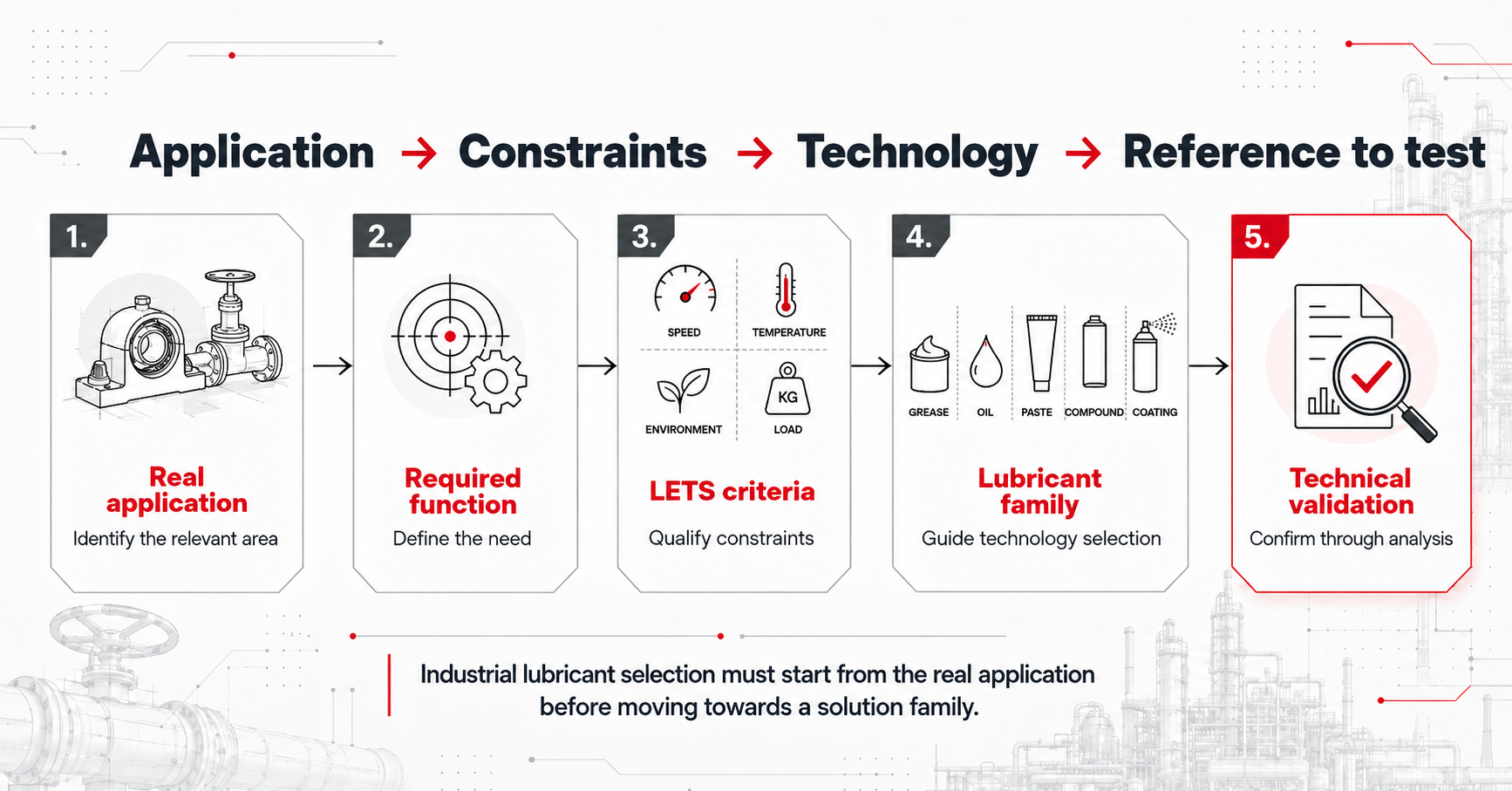
This is why selection must start from the real application: which area is involved? What function must be performed? Under what conditions does the equipment operate? What maintenance frequency is expected?
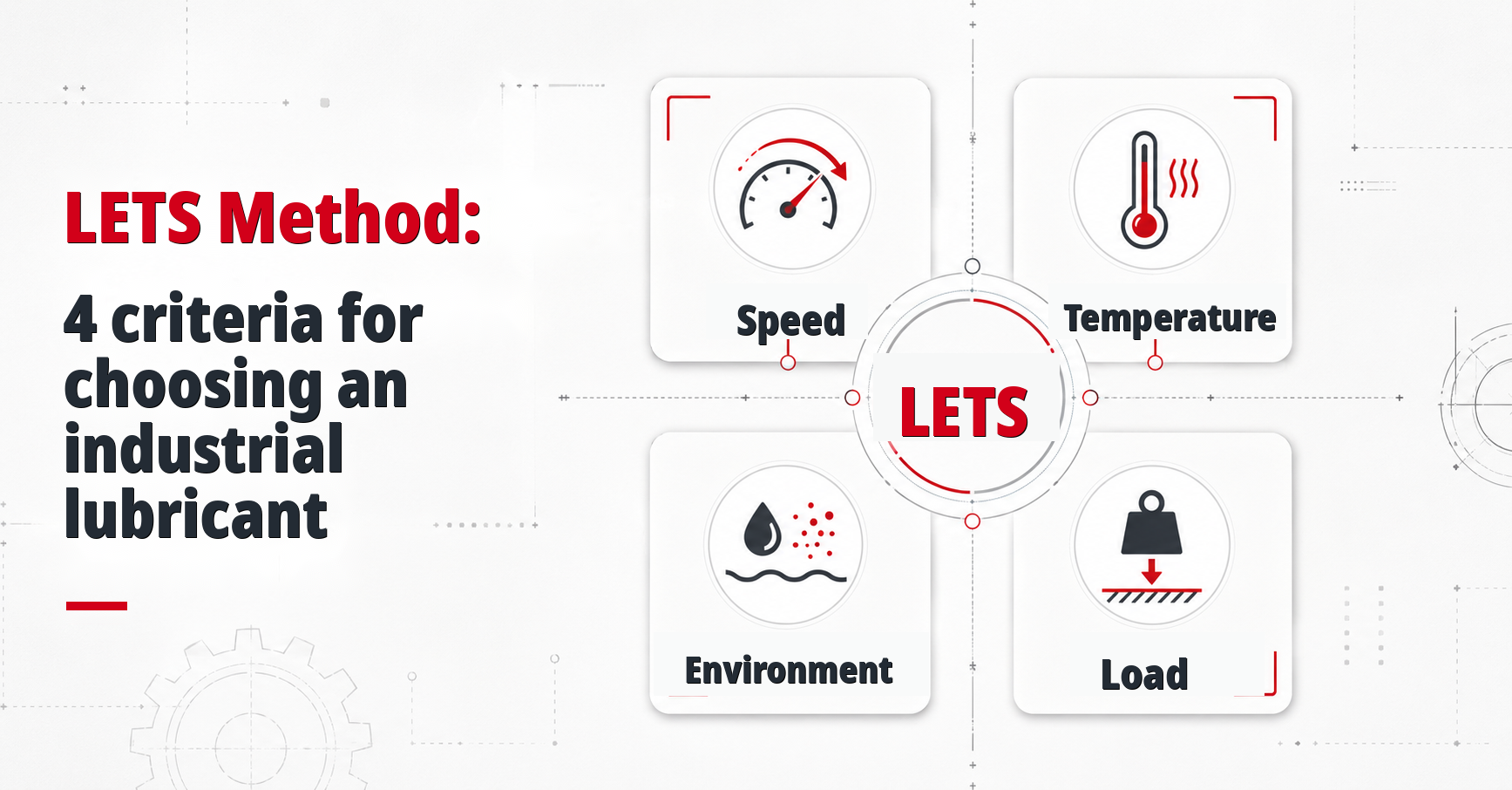
The LETS method helps structure this analysis around four simple criteria: Load, Environment, Temperature and Speed.
At Samaro, this framework is used as a starting point to better understand the requirement, guide the choice of a lubricant family and identify the references to be evaluated according to the specification.
Depending on the application, this approach may then lead to the study of technologies from ranges such as MOLYKOTE® or Krytox®, subject to technical validation, material compatibility and actual operating conditions.
Key takeaway
The LETS method helps ask the right questions before selecting an industrial lubricant. It analyses the speed, temperature, environment and load of an application. It does not replace technical validation, but it helps avoid selecting a solution based solely on habit or product family.
LETS method: 4 criteria for choosing an industrial lubricant
The LETS method helps quickly define the main constraints of a lubrication application. It acts as a first analytical framework before moving into the detail of technical datasheets, compatibility checks and any necessary trials.
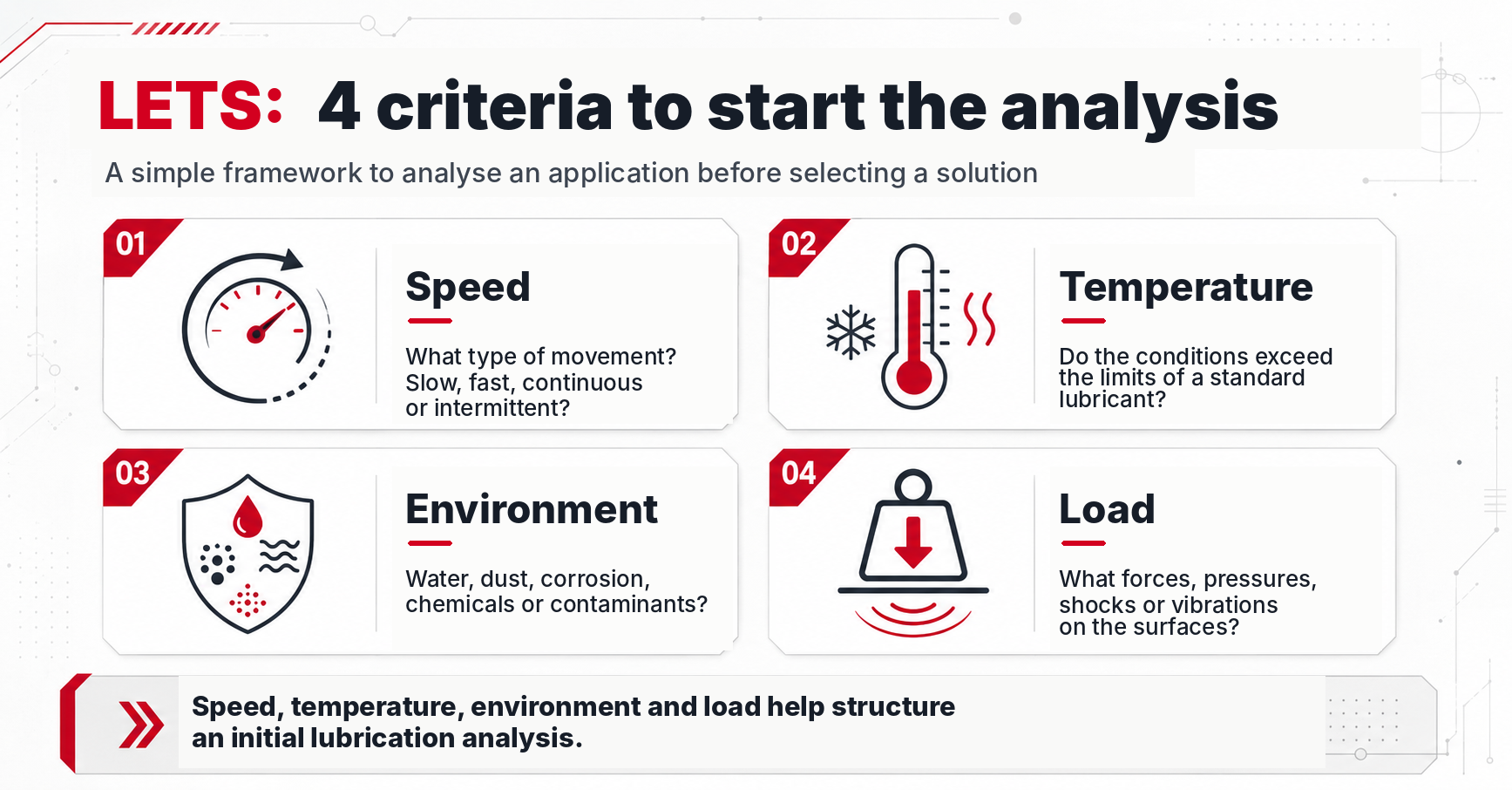
L for Load
Load refers to the forces applied to the surfaces: pressure, weight, mechanical stress, shocks, vibrations or repeated loads. A heavily loaded application may require an extreme-pressure solution, an assembly paste, a lubricant containing solid lubricants, or a specific technology to be validated according to the case.
E for Environment
The environment is often the criterion that changes everything. Water, humidity, salt spray, dust, corrosion, chemicals, solvents or fuels such as kerosene can change how a lubricant behaves. In a dusty area, for example, a wet product can retain particles. Depending on the application, dry lubrication or an anti-friction coating may then be considered.
T for Temperature
Temperature helps verify whether the operating conditions remain compatible with the lubricant’s limits. When actual temperatures, whether continuous or peak, exceed the limits of a standard lubricant, it may degrade more quickly: loss of consistency, evaporation, oxidation, oil separation or reduced performance. It is therefore important to distinguish between average service temperature, occasional peaks, thermal cycles and exposure time.
S for Speed
Speed concerns the type and intensity of movement: high-speed rotation, slow sliding, intermittent movement, repeated cycles or continuous operation. A high-speed application does not require the same properties as a slow movement under high pressure. Viscosity, lubricant film stability and the ability of the solution to stay in place can become important criteria.
It is the combination of the four LETS criteria that makes it possible to begin guiding the selection process, without drawing conclusions too quickly about a specific product reference.
Why lubricant selection starts with the application
Before discussing a product reference, it is important to understand the system in which the lubricant will operate. A lubricant works between surfaces, materials, movement, load and an environment. This combination determines the actual operating constraints.
Phrases such as “I am looking for a bearing grease” or “I am looking for a valve lubricant” provide an initial direction, but they are often too broad. To move forward, it is necessary to specify the area involved, the required function and the operating conditions.
The product may be expected to reduce friction, limit wear, prevent seizing, facilitate assembly, support tightening, protect certain surfaces against corrosion or make later disassembly easier. Each objective points towards different technologies.
From LETS to technology selection
Once the LETS criteria have been identified, it becomes easier to direct the analysis towards a family of solutions. This step does not yet provide a final product reference, but it helps narrow down the range of possibilities.
The choice depends on the required function and the constraints of the application: long-lasting lubrication, fluid circulation, assembly, anti-seize, sensitive interface or surface exposed to dust.
Oils are generally considered for systems where the lubricant needs to circulate or be applied in fluid form. Pastes are more suited to assembly, threaded connections, anti-seize or friction control under high pressure. Anti-friction coatings form a dry film on the surface and may be considered when clean, durable lubrication or reduced sensitivity to contamination is required.
Which lubricant family should be considered according to the application?
| Main requirement | Family to consider |
|---|---|
| Long-lasting lubrication of a mechanism | Grease |
| Fluid lubrication or circulation | Oil |
| Assembly, threaded connections, anti-seize | Paste |
| Seal, sensitive interface, specific protection | Compound |
| Clean surface or surface exposed to dust | Dry lubrication or anti-friction coating |
General examples to be confirmed according to the application specifications.
This family-based approach helps avoid confusing technologies that do not serve the same purpose. A grease, an oil, a paste, a compound or an anti-friction coating do not meet the same objectives, even though all these solutions may be part of a specialty lubrication approach.
Example: a threaded assembly exposed to water or corrosion
Let’s take the example of a bolted assembly exposed to humidity or a corrosive environment. The application may be static, but heavily stressed during tightening and difficult to disassemble after several operating cycles.
In this case, speed is not the dominant criterion. The analysis focuses instead on load, environment, materials, tightening behaviour, the risk of seizure and the ability to disassemble the assembly during maintenance.
A paste may therefore be more relevant than a conventional mechanical grease, provided that the materials, temperature, tightening torque, corrosion constraints and maintenance conditions are checked.
This example illustrates the value of the LETS method: it helps explain why two industrial applications that appear similar may require different technologies.
Sector focus: the same method can be applied to railway applications
The LETS method can be used in many sectors: mechanical engineering, energy, automotive, electronics, industrial equipment, maintenance, Oil & Gas or railway.
In railway applications, for example, a bogie, a door, a pantograph, a seal or a bellows do not present the same constraints. Loads, movements, contamination, corrosion, noise or maintenance frequency can vary significantly from one area to another.
This is why an application-based approach is essential before selecting a technology.
Checklist: preparing a lubrication recommendation request
To save time when discussing with a technical expert, it is useful to prepare a few pieces of information before requesting a recommendation.
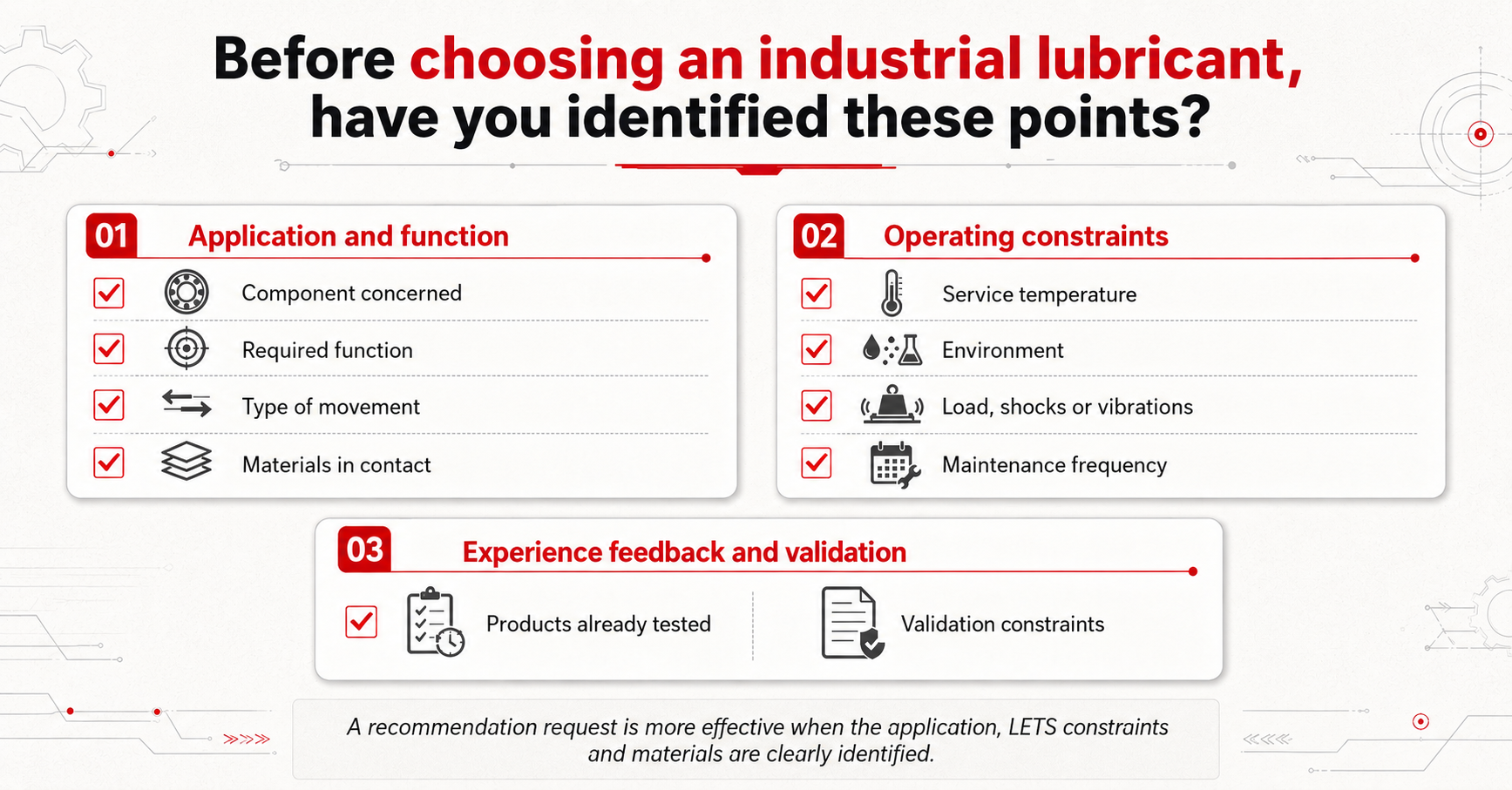
For an initial analysis, it is useful to specify the component involved, the required function, the type of movement, the temperature, the environment, the load, the materials, the maintenance frequency, the products already tested and the validation constraints.
This information helps guide the evaluation more effectively and avoid a selection that is made too quickly.
Why get support when choosing an industrial lubricant?
The LETS method helps ask the right questions, but it does not automatically provide a product reference.
The final choice must take into account the complete specification, the materials, technical datasheets, safety data sheets, compatibility, regulatory requirements and, when the application is critical, testing under representative conditions.
At Samaro, support starts from the actual requirement to help industrial companies structure their specification, compare technology families and identify the references to evaluate.
This approach connects supplier documentation with the reality of the application, the process and the maintenance objectives.
Need help choosing an industrial lubricant?
Tell us about your application, materials and LETS constraints. Samaro’s experts can support you in identifying the solution families and product references to evaluate.
Conclusion: LETS, a simple method for asking the right questions
The LETS method is not an automatic selection formula. Its value lies in structuring the thinking before choosing.
By analysing load, environment, temperature and speed, technical teams can better understand the dominant constraints of their application.
This initial reading then helps guide the evaluation towards a grease, an oil, a paste, a compound, dry lubrication or an anti-friction coating.
The final choice must always be confirmed according to the specification, technical documents, material compatibility, regulatory requirements and the necessary trials.
For Samaro, it is precisely this connection between the real application, the available technologies and the validation criteria that makes it possible to effectively support industrial companies in their lubrication projects.