





























Low-outgassing silicones: why material selection is critical in space applications
In space applications, a material must do more than fulfil its primary function.
An encapsulant must do more than protect an electronic module. A sealant must do more than provide sealing. A thermally conductive material must do more than help dissipate heat.
It must also remain compatible with a particularly demanding environment: high vacuum, temperature variations, sensitive electronics, optics, sensors, thermal radiators, vibrations, mass constraints and reliability requirements.
In this context, degassing, or outgassing, becomes a major selection criterion.
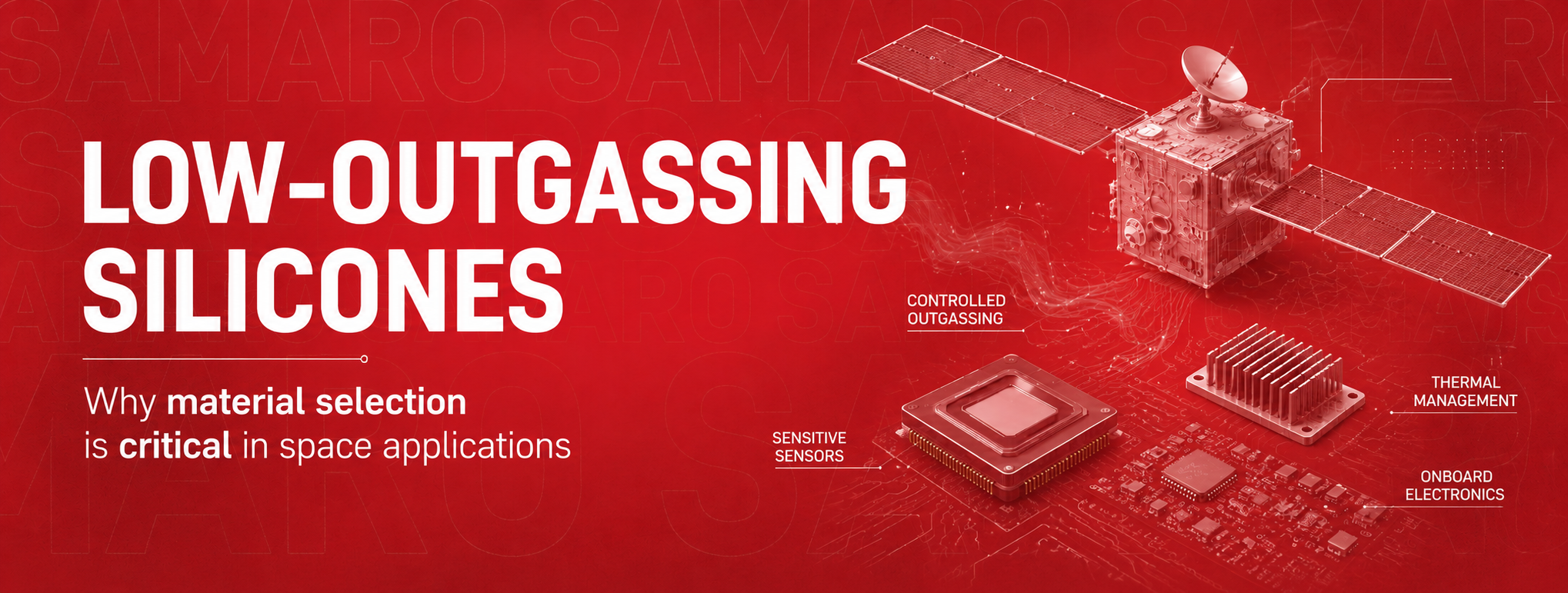
When a material releases volatile compounds in a vacuum environment, these substances can migrate, settle on sensitive surfaces or condense on certain components. In a satellite, payload or space electronic system, this phenomenon can affect electronics, optical devices, sensors or certain thermal management systems.
Dow highlights dedicated documentation on DOWSIL™ silicones for space applications, with a focus on low outgassing, thermally conductive materials, controlled-volatility sealants and space-grade encapsulants. Certain references are presented as evaluated according to ASTM E595 and as meeting NASA low-outgassing requirements.
At Samaro, our role is to help industrial teams connect this documentation with their real conditions of use: expected function, environment, materials, geometry, application process, technical documents and validation requirements.
Why is outgassing critical in space?
On Earth, material outgassing may remain barely visible, depending on the application. In space, the issue takes on a completely different dimension.
Satellites, payloads and onboard systems incorporate electronic components, sensors, optics, power assemblies and sensitive thermal interfaces. When a material releases volatile compounds, these substances can be transported through the vacuum environment and deposited on critical surfaces.
Potential consequences may affect optical performance, electronic reliability, sensor protection or certain thermal management functions. Low outgassing is therefore not a secondary property. It is a reliability criterion.
In space applications, the selection of a silicone, encapsulant, sealant or thermally conductive material must take this constraint into account from the earliest selection stages.
ASTM E595 and NASA requirements: two formulations to distinguish
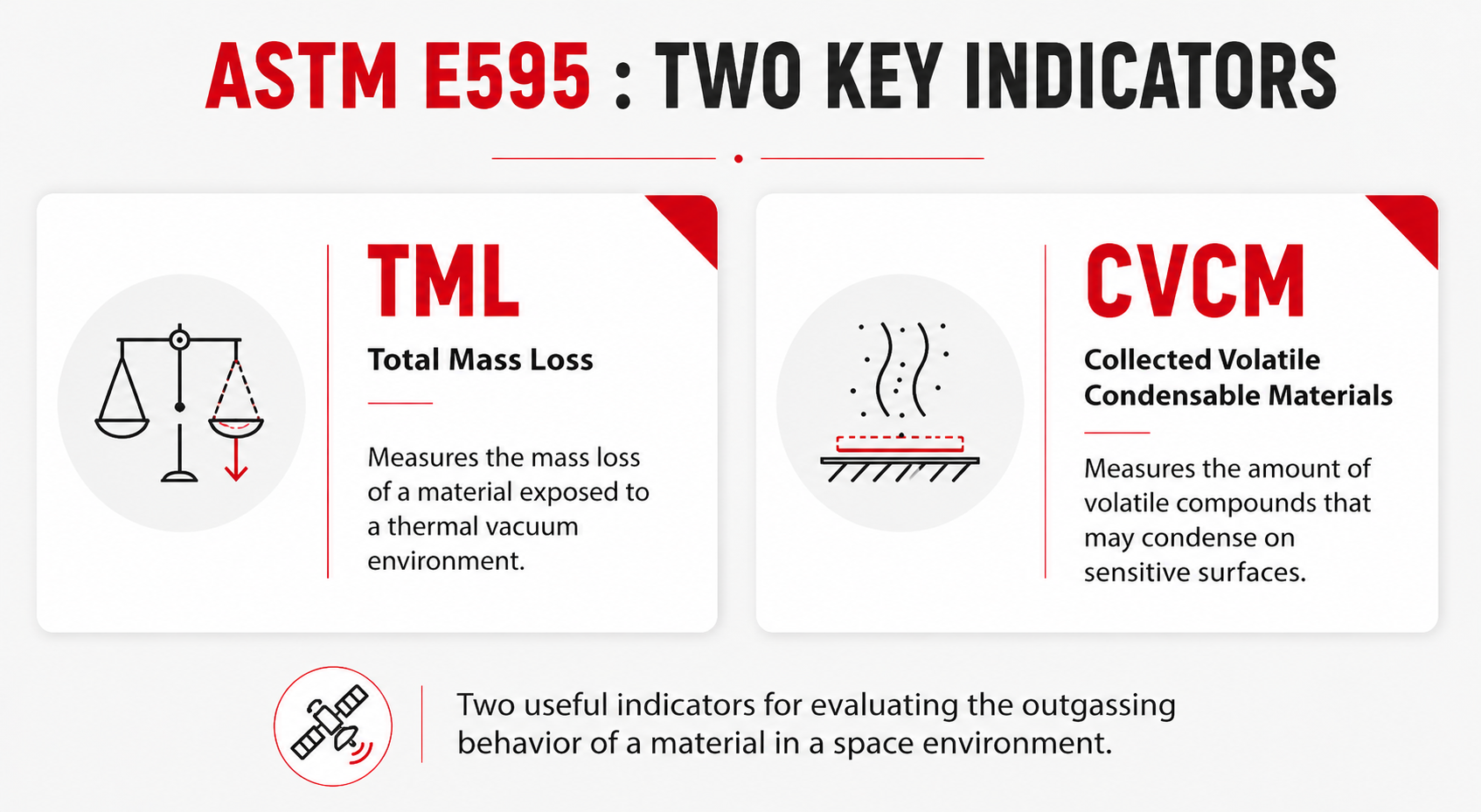
The ASTM E595 method is used to evaluate the behaviour of materials subjected to outgassing under thermal vacuum. In particular, it makes it possible to monitor two important indicators: total mass loss, often referred to as TML, and collected volatile condensable materials, often referred to as CVCM.
In space applications, CVCM is monitored particularly closely because it helps assess the proportion of volatile compounds likely to condense on sensitive surfaces.
To avoid ambiguity, it is preferable to use the following formulations: a material can be presented as evaluated according to ASTM E595, and certain references can be described as meeting NASA low-outgassing requirements when this information is properly documented by Dow.
However, it is better to avoid the wording “ASTM E595 requirements”. ASTM E595 is a test method, not an application requirement in itself.
This statement does not replace the need to review the technical data sheets, up-to-date supplier data and the requirements specific to the programme concerned. Numerical values for TML, CVCM or other qualification data must be confirmed in validated technical documents.
Why are silicones considered for aerospace environments?
Silicones are used in many demanding industrial environments, particularly when several functions must be combined: protection, flexibility, insulation, sealing, encapsulation, thermal management or resistance to severe conditions.
In aerospace applications, silicones can be considered to protect electronic components, encapsulate modules, provide sealing, contribute to thermal management or reduce certain mechanical stresses.
The value of a silicone therefore does not depend on a single property. It depends on the combination of the expected function, the real environment, the application process and the available qualification data.
Which DOWSIL™ families are highlighted for space applications?
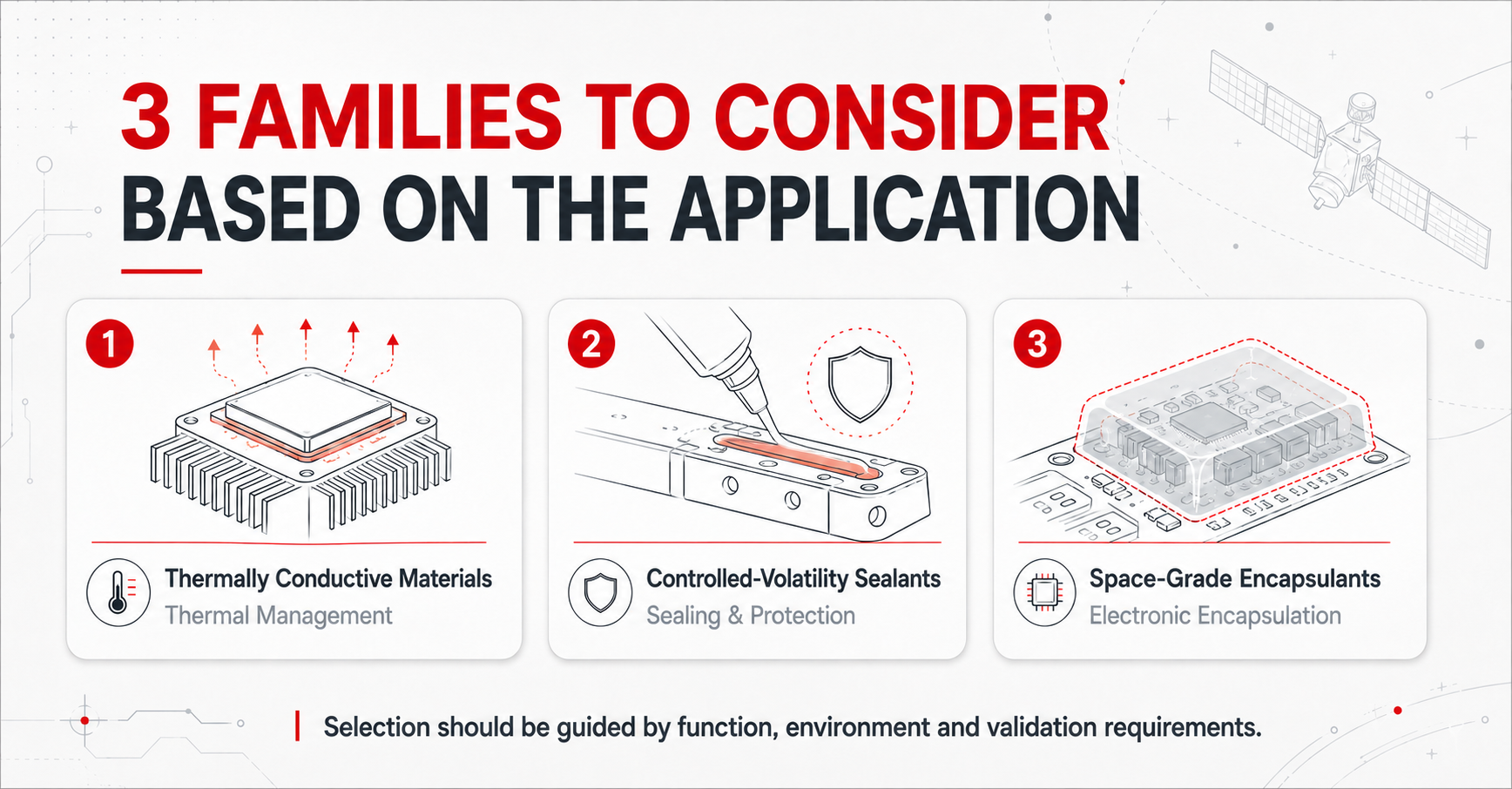
The Dow Space Grade documentation highlights several DOWSIL™ product families associated with low outgassing, electronic protection and thermal management challenges. These references should be considered as solution families to evaluate according to the application, not as automatic recommendations.
DOWSIL™ thermally conductive materials
In satellites and space electronic systems, thermal management is a key issue. Electronic components can generate heat, while the space environment imposes specific thermal dissipation constraints.
For these applications, several DOWSIL™ solutions can be evaluated depending on the expected function. DOWSIL™ TC-2035 Adhesive may in particular be considered when thermally conductive bonding is required, while DOWSIL™ TC-4060 Thermal Gel is more aligned with a thermal gel or interface management approach.
The choice must take several parameters into account: target conductivity, interface thickness, assembly geometry, application method, process constraints and available outgassing data. The final selection must be confirmed using up-to-date technical documents and the requirements specific to the application.
Controlled-volatility sealants
Controlled-volatility sealants are designed for applications where sealing, protection or attachment must be combined with particular attention to outgassing.
Within this family, DOWSIL™ 6-1104 Controlled Volatility Sealant can be evaluated when the application requires an extrudable, non-sag material intended to protect or seal a sensitive area while limiting collected volatile condensable materials according to the available data.
The selection must be validated according to the area to be protected, the proximity of sensitive systems, the application process, geometric constraints and the specifications of the programme concerned.
Space-grade encapsulants
Electronic encapsulation helps protect components, modules or assemblies against certain environmental or mechanical stresses.
For this type of requirement, DOWSIL™ 93-500 Space Grade Encapsulant and DOWSIL™ 93-500 Thixotropic Kit are among the DOWSIL™ references to consider when the application requires a silicone encapsulant suitable for space environments.
These solutions differ in particular in their application behaviour: a flowable version or a thixotropic version depending on the design, part geometry, area to be encapsulated and selected process. The choice between these behaviours must be confirmed using the technical documents, outgassing requirements and the tests required for validation.
How to choose a low-outgassing silicone for a space application
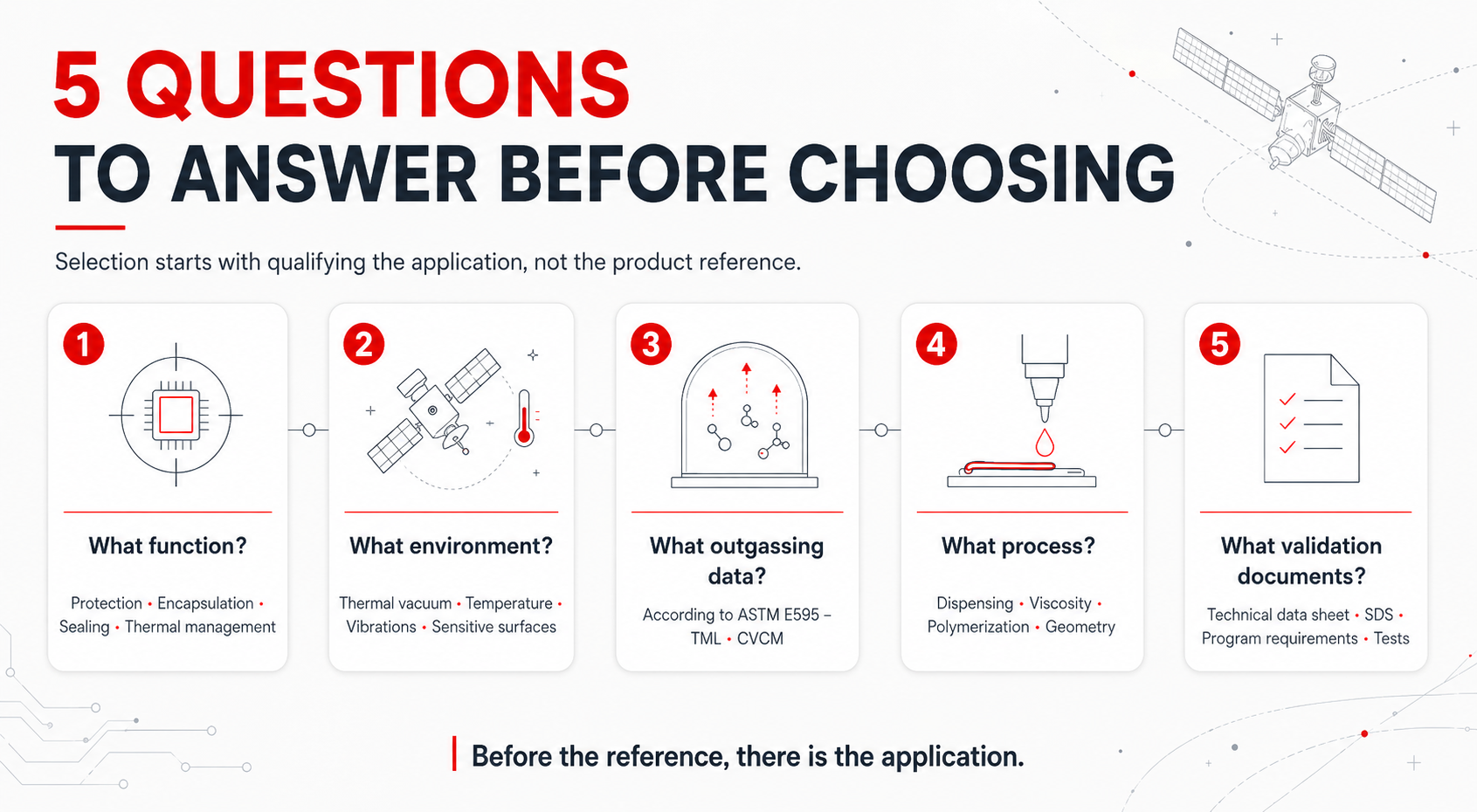
Selecting a low-outgassing silicone does not start with a product reference. It starts with qualifying the application.
1. Define the expected function
Does the material need to encapsulate, seal, protect, attach, conduct heat or reduce mechanical stresses? Two products can belong to the same chemical family while serving different functions.
2. Identify the real environment
Thermal vacuum, temperature, proximity to optical systems, sensitive electronics, vibrations, pre-launch humidity, geometry and mass constraints must be specified from the outset.
3. Check the outgassing data
Values measured according to ASTM E595, such as TML and CVCM, must be analysed against the programme requirements. Any value must come from a validated and up-to-date supplier document.
4. Review the application process
Viscosity, flowable or thixotropic behaviour, working time, curing conditions, repairability and process repeatability can be just as important as the intrinsic performance of the material.
5. Validate with technical documents
Technical data sheet, SDS, material compatibility, supplier recommendations, qualification requirements and any necessary testing must confirm the final selection.
Samaro supports you in analysing DOWSIL™ solutions
In space and aerospace applications, the difficulty is not only finding a high-performance product. The real difficulty is connecting a material family with a real application.
At Samaro, we support industrial teams in this approach by helping structure the first questions: what function must the material provide, what environment will it encounter, what low-outgassing data are required, which DOWSIL™ family should be evaluated first and which technical documents should be consulted?
Our goal is to help technical teams move from product documentation to a clear, documented and validatable application analysis.
The final choice must always be confirmed according to the specifications, technical data sheets, SDS, supplier requirements and any necessary testing. However, a well-structured initial analysis can already save time, avoid irrelevant comparisons and prepare a more effective technical discussion.
Conclusion: in space, low outgassing is not a detail
In space applications, material selection cannot be reduced to its primary function.
A sealant, encapsulant or thermally conductive material must also be assessed against its operating environment, behaviour under vacuum, outgassing data, stability and compatibility with the sensitive components in the assembly.
The DOWSIL™ Space Grade silicones highlighted by Dow represent solution families to evaluate in response to these challenges, particularly for electronic protection, encapsulation, thermal management and sealing.
Samaro supports you in this initial analysis, from understanding the requirement to identifying the technical documents needed for validation.