


























LED optical silicone: what applications and certifications for SILASTIC™ MS-1001, MS-1002 and MS-1003?
In an LED lighting system, a lens, light guide, collimator or TIR lens does more than shape the beam. The optical material must also retain its properties under the effects of heat, UV exposure, light and manufacturing constraints. For design engineers, automotive suppliers, luminaire manufacturers and molders, selection must therefore consider optical function, operating environment, processing method and certification requirements together.
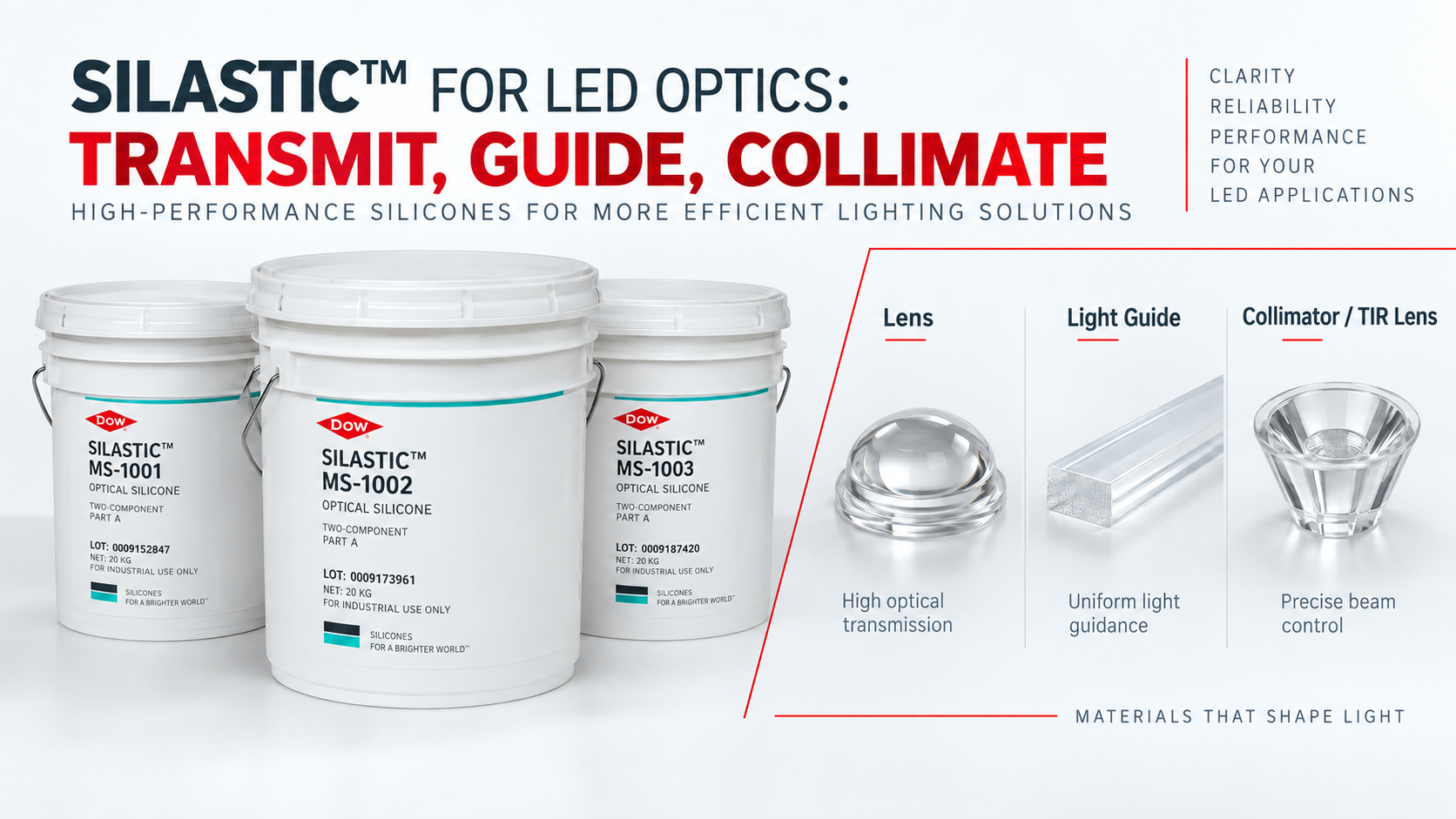
Dow develops the SILASTIC™ Moldable Silicones range, moldable optical silicones designed for the manufacture of primary and secondary lenses, light pipes and light guides, collimators and TIR lenses. In France, Samaro distributes these solutions and supports industrial customers in matching material properties to part geometry, the required level of flexibility, thermal and optical stresses, and project validation requirements.
Today, the range available for these applications is built around three transparent grades: SILASTIC™ MS-1001, MS-1002 and MS-1003. One of the main differences between them is their level of hardness and flexibility: MS-1001 is the firmest, MS-1003 the softest, while MS-1002 sits between the two. This choice can be decisive for complex parts, dimensional stability and demolding.
Key takeaways
- Today, SILASTIC™ MS-1001, MS-1002 and MS-1003 are the three transparent grades in the SILASTIC™ Moldable Silicones range to consider for lenses, light pipes and light guides and, depending on the grade, collimators and TIR lenses.
- Dow documentation associates grades in the range with various UL 94, UL 746A and UL 746C(f1) ratings or listings and, for certain grades, AMECA for automotive applications.
- SILASTIC™ MS-1002 sits between MS-1001 and MS-1003 in terms of hardness and flexibility. It is particularly relevant to consider for automotive and outdoor optics: lenses, light pipes, light guides, collimators and TIR lenses, with AMECA and UL 746C(f1) references.
- Certifications and typical values are preselection criteria: the exact grade, thickness, process and final specification still need to be validated.
SILASTIC™ MS-1001, MS-1002 or MS-1003: which grade for which LED optic?
To save time, the first question is not “which silicone is best?”, but rather what function the part must perform and how much flexibility its geometry requires. All three grades are transparent, but their hardness and ability to deform differ significantly.
| Grade | Applications | Benefits / technical reference points | Certifications |
| SILASTIC™ MS-1001 | Primary / secondary lenses, light pipes and light guides, other optical devices. | High transparency and transmission, low haze, high thermal stability. 87 Shore A, typical elongation 50%. The hardest of the three grades: relevant when dimensional stability is a priority, but less suitable for certain complex geometries if demolding requires substantial deformation. | AMECA for automotive headlamp applications, UL 94 HB. |
| SILASTIC™ MS-1002 | Primary / secondary lenses, light pipes, light guides, collimators and TIR lenses. | High transparency, thermal stability, good resistance to heat and UV exposure, low-pressure liquid molding and excellent replication of detail. 72 Shore A, typical elongation 80%. Intermediate balance between rigidity and flexibility. | UL 94, UL 746A, UL 746C(f1), AMECA. UL 94 classification depends on thickness according to the Yellow Card. |
| SILASTIC™ MS-1003 | Primary / secondary lenses, light pipes, light guides, collimators and TIR lenses. | High transparency, high transmission, low haze and high flexibility. 51 Shore A, typical elongation 325%, typical light transmission 92% at 10 mm. The lowest-hardness grade of the three, particularly worth considering for geometries that require greater flexibility during demolding. | UL 94 / UL 746A / UL 746C(f1) |
Lenses, light guides, collimators and TIR lenses: where are SILASTIC™ silicones used?
SILASTIC™ moldable optical silicones cover several functions in LED systems. For a primary or secondary lens, the material must transmit and direct light. For a light guide or light pipe, optical stability and the accurate replication of fine geometries become essential. For a collimator or TIR lens, optical-surface precision, material flexibility and controlled demolding become decisive.
These functions are found in automotive lighting, outdoor and roadway lighting, high-power industrial luminaires, certain signaling solutions and other compact LED architectures. Dow also illustrates the use of silicone optics in Adaptive Driving Beam (ADB) automotive projects, where lens geometry and photometric accuracy are particularly demanding.
For Samaro, this application-focused positioning is important: a buyer may search for a grade by standard or brand, while a design engineer will often start by looking for a solution to a specific problem: a UV-resistant LED lens, an AMECA automotive optic, a silicone for a TIR lens, a transparent light guide, or a silicone flexible enough for a complex geometry. These are the criteria that should guide preselection.
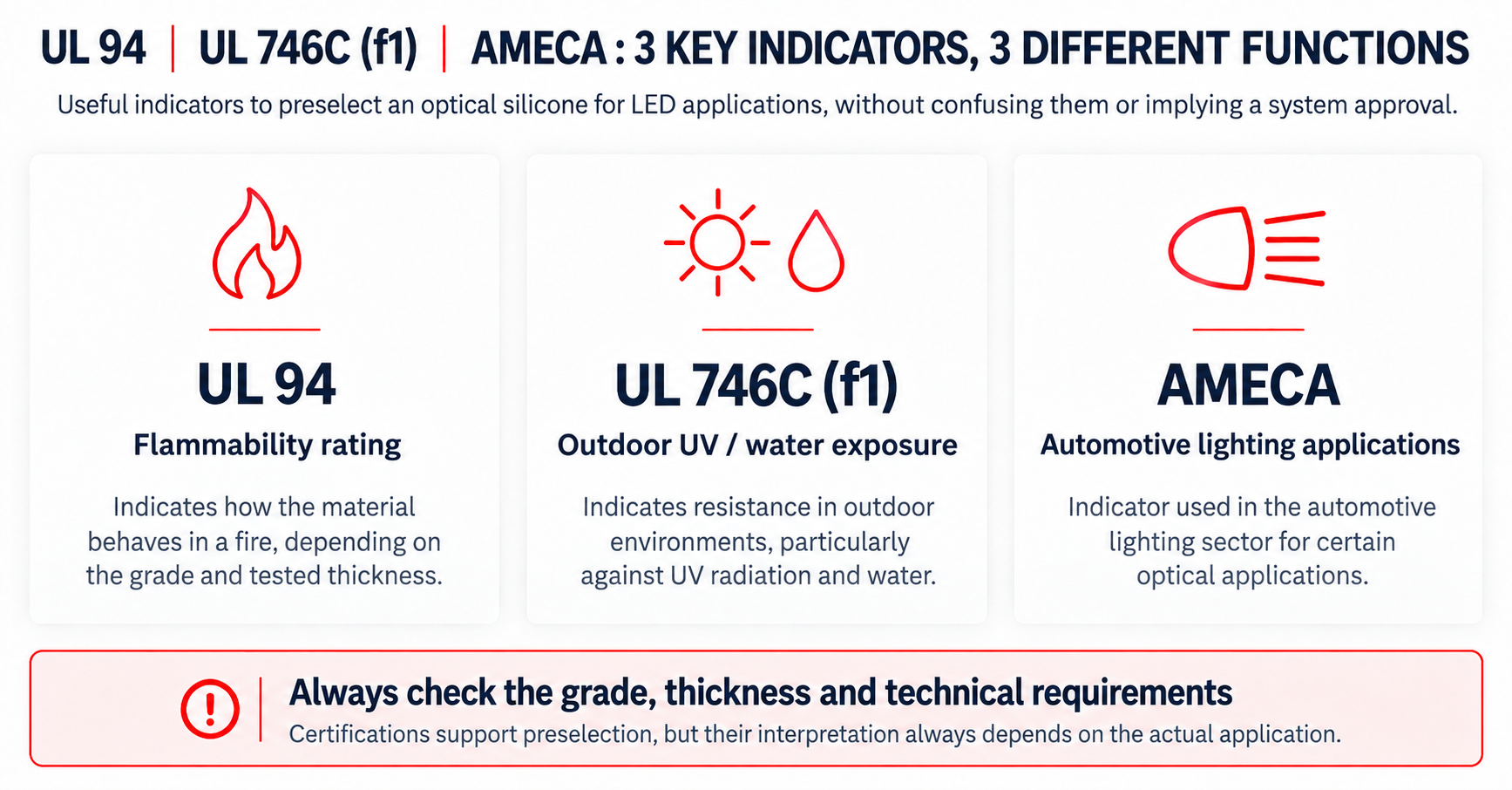
UL 94, UL 746C(f1), AMECA: what do these references mean for automotive and outdoor applications?
Standards and listings can become selection criteria in their own right. However, it is important to distinguish what they actually describe so that material-level data is not turned into a claim about the final equipment.
UL 94: a material flammability classification
UL 94 characterizes the flammability behavior of plastic materials under defined test conditions. The result depends in particular on thickness. A grade should therefore not be reduced to a generic “UL 94” statement, nor should V-0 be claimed without checking the Yellow Card for the relevant grade and thickness. For example, the current MS-1002 Yellow Card shows different classifications depending on thickness, from HB to V-1 / 5VA.
UL 746C(f1): a useful reference for outdoor exposure
The f1 suffix under UL 746C indicates suitability for outdoor use with regard to UV exposure, water exposure and immersion under the applicable UL criteria. This information is particularly relevant when the lens or optical component must operate outdoors, but it does not replace aging tests on the finished product.
AMECA: a particularly relevant criterion for automotive lighting
Dow associates SILASTIC™ MS-1001 and MS-1002 with AMECA certification for automotive lighting applications. For an automotive supplier or lighting-system designer, this information can become an important preselection criterion, particularly for headlamp lenses and complex optical architectures.
Heat, blue light and UV: why long-term stability remains a key selection criterion
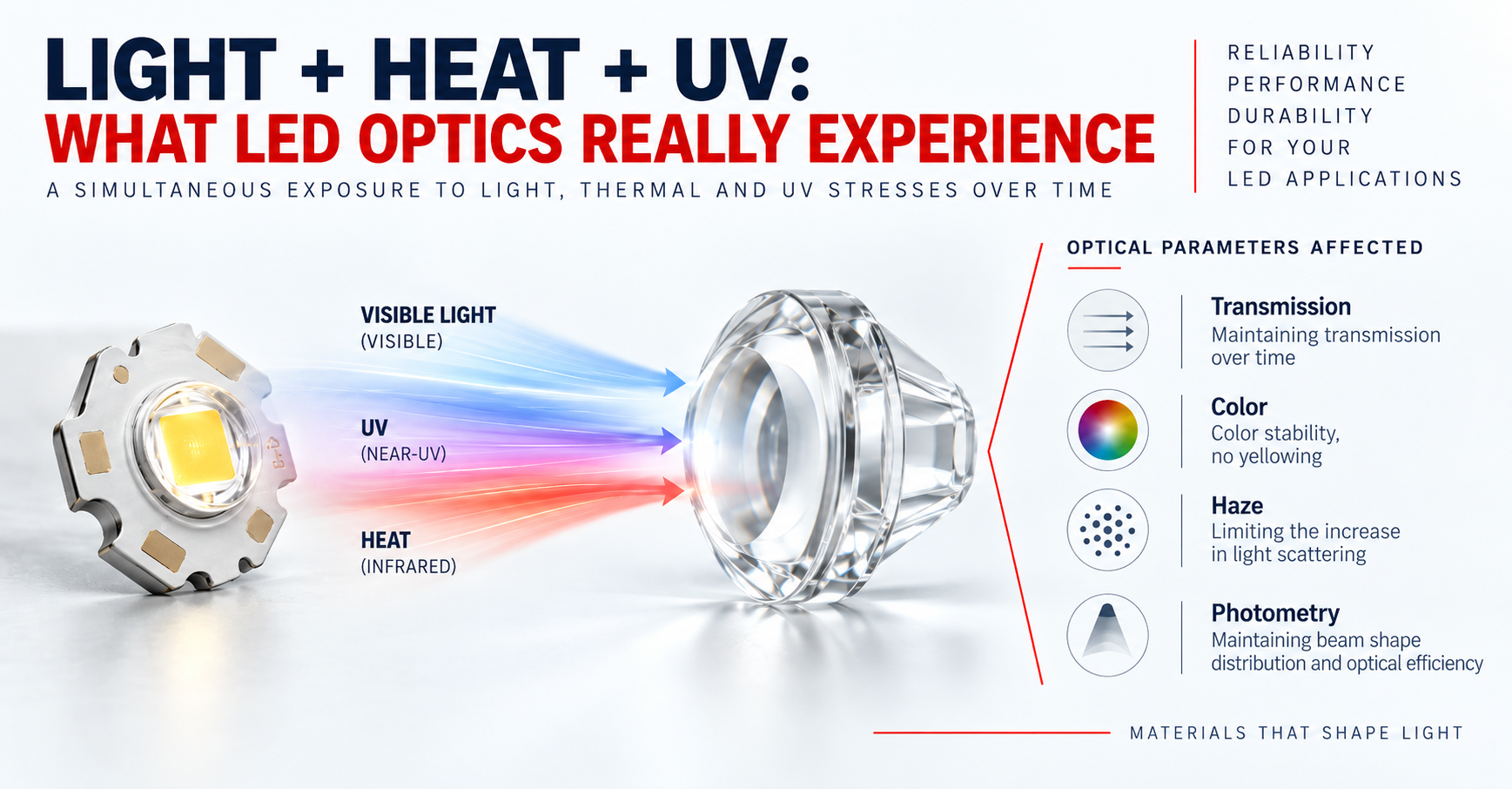
An LED optic can provide excellent initial transmission and then change under the combined effects of light, heat and UV exposure. This photothermal stress becomes more significant when the source is powerful, the architecture is compact, or the lens is located close to the LED.
Depending on the material, this exposure can lead to changes in color, haze, transmission or photometric performance. Thermoplastics such as PC or PMMA remain suitable for many applications, but their behavior must be assessed under actual project conditions. SILASTIC™ optical silicones are designed to provide high thermal stability and, depending on the grade, resistance to UV exposure suited to demanding environments.
The key is therefore not to select a material based only on initial transmission or a nominal temperature. For an LED lens, the most useful data point is the actual temperature reached by the optic, considered together with incident light intensity, spectrum, target service life and operating environment.
Optical silicone or PC / PMMA: when should you broaden the preselection?
Silicone is not an automatic replacement for polycarbonate or PMMA. Thermoplastics remain competitive when temperature and light intensity are moderate, the geometry is conventional and the process is already well controlled. Silicone becomes particularly relevant when several constraints are combined.
| Project situation | Preselection route | To validate |
| Moderate thermal / light load | PC / PMMA may remain relevant | Validate the grade, thickness and real-world aging. |
| High heat, UV exposure, long performance life | Include SILASTIC™ in the comparison | Measure lens temperature and define aging tests. |
| Complex geometry / fine details / undercuts | Consider moldable silicone | Compare hardness, elongation, tooling and demolding. |
| Automotive or outdoor project with documentation requirements | Prioritize grades with the relevant listings | Check AMECA, UL 94, UL 746C(f1) and the applicable Yellow Cards. |
Injection or compression molding: the material also influences design and the production cycle
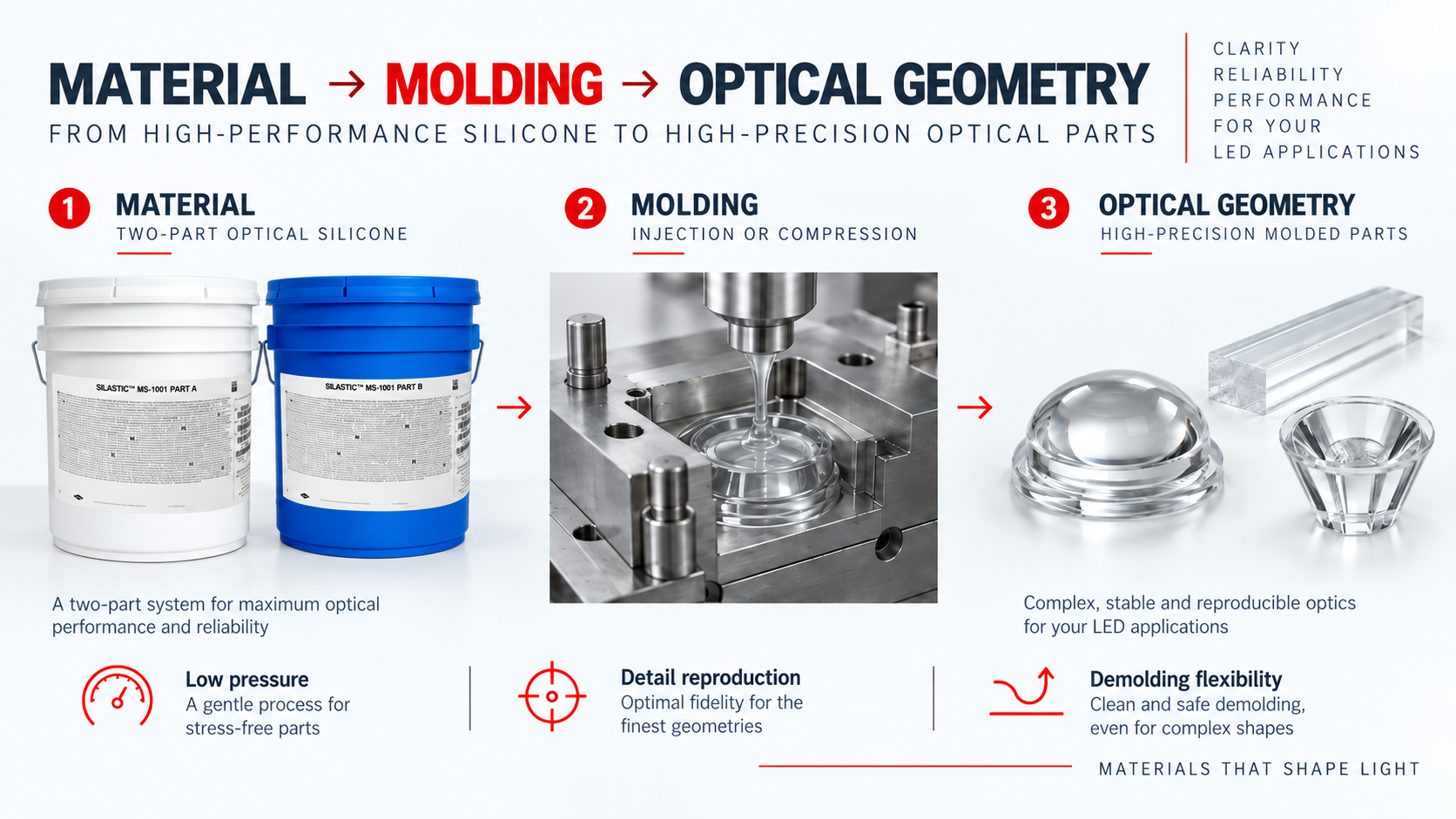
SILASTIC™ MS-1001 is documented for injection or compression molding of optical components. MS-1002 notably highlights low-pressure liquid molding and excellent replication of surface detail. These characteristics can be valuable for thick lenses, microstructures, freeform shapes or geometries that are difficult to demold with a rigid material.
Flexibility increases significantly from MS-1001 to MS-1002 to MS-1003. This difference affects dimensional stability, handling and demolding options. MS-1001, being harder, may be suitable when part rigidity is the priority, but some complex geometries can create excessive mechanical stress during demolding. MS-1003, which has the lowest hardness, provides greater flexibility for designs that require substantial deformation. MS-1002 offers an intermediate compromise to evaluate according to the part and the process.
However, the process cannot be separated from the material. Mold temperature, filling, air evacuation, post-curing, production rate, tolerances and dimensional control must be defined with the molder. A grade that appears ideal in a table may prove unsuitable if it does not match the tooling or production cycle.
Automotive, outdoor lighting, industry: which applications require particular attention?
Automotive lighting is a representative case. ADB systems use complex optics to distribute the beam precisely while adapting the lighting to driving conditions. SILASTIC™ MS-1002 is documented for lenses and collimators and is associated with AMECA certification, making it a grade to consider when a project combines complex geometry, heat, UV exposure and automotive requirements.
The same considerations apply to outdoor and roadway lighting, where resistance to UV, water and aging becomes more important, as well as to high-power industrial luminaires. In these environments, UL 746C(f1), thermal stability and the material’s ability to retain its optical properties can become more important selection criteria than material cost alone.
For design engineers, the objective is to translate these constraints into measurable data: lens temperature, UV exposure, target service life, optical thickness, photometric requirements, source type and certification requirements. The earlier this information is available, the more accurately MS-1001, MS-1002 and MS-1003 can be compared.
What information should you prepare before requesting a recommendation?
- Optical function: primary or secondary lens, light guide, light pipe, collimator or TIR lens.
- Market and requirements: automotive, outdoor, industrial; AMECA, UL 94, UL 746C(f1) or other documentation requirements.
- LED source: power, spectrum, distance between the source and the optic.
- Actual temperature: ambient temperature, but above all the temperature reached by the lens or optical component.
- Environment: UV, humidity, water, contamination, vibration, shock and thermal cycling.
- Geometry: thickness, dimensions, fine details, undercuts, tolerances and surface finish.
- Process: injection or compression molding, tooling, production rate, demolding, post-curing and automation.
- Validation criteria: transmission, haze, color, photometric performance, dimensional stability and aging.
Samaro and Dow: from product grade to application validation
Samaro supports industrial customers beyond simply reading a technical data sheet. The objective is to connect Dow’s SILASTIC™ solutions to the actual need: optical function, required standard, geometry, temperature, environment and production process.
Depending on the project, support may include identifying grades to compare, retrieving TDSs and Yellow Cards, checking available listings, comparing hardness and flexibility levels, analyzing molding constraints and preparing tests. Final validation always remains specific to the project and the industrial customer’s specification.
FAQ - SILASTIC™ optical silicones for LED applications
Conclusion: selecting optical silicone based on the application, process and validation requirements
For an LED optic, initial transmission is only the starting point. Selection must take into account the function of the part, temperature, UV exposure, geometry, molding method and required certifications. This combination determines whether a moldable optical silicone offers real value compared with a thermoplastic.
Today, SILASTIC™ MS-1001, MS-1002 and MS-1003 are the three grades to compare for these transparent optical functions. MS-1001 favors rigidity, MS-1003 flexibility, while MS-1002 offers an intermediate position. UL and AMECA listings available depending on the grade are useful references for outdoor and automotive applications and should be checked against current documentation.
Are you developing a new LED optic or looking to replace an existing material? Samaro can help you qualify your requirements, identify relevant SILASTIC™ grades and prepare the necessary documentation review and testing.