
































Large-format 3D printing: from Dahltram® thermoplastic pellets to a ready-to-use drone mold
How do you go from a 3D file to a 1.20 m composite mold in less than 24 hours of printing and machining? That was the practical challenge Samaro, Airtech Advanced Materials Group, IPC and CEAD addressed together through a demonstrator developed for JEC World 2026.
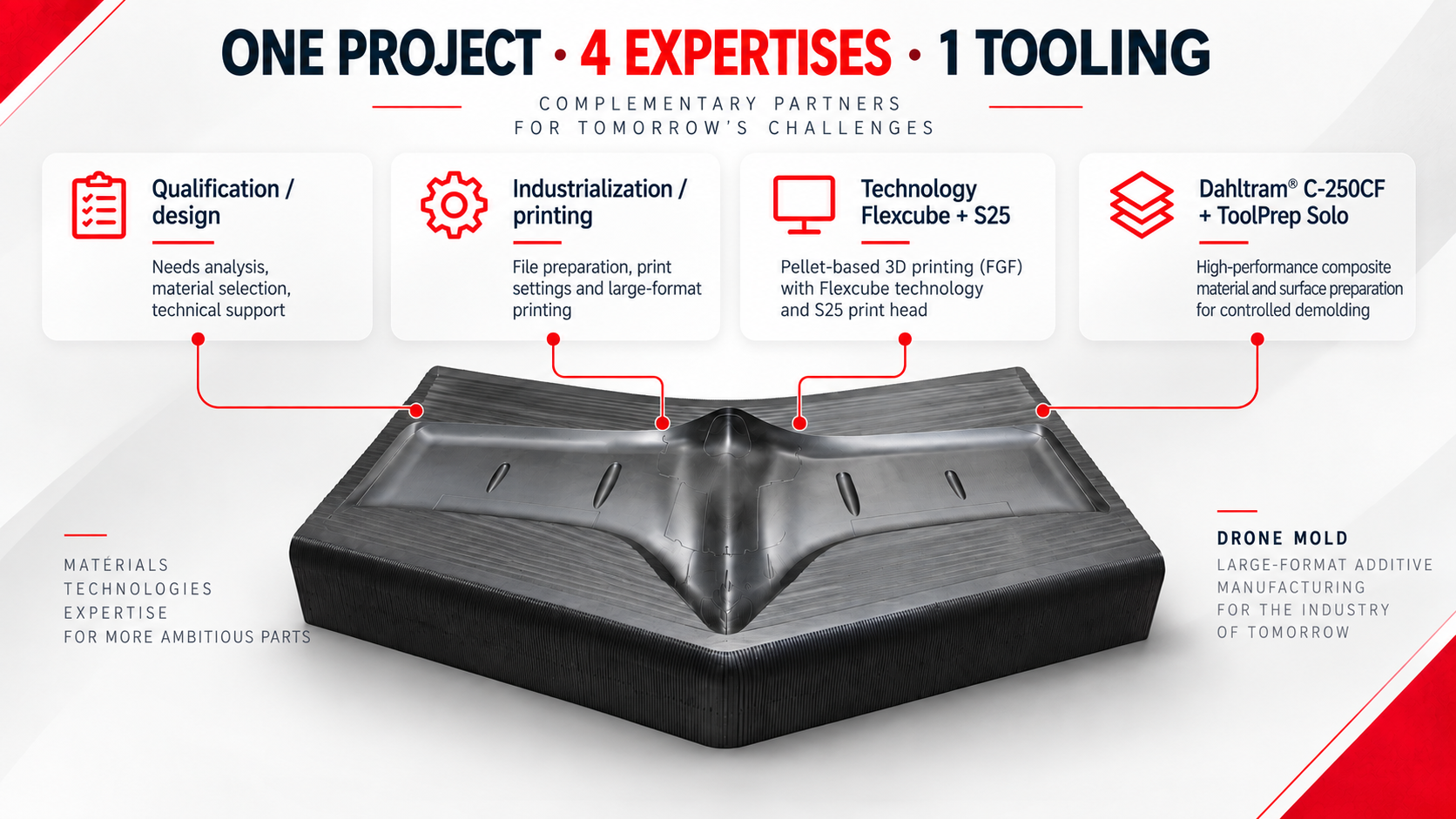
Samaro supports composite manufacturers in selecting materials, process consumables and tooling solutions. Airtech Advanced Materials Group, Samaro’s partner for vacuum-bagging and process materials, develops the Dahltram® range for additive manufacturing as well as associated surface-preparation products. IPC, the French Technical Centre for Plastics and Composites, contributes its expertise in additive manufacturing and its cross-disciplinary knowledge of plastics and composites, while CEAD provides the large-format pellet-extrusion 3D-printing technology used for this project.
The demonstrator is a drone mold designed for manufacturing composite parts by infusion. It provides a real-world example of how a carbon-fiber-reinforced thermoplastic can be printed at large scale, machined, surface-prepared and then integrated into a composite part manufacturing process.
Key takeaways
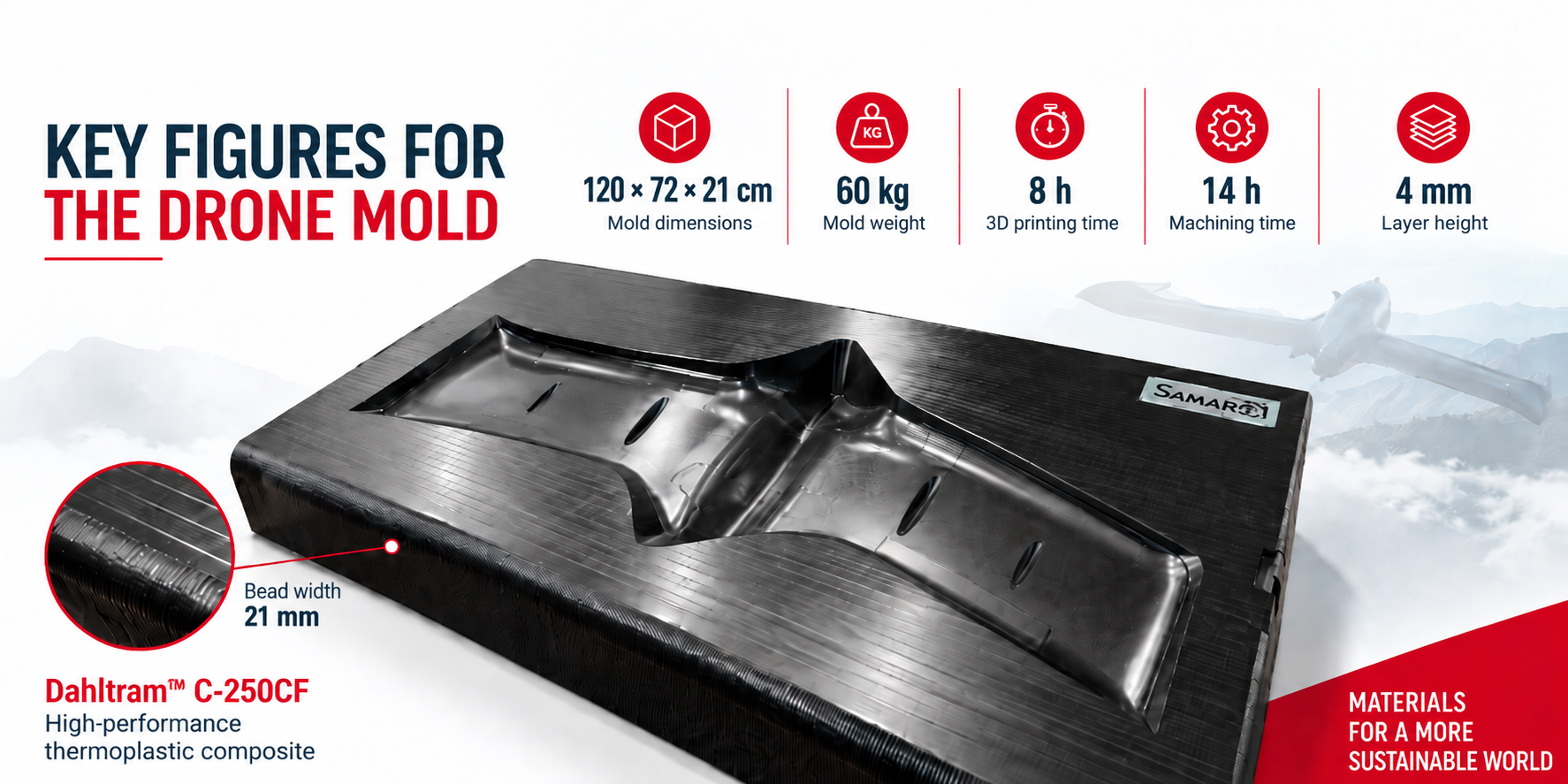
- The mold measures 120 × 72 × 21 cm and has a final weight of 60 kg.
- It was produced using FGF additive manufacturing on a CEAD Flexcube equipped with an S25 extruder.
- The selected material is Airtech Dahltram® C-250CF: a modified polycarbonate reinforced with 20% carbon fiber.
- The project required 8 hours of printing followed by 14 hours of machining.
- The surface was prepared with Airtech ToolPrep Solo before the application of the mold sealer and release agent required for the impregnation process.
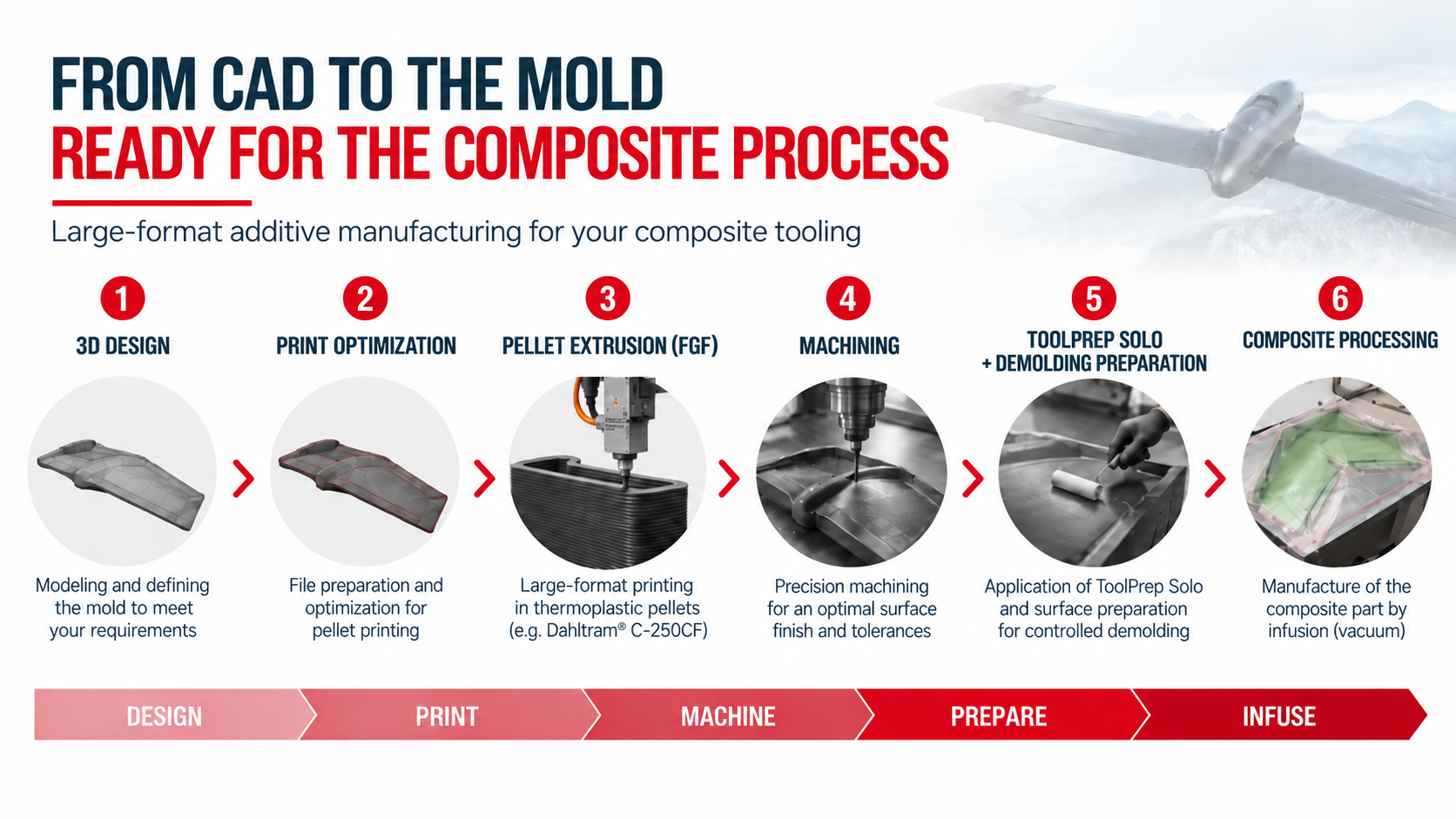
- The mold was presented as a demonstrator at JEC World 2026 to illustrate a complete workflow: design, material selection, printing, machining, preparation and composite part production.
Dahltram® C-250CF and ToolPrep Solo: two Airtech solutions at the heart of the project
Dahltram® C-250CF is an additive-manufacturing polymer based on modified polycarbonate reinforced with 20% carbon fiber. Its maximum recommended use temperature is 135°C, with a typical HDT of 144°C on annealed specimens. It is particularly suited to tooling used with cure systems around 121°C, master molds and applications requiring increased stiffness and thermal performance.
For composite tooling, several properties are particularly relevant: the material can be machined to achieve the required tolerances, surface condition and finish; it is designed for vacuum-tight tooling and can be used in autoclave environments. Combined with the appropriate post-processing steps, it can be used to produce tooling ready for composite part manufacturing. Carbon-fiber reinforcement also provides greater stiffness and helps improve dimensional stability compared with glass-fiber reinforcement.
| Property | Dahltram® C-250CF |
| Base polymer | Modified polycarbonate |
| Reinforcement | Carbon fiber – 20% |
| Maximum recommended use temperature | 135°C |
| Typical HDT | 144°C – ASTM D648, annealed specimen |
| Tensile strength – X direction | 112.4 MPa |
| Tensile strength – Z direction | 50.3 MPa |
| Flexural strength – X direction | 180 MPa |
| Flexural strength – Z direction | 93.8 MPa |
| Typical as-printed density | 1.21 g/cm³ |
| Airtech formats | 25 kg, 100 kg and 590 kg pellets |
ToolPrep Solo is used after printing and surface machining. This low-viscosity liquid primer helps seal porosity and protect the tool surface. It contributes to a smooth finish ready for release-agent application. Developed for 3D-printed Dahltram® tooling, it is applied in successive coats depending on the porosity of the substrate.
Watch the video: from material selection to the JEC World demonstrator
The project is presented in the video by Dorian Bouchardon, Brand Manager Composites at Samaro. He looks back at how the partnership began, the qualification of the Airtech material, the optimization of the model with IPC and CEAD, the mold printing process and its preparation before being presented at JEC World 2026.
How was the mold developed with Samaro, IPC, CEAD and Airtech?
1. Samaro: qualifying the need and connecting material, process and application
The project began in 2025 when IPC contacted Samaro to identify thermoplastic pellets suitable for large-format 3D printing. Samaro’s role goes beyond supplying a material: the user’s requirements must be connected with a printing technology, an operating temperature, a target surface finish and, ultimately, the intended composite process.
Samaro also designed the initial 3D model of the demonstrator. Choosing a drone mold created a sufficiently representative geometry to work on additive manufacturing, machining and its use as a training and demonstration tool.
2. IPC: turning the concept into a manufacturing strategy
IPC operates a technical platform dedicated to polymer and composite additive manufacturing and supports manufacturers across the entire value chain. For this project, the technical center produced the demonstrator, adapted the file to the printing strategy and organized the finishing stages.
3. CEAD: a Flexcube equipped with an S25 extruder
Printing was carried out on a CEAD Flexcube equipped with an S25 pellet extruder. The Flexcube is a Cartesian large-format additive-manufacturing solution designed to combine printing and, depending on the configuration, finishing operations. The S25 extruder processes thermoplastic pellets with a throughput of up to 25 kg/h and nozzle sizes ranging from 2 to 18 mm.
For the drone mold, the selected setup used a single-bead deposition strategy with a 4 mm layer height and a 21 mm bead width. The 1.20 m × 0.72 m × 0.21 m tool was printed in eight hours.
4. Airtech: material and surface preparation designed for printed tooling
Selecting Dahltram® C-250CF directly connected the material choice with the intended tooling cycle. Airtech’s Print-Tech® range was developed for industrial additive manufacturing and tooling. C-250CF combines a modified PC base with 20% carbon fiber, providing stiffness, thermal performance and machinability suited to low- and medium-temperature tooling.
Why is large-format pellet 3D printing relevant to composite tooling?
For large molds, master models, jigs or fixtures, pellet-based additive manufacturing can significantly reduce the number of steps required to obtain a near-net-shape geometry. The principle is to extrude a thermoplastic directly in pellet form at a throughput suited to large parts, then machine the printed tool when tighter tolerances and a higher-quality surface finish are required.
This approach does not eliminate machining: it changes its role. Instead of removing material from a solid block, printing creates a geometry close to the useful final shape. Machining is then used to achieve the functional areas, dimensions and finish required.
On the Samaro demonstrator, 8 hours of printing were followed by 14 hours of machining. These figures are specific to this project and illustrate how additive and subtractive manufacturing can complement one another. They should not be extrapolated to other tooling without considering volume, geometry, material and the required tolerances.
Why are machining and surface preparation still essential?
A large-format printed part naturally shows bead and layer lines created by the layer-by-layer deposition process. For composite tooling, the overall geometry alone is not enough: functional surfaces must meet the shape, surface-condition, finish and final processing requirements.
Machining is used to obtain the final mold geometry. ToolPrep Solo then prepares the printed and machined surface. Its low viscosity facilitates application on large or complex shapes; it smooths and protects the surface and prepares it for the mold sealer and release agent.
For manufacturers, material selection must therefore be matched to post-processing requirements from the outset. The best pellet is not simply the one that prints well: it is the one that, after printing and finishing, can deliver the performance required by the tool and the final manufacturing process.
From a printed mold to composite part manufacturing by infusion
The demonstrator was not designed as a simple printed part: it is tooling intended for manufacturing composite parts by infusion. Infusion consists of placing dry reinforcements in a mold, applying vacuum and then drawing resin through the reinforcement stack using a resin-feed and flow-distribution network.
This end use means the tooling must be considered as part of the overall process. Vacuum integrity, finish, release agent, vacuum-bagging consumables, cure temperature and dimensional stability must all be consistent with one another. This relationship between material, tooling and process is precisely what the demonstrator is intended to illustrate.
Samaro can support this workflow beyond the printing pellet itself: Airtech vacuum-bagging consumables, films, peel plies, flow media, sealant tapes, release solutions and composite resin systems can all be selected according to the process and specification requirements.
JEC World 2026: a demonstrator that makes the technology tangible
The mold was presented on the Samaro stand at JEC World 2026. Its purpose was to move beyond theory by showing a real part, its dimensions, its surface finish and how several areas of expertise can be combined to produce usable tooling.
For Samaro, this type of demonstrator also serves as a training tool. It allows internal teams, customers and partners to discuss the same tangible object: which material should be selected? What temperature must be supported? Which printing strategy is appropriate? How much machining is required? Which surface preparation? Which manufacturing process comes next?
JEC World 2027: which new tooling projects would you like to challenge?
JEC World 2027 will take place from 2 to 4 March 2027 at Paris Nord Villepinte. The drone mold produced for the 2026 edition opens up a broader question: which other demonstrators and industrial applications could benefit from large-format additive manufacturing for tooling used to produce composite parts?
Mold, master model, jig, fixture, lay-up tool or demonstration part: applications should be assessed according to the resin type, required cure cycle, dimensions, target mechanical properties, number of parts to be produced, manufacturing process and expected finish.
Do you have a project you would like to present, test or develop further for 2027? The Samaro team can work with you on material qualification, the selection of Airtech solutions and the development of a test scenario with the appropriate technology partners.
Conclusion: large-format 3D printing is another tool in the composite manufacturing toolbox
The Samaro drone mold is not intended to demonstrate that additive manufacturing replaces every tooling process. It demonstrates something more useful: when combined with a qualified material, an appropriate printing strategy, machining and controlled surface preparation, large-format 3D printing can be a practical route for producing certain types of composite tooling.
Dahltram® C-250CF, the CEAD Flexcube, IPC’s expertise and Samaro’s support made it possible to demonstrate this complete workflow on a 1.20 m tool. The next project could be a mold, master model, jig or specific tool: its relevance depends on the application.