








Aeromart Toulouse 2026: how to choose specialty lubricants for aerospace applications?
In an aircraft, temperature is never the only criterion when selecting a lubricant. A bearing, fastener, hinge or sliding surface may operate in the same environment yet require very different technologies. Speed, load, materials, contaminants, maintenance requirements, standards and specifications all influence the selection.
At Aeromart Toulouse 2026, Samaro will showcase its expertise in specialty lubrication and solutions from partner brands such as MOLYKOTE® and Krytox™. A new Aerospace Selection Guide will also be released to coincide with the event and support the initial screening of suitable technologies.
The purpose of this article is simpler: to understand when to consider a grease, a paste or an anti-friction coating, and to identify the information that really matters before comparing product references.
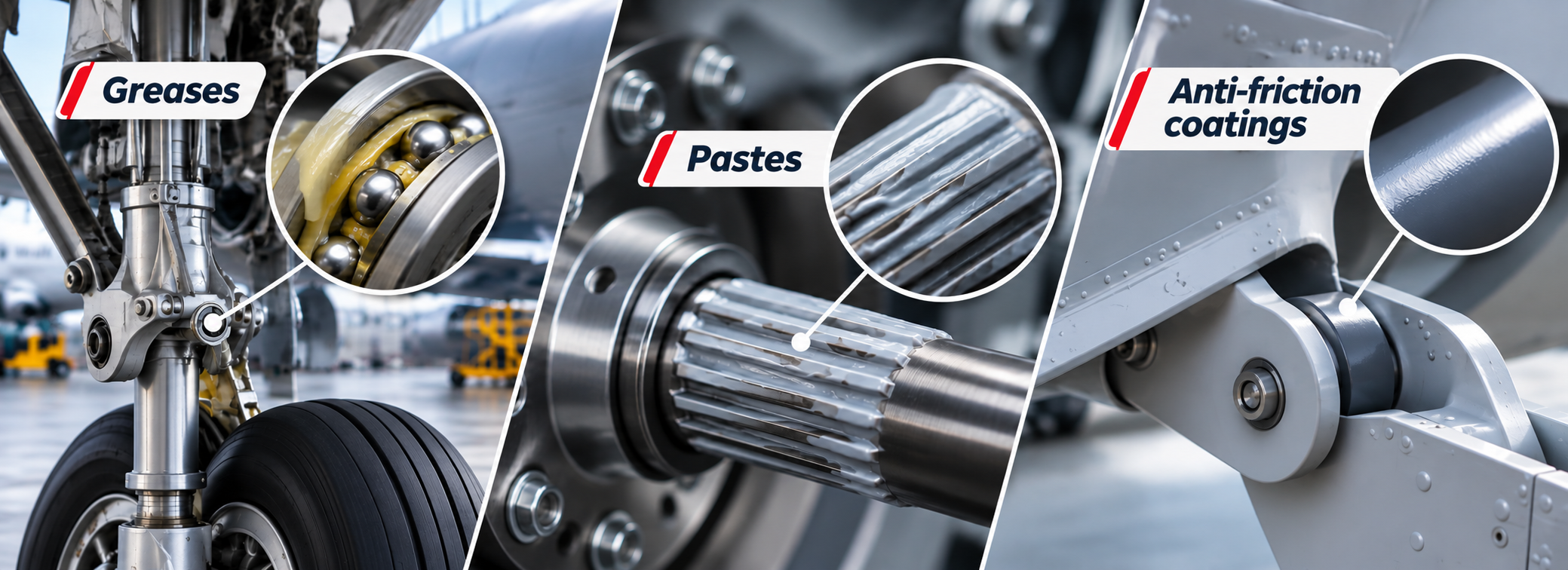
Grease, paste or anti-friction coating: three different functions
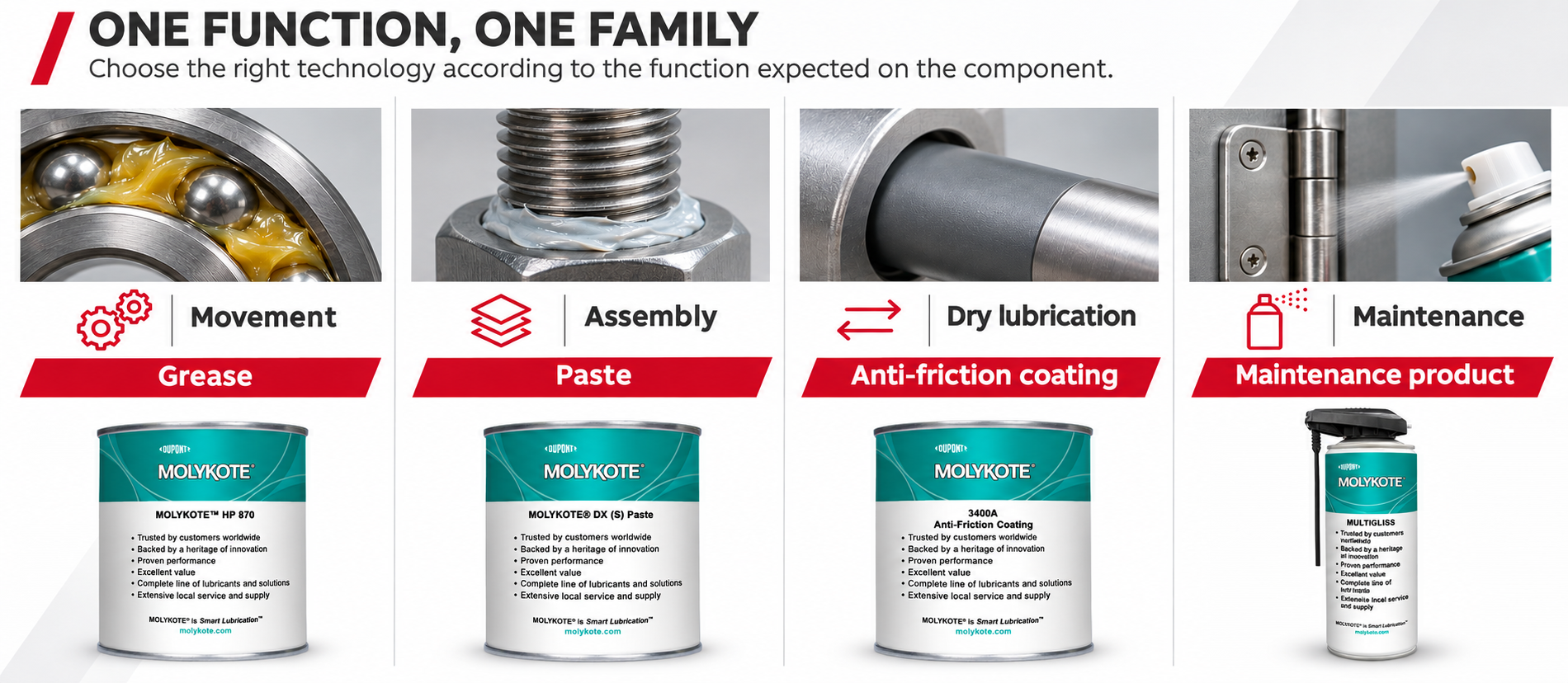
Comparing product references too early often means mixing technologies that do not serve the same purpose. A grease remains at the lubrication point and supports motion over time. A paste is mainly used during assembly or under high pressure. An anti-friction coating, by contrast, creates a dry film on the surface.
| Application / situation | Technology to consider | What it provides | Examples to consider |
| Bearing, plain bearing, continuous motion | Grease | Maintains a lubricating film within the mechanism. | MOLYKOTE® HP 870, BR2 Plus, Krytox™ 240 AC |
| Assembly, press fitting, low speed, high pressure | Paste | Controls friction, reduces the risk of seizure and can facilitate disassembly. | MOLYKOTE® G-Rapid Plus, DX (S), P-1042 |
| Slow or oscillating motion, exposed surface | Anti-friction coating | Creates a dry, clean film that is less sensitive to contamination build-up. | MOLYKOTE® 3400A AERO, 3402 C Lead Free, D-321 R, D-7409 |
| Storage, corrosion, seized parts | Maintenance solution | Protects the surface or supports a one-off maintenance operation. | Metal Protector Plus, Z Powder, Multigliss |
Greases: maintaining a lubricating film over time
A grease combines a base oil with a thickener, to which additives or solid lubricants may be added. This structure helps it remain in place in a bearing, plain bearing or mechanism where an oil could otherwise flow away.
The choice then depends on the operating context. For heavily loaded mechanisms, MOLYKOTE® BR2 Plus provides an extreme-pressure approach together with wear protection. Where temperature and the chemical environment become more demanding, a fluorinated technology such as MOLYKOTE® HP 870 may be considered. Krytox™ 240 AC goes further in this direction: this aerospace-grade PFPE grease is notably associated with the MIL-PRF-27617 specification.
These examples show why maximum temperature alone is not enough. Base oil, thickener, speed, load and the materials in contact can lead to very different choices.
Pastes: when friction is mainly managed during assembly
A paste is not simply a thicker grease. Its high solid-lubricant content makes it particularly suitable for slow movements, highly loaded assemblies and assembly operations where controlling friction, preventing seizure or enabling later disassembly are key requirements.
MOLYKOTE® G-Rapid Plus illustrates this function on highly loaded contacts. MOLYKOTE® DX (S), intended for slow movements under high pressure, notably stands out for a formulation with no intentionally added PTFE or PFAS-type substances.
The right criterion is therefore not just temperature: do you need to control tightening friction, resist washout, limit fretting corrosion or ensure disassembly after several service cycles?
Anti-friction coatings: lubrication without leaving a greasy surface
Some interfaces are poorly suited to grease lubrication, particularly when they are exposed to dust or are difficult to relubricate. Anti-friction coatings deposit a film containing solid lubricants on the surface. Once cured, the surface remains dry.
Their selection depends as much on the application process as on tribological performance. MOLYKOTE® 3400A AERO requires heat curing, while 3402 C Lead Free and D-321 R can be considered when the part needs to cure at room temperature. D-7409 is positioned for highly loaded metal-to-metal contacts where wear, fretting and exposure to different contaminants are key concerns.
Surface preparation remains critical: even a well-selected coating will lose film consistency and adhesion if the surface is not prepared correctly.
What about maintenance? Lubrication does not cover every need. Metal Protector Plus protects metal parts against corrosion; MOLYKOTE® Z and Powder Spray provide occasional MoS₂-based dry lubrication; Multigliss is more appropriate when the priority is to free seized parts and facilitate disassembly. These are different functions and should be treated accordingly.
Standards, specifications and requirements: what really changes in aerospace
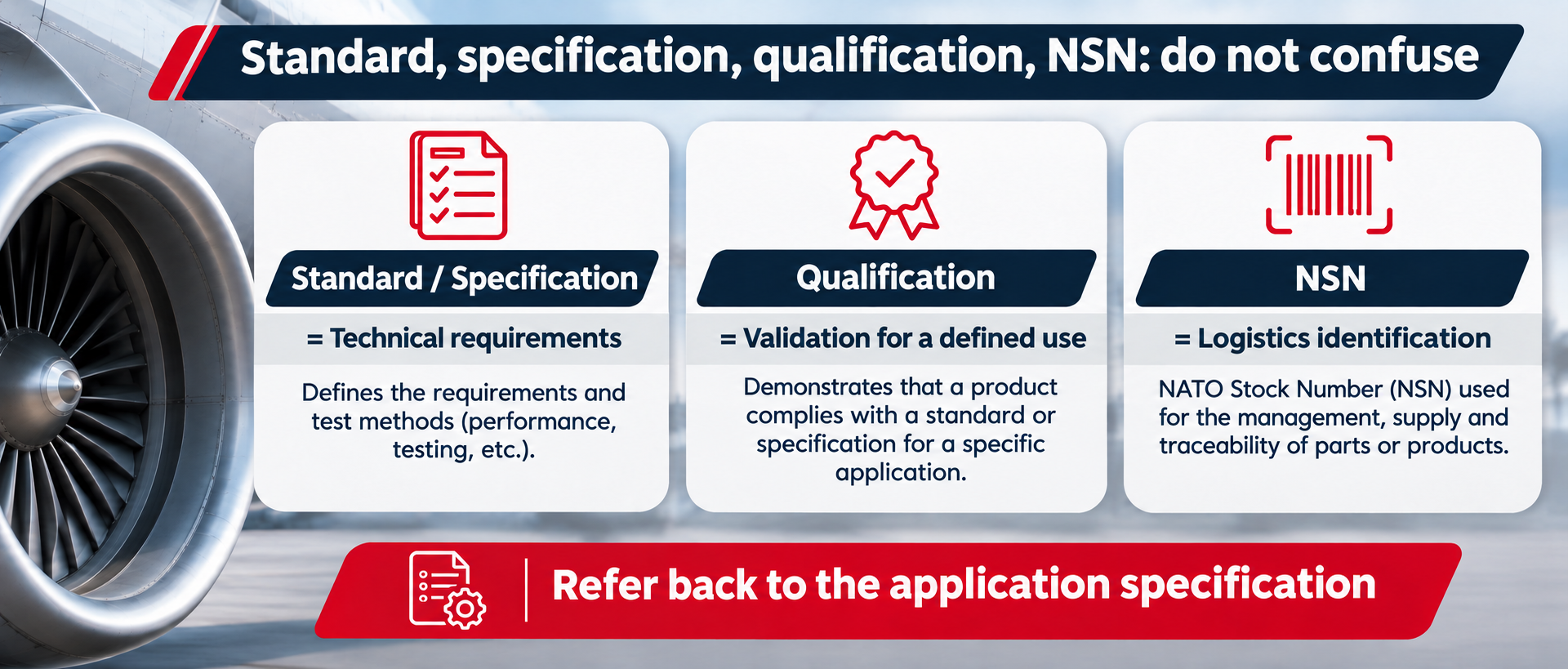
In aerospace and defence, good technical performance is not always enough. The requirements specification may impose a standard, an OEM or military specification, a specific qualification, or even an already approved product reference.
This is what makes substitutions more complex: two products may show similar temperatures, viscosities or load ratings without being interchangeable. Before replacing a product, the project requirements, materials and application process must be checked, together with any testing or requalification that may be required.
NSNs (NATO Stock Numbers) serve a different purpose: they are used to identify a supply item within a logistics system. An NSN is therefore neither a standard nor a technical qualification.
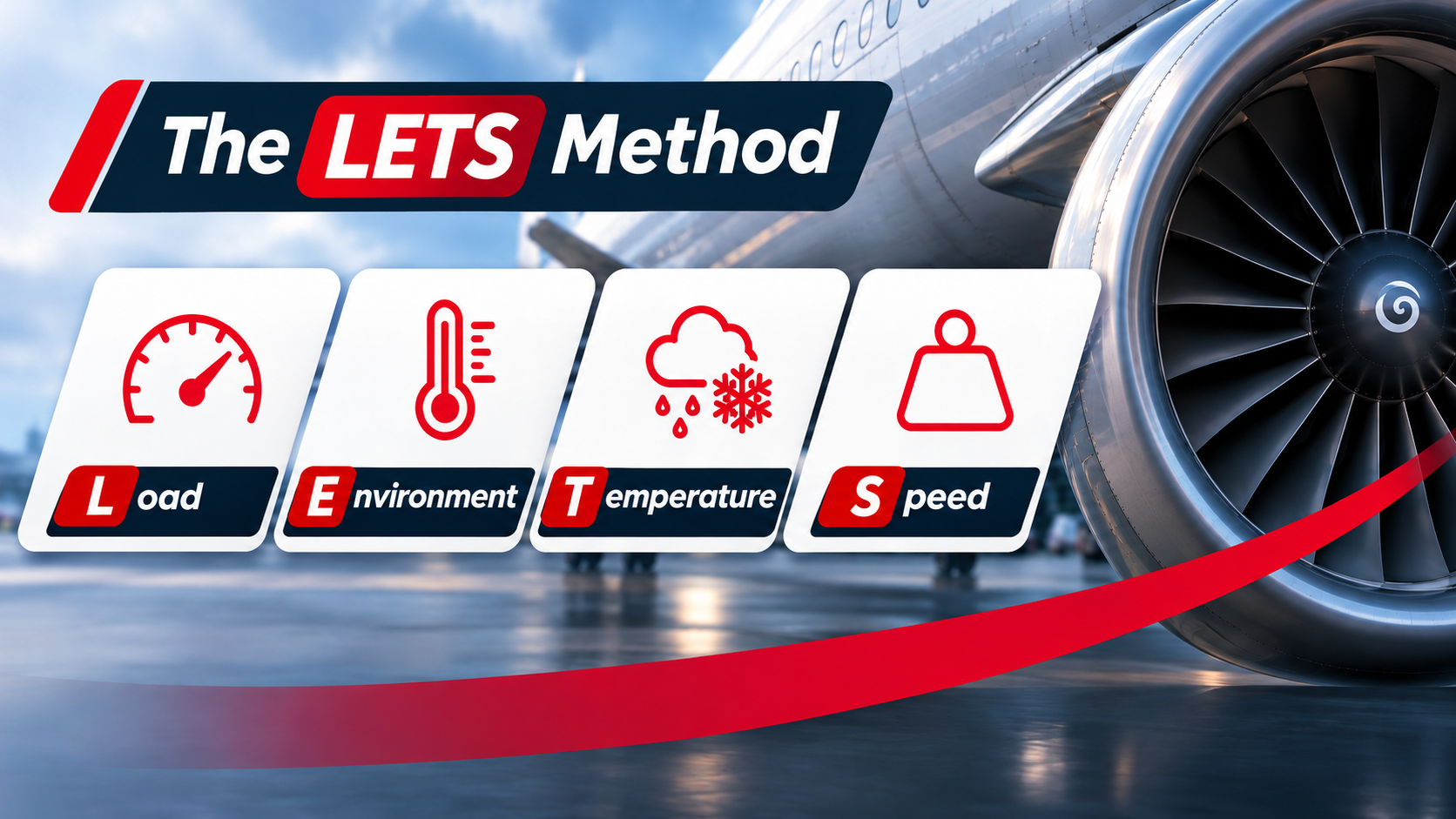
LETS: four criteria to quickly define an application
To structure an initial assessment, the LETS method brings together four parameters that quickly help point towards the most appropriate family of solutions:
- Load: pressure, repeated stresses, vibration or shock.
- Environment: humidity, dust, fuels, solvents, corrosion or other contaminants.
- Temperature: normal operating level, peaks, hot/cold cycles and exposure time.
- Speed: continuous rotation, slow sliding, intermittent motion or oscillation.
This initial framework is then complemented by the materials involved, maintenance frequency, application method, and the standards or specifications that must be met.
Do you have a lubrication application to qualify?
An initial recommendation can often begin with a few simple pieces of information:
- Component or area concerned: bearing, fastener, hinge, slide, thread…
- Motion and speed: rotation, sliding, oscillation, intermittent operation…
- Minimum and maximum temperatures, including any thermal cycling.
- Environment: humidity, dust, fuel, solvents, corrosion, vacuum…
- Materials in contact and the main mechanical constraints.
- Standard, specification or current product reference, if known.
Meet Samaro at Aeromart Toulouse 2026
Samaro will attend Aeromart Toulouse at MEETT from 1 to 3 December 2026. B2B meetings will take place on 2 and 3 December.
The event will be an opportunity to discuss your lubrication challenges, as well as other technologies offered for aerospace applications: bonding and sealing, composites, MRO repair, and electrical & electronic protection.
Do you already have an application, an existing product reference, a standard, a specification or a requirements document? Bring these elements with you: they provide the best starting point for an efficient technical discussion.