

























PERMABOND® 751: the flexible cyanoacrylate adhesive for demanding industrial assemblies
Cyanoacrylate adhesives are often chosen for their speed: simple application, fixture in just a few seconds and effective bonding on many materials. But some assemblies require more than fast bonding. They also need to withstand movement, impact, vibration, flexible materials or differences in thermal expansion.
PERMABOND® 751 addresses this specific need. This flexible cyanoacrylate adhesive is designed to offer a balance between strength and flexibility, with 150% elongation at break, a viscosity of 150 mPa.s at 25°C and good impact resistance. It can be evaluated for assemblies involving plastics, rubbers, metals or dissimilar materials exposed to mechanical or thermal stresses.
As a specialist in industrial adhesives, Samaro supports manufacturers in selecting solutions suited to their real constraints: material type, assembly geometry, production rate, operating environment, strength requirements and validation testing. This expertise makes it possible to go beyond a simple comparison of technical data and identify the solution most consistent with the application and specifications.
Why choose a flexible cyanoacrylate adhesive?
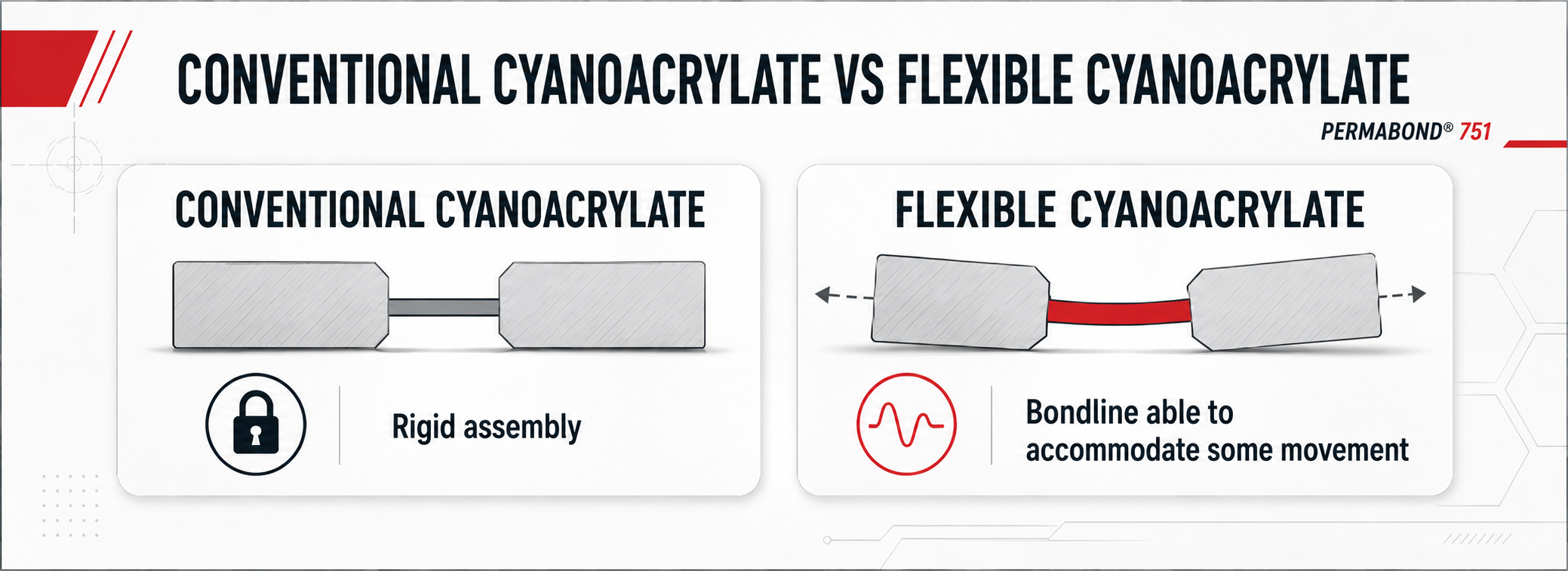
A standard cyanoacrylate adhesive can be highly effective on a rigid, well-fitted assembly. However, when parts move or work over time, an overly rigid joint can become a weak point. Stresses can come from impact, vibration, a temperature change or different behaviour between two bonded materials.
Flexibility helps accommodate certain deformations and distribute some of the stresses within the joint more effectively. This is particularly relevant for flexible materials, elastomers, metal/plastic assemblies or applications exposed to thermal cycling. This is where PERMABOND® 751 becomes especially relevant: when an instant adhesive also needs to retain the ability to adapt to movement, vibration or differences in behaviour between substrates.
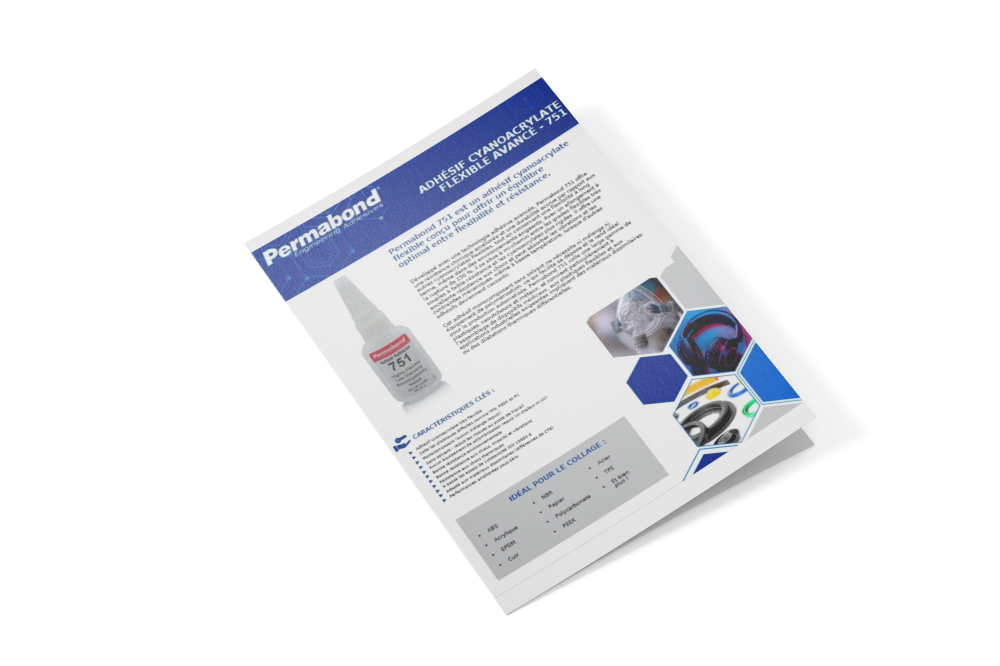
Receive the PERMABOND® 751 documentation
Would you like to evaluate PERMABOND® 751 for a flexible bonding application? Download the documentation to:
How can you tell whether the application requires flexibility?
The question is not simply whether the adhesive is flexible, but whether the assembly actually needs a joint capable of accommodating stresses. A flexible cyanoacrylate adhesive may be relevant when there is a difference in behaviour between two substrates, for example between a plastic and a metal, or when a flexible part must not be locally stiffened.
It can also be evaluated when a bond is exposed to small repeated deformations, vibration, impact or thermal cycling. In these cases, the objective is not only to obtain high initial strength, but to maintain consistent performance over time. Flexibility then becomes a durability criterion for the assembly.
Conversely, if the assembly is perfectly rigid, heavily loaded in static shear or if the gap between the parts is significant, another adhesive technology may be more suitable. This is why PERMABOND® 751 should be analysed as a fast, flexible bonding solution, but not as a universal answer to every industrial bonding requirement.
PERMABOND® 751: key characteristics to remember
PERMABOND® 751 is a single-part, 100% reactive and solvent-free cyanoacrylate adhesive. It requires no mixing and no thermal or UV curing equipment. This ease of use can help support integration into manual or automated production, subject to process validation.
| Criterion | Technical point to remember | Why it is useful |
| Chemistry | Ethyl cyanoacrylate | Formulation base to be confirmed in the up-to-date TDS/SDS. |
| Viscosity | 150 mPa.s at 25°C | Low-viscosity adhesive, suitable for thin films and well-fitted assemblies. |
| Elongation at break | 150% | Key indicator for a flexible cyanoacrylate adhesive. |
| Hardness | 80 Shore A | Helps assess the behaviour of the cured joint. |
| Service temperature | -55°C to +80°C | To be checked against the real application and tests. |
| Full strength | 24 hours | To be distinguished from initial fixture time. |
| Storage | 2 to 7°C | Allow the adhesive to reach room temperature before opening. |
These data alone are not enough to validate an application. They make it possible to preselect the reference and prepare tests on real parts.
Which applications can PERMABOND® 751 be evaluated for?
PERMABOND® 751 can be evaluated when the application combines several requirements: fast fixture, bonding of varied materials, a need for flexibility and resistance to certain mechanical or environmental stresses. Materials to assess include plastics, rubbers and metals, as well as substrates such as TPE, PEEK, polycarbonate, ABS, acrylic, EPDM, NBR, leather, paper and steel.
PERMABOND® 751 can also be evaluated for flexible surfaces, dissimilar materials or industrial applications exposed to vibration, impact or differences in thermal expansion. It has passed ISO 10993-5 cytotoxicity testing, which may be of interest for certain medical applications, without constituting automatic validation of a final device.
As always, compatibility must be confirmed according to the exact material, surface preparation, geometry, gap, environment and production constraints.
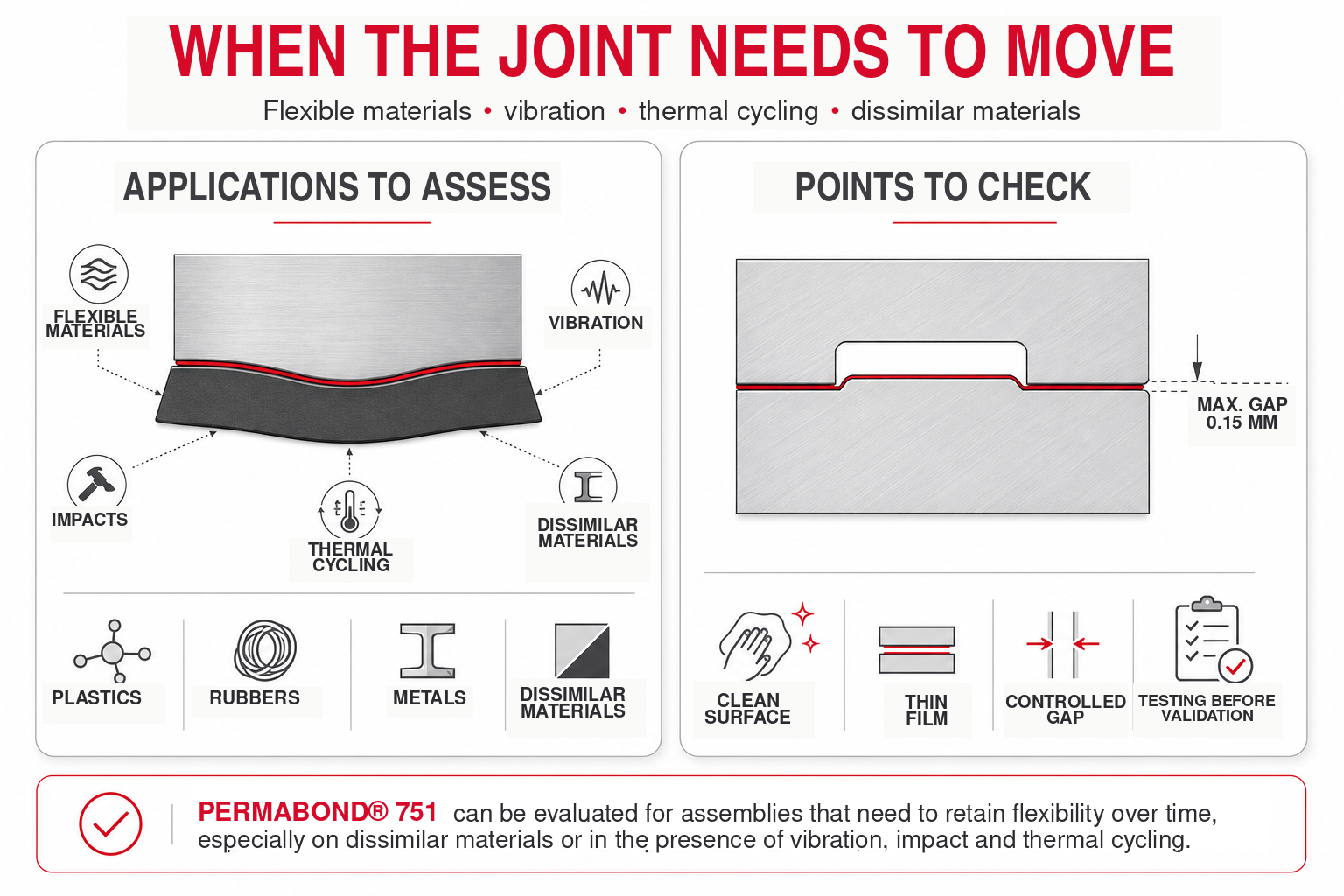
Application: points to check before testing
The performance of a cyanoacrylate adhesive depends heavily on application conditions. For PERMABOND® 751, the maximum gap fill is 0.15 mm. This point is important: it is not a gap-filling adhesive. The adhesive should be applied sparingly to one surface, so that it forms a thin film after assembly.
Surfaces should be clean, dry and grease-free. Suitable degreasing, for example with acetone or isopropanol, may be required. Some metals such as aluminium, copper and its alloys may benefit from light abrasion to remove the oxide layer.
Primers and activators must also be anticipated. For polypropylene, polyethylene, PTFE or silicone, the use of PERMABOND® POP Polyolefin Primer may be required, with one point of caution: it may affect the adhesive’s elongation. Conversely, certain cyanoacrylate activators can cause PERMABOND® 751 to lose its flexibility. These points must be validated before freezing a process.
Another point should be anticipated: initial fixture time should not be confused with final strength. Handling times can be just a few seconds depending on the substrates, while full strength is achieved after 24 hours. For an assembly exposed to stress, it is therefore important to define when the part can be handled, tested or put into service.
- To check before testing: exact materials, surface condition, gap, mechanical stress, need for flexibility, environment and production rate.
- To avoid: reasoning only on fixture time or treating a flexible cyanoacrylate adhesive as a gap-filling adhesive.
What limitations should be kept in mind?
Like any cyanoacrylate adhesive, PERMABOND® 751 must be used within a coherent application framework. Its value lies in fast bonding, in a thin film, with correctly fitted parts. If the objective is to fill a large gap, create a thick bead or provide high gap-filling capability, other adhesive families may be more relevant.
Caution is also required with chemical environments. PERMABOND® 751 is not recommended for use in contact with strong oxidising materials or polar solvents. Application testing therefore remains essential when the bond is exposed to fluids, solvents, oils, fuels or specific ageing conditions.
Samaro supports you in choosing a flexible cyanoacrylate adhesive
Choosing a flexible adhesive is not limited to reading an elongation value. The product property must be linked to the real application: materials, movement, vibration, impact, gap, surface preparation, production rate and documentation requirements.
Samaro can help you determine whether PERMABOND® 751 is among the solutions to evaluate, identify points of caution and prepare the tests required before production. This approach saves time and avoids comparing references before the expected function of the joint has been clearly defined.
FAQ: PERMABOND® 751 and flexible cyanoacrylate adhesives
PERMABOND® 751 Documentation
Download the PERMABOND® 751 documentation to better assess this flexible cyanoacrylate adhesive for your industrial application. You will find useful information to: