






















ARALDITE® 2080-15: the low-odour MMA adhesive for metal bonding and demanding industrial assemblies
Methyl methacrylate adhesives, often referred to as MMA adhesives, are widely used for industrial assemblies that require fast processing, mechanical strength and adhesion to a variety of substrates. They are particularly relevant for bonding metals, composites and certain plastics, especially when an assembly needs to replace or complement mechanical fasteners, reduce weight or simplify a manufacturing process.
However, conventional MMA adhesives also have a well-known limitation in workshops: their odour can be noticeable. In enclosed environments, poorly ventilated production areas or repeated operations, this can become a real HSE concern. Adhesive selection is therefore not limited to final strength. It must also take into account operator comfort, safety, workstation organisation, surface preparation and the regulatory constraints of the target market.
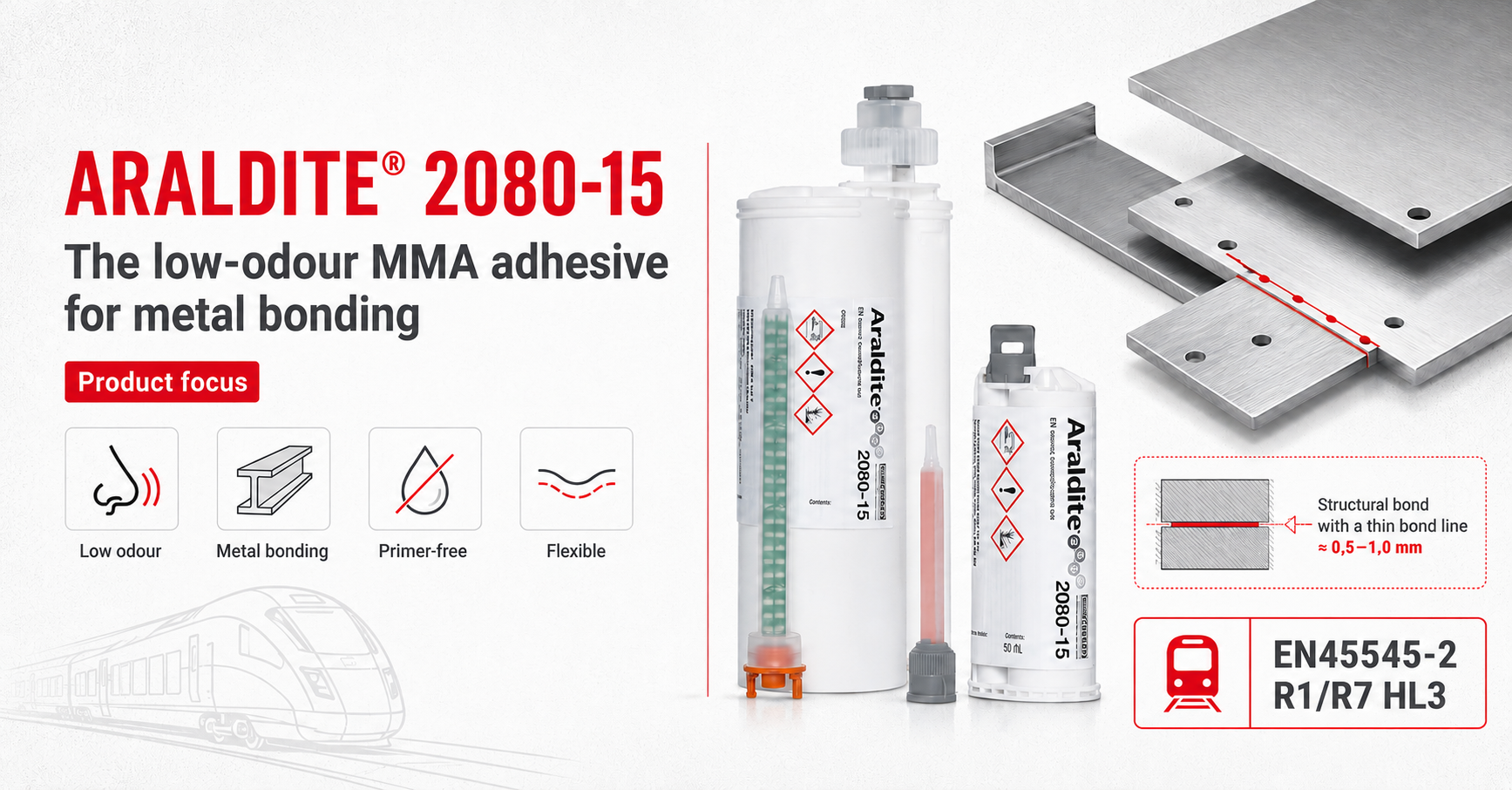
ARALDITE® 2080-15 meets this logic. This two-component, low-odour methacrylate adhesive is designed for bonding metals, with a balance between mechanical strength and flexibility. It is non-flammable, primer-free and approved to EN45545-2 R1/R7 HL3. For manufacturers in transport, railway, marine or wind energy markets, this combination can make it possible to evaluate a high-performance solution while improving application conditions.
As a specialist in industrial adhesives, Samaro supports manufacturers during this selection phase: understanding the specification, materials to be bonded, joint geometry, required working time, operating environment, HSE requirements, approvals and tests on real parts. The aim is not simply to choose a reference, but to secure the fit between the expected bonding function and the real production constraints.
Why can a low-odour MMA adhesive change workshop application?
Methyl methacrylate adhesives are valued for their ability to create fast and strong structural assemblies. They generally provide good adhesion to a wide range of materials, useful application tolerance and strength build-up suited to industrial production rates. This explains their use in sectors such as transport, automotive, railway, composites, marine and wind energy.
Their odour nevertheless remains a point of attention. In an open workshop, it can be managed with suitable ventilation and compliance with safety instructions. In a more confined space, near operators or on repetitive workstations, it becomes a more structuring factor. It can influence product selection, workstation organisation, the need for extraction, PPE, and the acceptability of the process by the teams.
This is where low-odour formulations become particularly useful. They make it possible to evaluate a methacrylate solution when bonding performance is required, while reducing an application constraint often associated with this technology. For a manufacturer, this is not just a comfort argument. It is also a lever for HSE control, workstation ergonomics and repeatability. An adhesive that is more pleasant to apply under real production conditions can contribute to a better accepted, more stable and easier-to-deploy process.
ARALDITE® 2080-15 belongs to this family of low-odour methacrylate adhesives. It is particularly relevant when the application requires high-performance metal bonding without returning to more odorous conventional MMA adhesives. This does not remove the need to analyse ventilation, application conditions and SDS documents, but it opens up a relevant option for workstations where odour is a decision criterion.
ARALDITE® 2080-15: useful technical characteristics to remember
ARALDITE® 2080-15 is a two-component methacrylate adhesive intended for industrial assemblies. Its positioning is based on four key arguments: low odour, metal bonding, primer-free application, and a balance between mechanical strength and flexibility. These elements make it a reference to evaluate when bonding must meet requirements for productivity, application comfort and mechanical performance.
| Criterion | Summary data | Why it is useful |
| Technology | MMA / two-component methacrylate | Technology suited to industrial structural assemblies. |
| Mix ratio | 10:1 | To be taken into account when choosing the cartridge, mixer and dispensing equipment. |
| Working time | Approx. 15 min according to the MMA guide | Allows assemblies that require more time than a very fast version to be processed. |
| Fixture time | Approx. 30 min according to the MMA guide | To be integrated into workstation organisation and handling steps. |
| Viscosity | 20-40 Pa.s | Determines dispensing behaviour, bead hold and gap-filling capability. |
| Maximum gap | 2 mm according to the MMA guide | Helps qualify the geometric tolerance of the assembly. |
| Shear strength | Approx. 23 MPa according to the MMA guide | Preselection indicator for metal assemblies and loaded parts. |
| Elongation at break | 50% according to the MMA guide | Reflects a compromise between rigidity, strength and flexibility. |
| Service temperature | -40 °C to +120 °C according to the MMA guide | To be cross-checked with thermal cycling and the operating environment. |
| Approval | EN45545-2 R1/R7 HL3 according to the MMA guide | Point of interest for railway applications subject to fire/smoke requirements. |
| Pack sizes | 50 ml and 480 ml | Makes it possible to adapt testing, small series and production. |
These data are preselection guidelines. Final validation must always be based on the latest technical data sheet, SDS documents, tests on real substrates and the criteria in the specification.
Metal bonding: why ARALDITE® 2080-15 may be relevant
Metal bonding requires precise analysis. The nature of the metal, its surface condition, the possible presence of oxides, oils, surface treatments or paints can strongly influence adhesion. Raw steel, treated aluminium, stainless steel, galvanised sheet metal or a powder-coated part do not behave in the same way. The adhesive must therefore be selected according to the exact material, but also according to the real condition of the part in production.
ARALDITE® 2080-15 is positioned as an MMA adhesive for metal bonding. This is important for applications where a solution is needed to hold metal assemblies subjected to mechanical loads, vibrations or temperature variations. MMA technology can also help limit certain mechanical operations, distribute stress over a larger surface area and preserve the appearance of the assembly by avoiding visible fasteners.
The primer-free positioning is a process advantage. It can simplify preparation, reduce the number of steps and limit the risk of errors linked to the application of an additional treatment. This simplicity should not be confused with the absence of preparation. Reliable bonding always requires surfaces that are clean, dry, cohesive and compatible with the adhesive. Depending on the case, degreasing, light abrasion, checks on surface treatments or comparative tests may be necessary.
The flexibility of this reference is also useful for metal assemblies that are not perfectly static. Parts may expand, vibrate or be subjected to micro-movements. An overly rigid adhesive can concentrate certain stresses in the joint. By contrast, a balanced formulation can help the assembly accommodate movement more effectively, provided the joint design is suitable.
Railway focus: EN45545-2 and assemblies in transport
The railway sector imposes specific requirements. Materials and products used on board must be evaluated not only for their mechanical performance, but also for their behaviour in the event of fire, their compatibility with the operating environment, their durability over time and the repeatability of the process. Choosing an adhesive is therefore rarely a simple product decision. It is part of a broader set of technical, quality and regulatory validations.
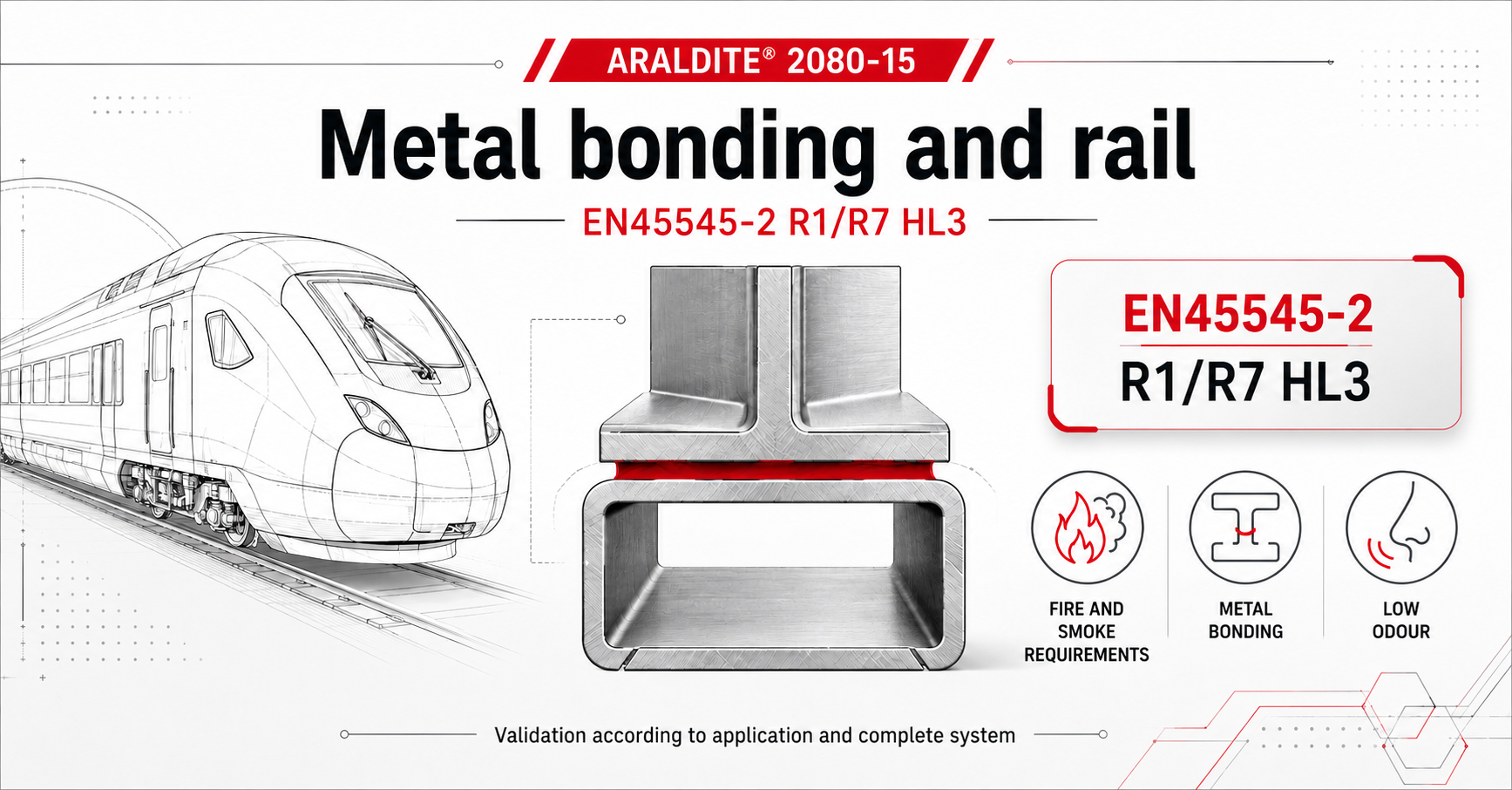
ARALDITE® 2080-15 is of particular interest in this context thanks to its EN45545-2 R1/R7 HL3 approval, according to the information available. This is a strong point for railway applications, especially when assemblies involve subassemblies where fire/smoke requirements must be taken into account. It must nevertheless be linked precisely to the scope of the application, the substrate, the thickness, the complete system and the project requirements.
Methacrylate adhesives are used in the railway sector for a variety of applications: bodywork elements, floors, interior modules, modular bathrooms, sandwich panels in metros or tramways. In these cases, the objective may be to increase productivity, reduce assembly weight, reduce mechanical fasteners, distribute stresses more effectively or simplify certain assembly steps.
For a railway manufacturer, ARALDITE® 2080-15 can therefore be evaluated when metal or multi-material bonding must combine low odour, simplified application, mechanical strength, flexibility and the EN45545-2 framework. Final validation must always be carried out on the complete system, with the real materials, thicknesses, surface treatments, ageing conditions and project-specific requirements.
Low odour, non-flammability and HSE: an advantage to integrate from the specification stage
In many workshops, HSE criteria are becoming as structuring as mechanical performance. An adhesive may be technically effective, but difficult to deploy if it imposes constraints that are too heavy for operators, production areas or internal procedures. Odour, flammability, storage conditions, labelling and waste management must therefore be studied very early.
ARALDITE® 2080-15’s low-odour positioning meets this need. It can be particularly relevant for indoor operations, repetitive workstations, confined areas or markets where operator comfort is an important criterion. Reduced odour does not remove safety obligations: SDS documents must remain the reference for defining precautions for use, ventilation, PPE, storage and handling procedures.
The non-flammable positioning is also interesting for industrial environments where products with a low flash point can complicate organisation. Here again, the benefit must be worded precisely: choosing a reference presented as non-flammable can help simplify certain HSE constraints, but the applicable rules must be validated with the SDS, stored quantities, transport conditions and internal site procedures.
For Samaro, this approach is essential: advising on an adhesive is not only about comparing technical performance. It also means anticipating the real life of the product in the workshop, from receipt to dispensing, including storage, mixing, application, curing, inspection and workstation maintenance.
Application: points to check before testing
ARALDITE® 2080-15 is a two-component adhesive with a 10:1 ratio. In a cartridge, mixing is provided by a static mixer, which simplifies application and helps secure mix homogeneity. This simplicity is a major advantage compared with manual mixing, particularly when operators need to reproduce the same bead on several parts or when the process needs to be stabilised in production.
The choice of pack size and dispensing equipment must be adapted to the bead length, viscosity, production rate and workstation ergonomics. 50 ml cartridges can be useful for testing, maintenance or small series. 480 ml cartridges are more suitable for applications requiring higher volume. The right choice depends on the bead diameter, the number of parts, the available working time and the acceptable waste at the end of the mixer.
The working time of approximately 15 minutes must be compared with the actual time required to apply the bead, position the parts, check alignment and hold the assembly. A window that is too short can create operator stress or positioning defects. A window that is too long can slow the production rate. This is why working time must be considered as a process criterion, not only as a technical value.
The maximum gap indicated at around 2 mm is another preselection point. Structural bonding is not only a matter of product selection: joint geometry directly influences performance. Adhesive thickness, overlap area, stress distribution, peel loads, vibrations, thermal cycling and ageing conditions must be checked. For critical assemblies, a test plan on real parts is essential.
- Exact materials: metal, composite, plastic, surface treatment, paint or coating.
- Preparation: cleaning, degreasing, possible abrasion, contamination control.
- Geometry: overlap, gap, bead thickness, access to the dispensing workstation.
- Process: working time, holding, fixture, production rate, choice of mixer and dispensing gun.
- Environment: temperature, humidity, vibrations, ageing, fire/smoke requirements.
- Safety: SDS, PPE, ventilation, storage, internal site rules.
When should ARALDITE® 2080-15 be chosen instead of another MMA adhesive?
ARALDITE® 2080-15 is not intended to replace all MMA adhesives. It should be evaluated when the application combines several needs: metal bonding, low odour, primer-free application, mechanical strength, flexibility and market requirements such as railway. If the application is focused on bonding plastics, another reference in the family may be more relevant. If the main need is filling very large gaps or achieving high elongation, other formulations may need to be evaluated.
The choice also depends on the desired working time. A faster version may suit small parts or highly paced workstations. A version with a longer working time may be preferable for longer beads, larger parts or assemblies requiring more progressive positioning. ARALDITE® 2080-15 sits in an interesting intermediate position: it provides more time than a very fast version while maintaining a rate compatible with many industrial processes.
In a Samaro approach, the right question is therefore not: ‘which product is the most powerful?’. The right question is: ‘what function must the joint perform, under what conditions, and with what production and validation constraints?’. This method helps avoid oversizing a solution, overlooking an HSE point or choosing a reference solely on the basis of a strength value.
Download the MMA Adhesive Selection Guide
A guide to help you:
Samaro supports you in selection and validation
The choice of an industrial adhesive should not be limited to a quick reading of a technical table. Strength, viscosity, working time and service temperature values are essential for preselecting a reference, but they do not replace testing. Each application has its own constraints: materials, surface treatment, thickness, type of load, production rate, environment, normative requirements and maintenance conditions.
Samaro intervenes precisely at this stage. Our experts help technical, methods, purchasing or quality teams transform a functional need into concrete selection criteria. For ARALDITE® 2080-15, support can cover the analysis of metal substrates, the choice of pack size, dispensing equipment, surface preparation, mechanical performance tests, HSE constraints or railway requirements associated with EN45545-2.
This approach helps avoid two frequent pitfalls: choosing an adhesive only because it is technically high-performing, or rejecting a technology because a constraint has been misunderstood. A low-odour MMA adhesive such as ARALDITE® 2080-15 can be a very relevant option, provided it is qualified using the right criteria. The Samaro teams can help you prepare this validation, compare alternatives in the range and identify the documents needed to move forward.
FAQ - ARALDITE® 2080-15 and low-odour MMA adhesives
Conclusion: a low-odour MMA adhesive to evaluate for demanding metal assemblies
ARALDITE® 2080-15 addresses a very concrete industrial need: benefiting from the performance of an MMA adhesive while reducing some constraints associated with conventional formulations. Its low-odour, metal-oriented, non-flammable, primer-free, flexible positioning and EN45545-2 R1/R7 HL3 approval make it an interesting reference for markets where bonding performance must be accompanied by real HSE and process thinking.
For railway, transport, marine, wind energy or industrial metal assemblies, this reference can be included in a technical preselection. The final choice must nevertheless remain guided by the real application: materials, geometry, mechanical constraints, environment, working time, normative requirements and validation tests.
Would you like to evaluate ARALDITE® 2080-15 for a metal or railway bonding project? Samaro can support you in analysing your specification, selecting the appropriate reference and preparing tests. Contact our bonding expert or request the documentation to move forward with the right criteria.