























Integrating Composites and Adhesives in Aerospace and Defence
The strategic value of JEC for the aerospace and defence sectors
JEC World is one of the major international gatherings for composite innovation, with particular weight in aerospace and defence. In a context where weight reduction, mechanical performance and durability have become non-negotiable, the challenge is no longer simply choosing the right material: it is about robustly integrating composites, interfaces and assembly processes.
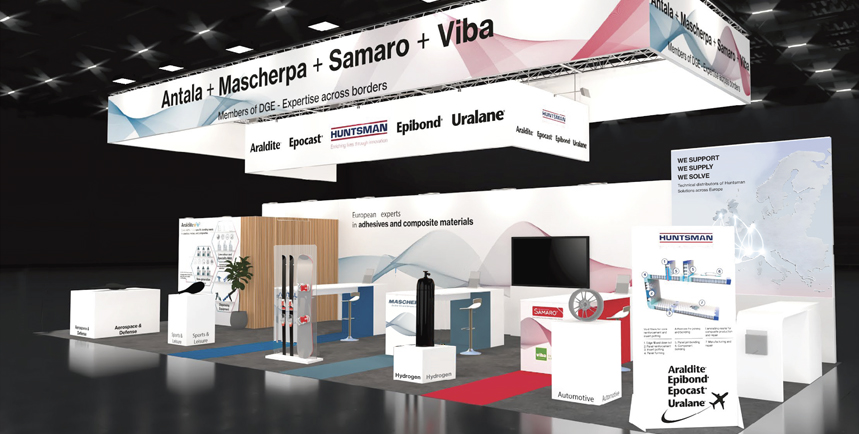
On the Samaro stand (Hall 6 – G74), alongside our European partners ANTALA, MASCHERPA and VIBA, we will focus precisely on this “material + process” approach, built around Huntsman Advanced Materials solutions — Araldite®, Epocast®, Epibond® and Uralane® — to support your design, industrialisation and maintenance (MRO) challenges.
Composites as structural materials in aerospace and defence platforms
The use of composite materials has evolved significantly: from fairings and secondary parts, they have moved into primary structures on aircraft, drones (UAVs) and defence vehicles. Their strength-to-weight ratio, combined with great design freedom, makes them key materials for improving overall efficiency: reduced mass, optimised shapes and performance gains.
In defence, composites also extend to structures and sub-systems exposed to harsher environments (vibration, shock, thermal cycling, contaminants). This scaling-up, however, comes with recurring industrial constraints: moisture sensitivity during certain cure cycles, more complex non-destructive inspection (NDI), and strict certification/traceability requirements.
Adhesive: an engineering element, not just a joining method
In modern aerospace structures, structural adhesive plays a multifunctional role. Beyond bonding dissimilar substrates (metal/composite) or complex geometries, it distributes loads continuously, reduces stress concentrations, and contributes to fatigue resistance.
From a functional standpoint, it can also contribute to:
- environmental sealing (moisture, chemicals, contaminants),
- management of thermal gradients (transition areas),
- electromagnetic compatibility (EMC), depending on the architecture and application.
In this context, structural bonding solutions such as Araldite® and Epibond® (depending on grades) fit into high-requirement assembly strategies, where performance is not limited to a single strength value, but to a complete “properties + process + traceability” package.
Beyond bonding: why material integration also matters for casting, encapsulation and protection
In aerospace and defence, integration is not limited to structural bonding. It also covers related needs that are often critical in severe environments:
- encapsulation / potting / casting to protect or stabilise sub-assemblies,
- protection and mechanical behaviour using suitable polymer systems (e.g. polyurethane solutions depending on use),
- tooling / moulds / support operations depending on manufacturing and maintenance stages.
This is where ranges such as Epocast® (casting systems) and Uralane® (PU solutions) can complement the “structural adhesive” building block, within a broader approach focused on reliability and industrialisation.
Objective: think in terms of a system (materials + process + service conditions), rather than an isolated product.

Adhesive–composite integration in industrial processes
The reliability of an adhesive joint on composites depends not only on the material, but on controlled implementation. This includes:
- Surface preparation: cleaning, activation/treatment, operational repeatability.
- Traceable cure conditions: control of temperature/time/pressure/humidity, parameter recording.
- Bondline thickness control: geometry, shimming, consistency, reduction of variability.
- Application automation: controlled dispensing, homogeneous coverage, repeatability.
In production, automation and standardisation (procedures, controls, traceability) become major levers to secure large-scale structural performance.
MRO: field applicability as a decisive criterion
In maintenance (MRO), the question is not only “what is the maximum lab performance?”, but “what is robust and reproducible performance in real conditions?”. For defence platforms, often deployed in uncontrolled environments, selection criteria evolve:
- ease of application (clear procedures, reduced risk of error),
- process window (use conditions, environmental variability),
- return to service (set/cure time vs robustness),
- compatibility with repaired surfaces (achievable preparation, surface state, contaminants).
The challenge: finding the right balance between mechanical performance, field practicality and traceability requirements.
Defence vs civil aerospace: specific constraints
Even if structural principles are similar, defence applications often require:
- robustness in extreme conditions (shock, vibration, thermal cycling, contaminants),
- field repairability (fast interventions, limited resources),
- traceability in regulated supply chains (qualification, compliance, OEM requirements).
In this context, working with players able to deliver products + process support is an industrial risk-reduction factor, both in design and in maintaining operational readiness.
Trends observed at JEC World
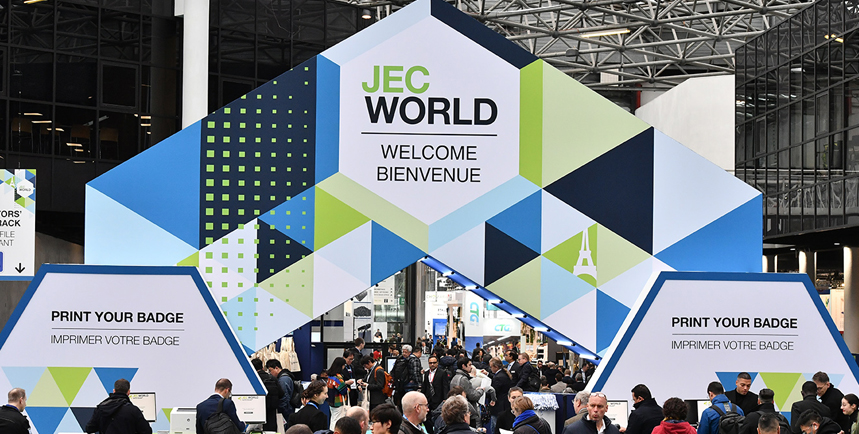
Each year, JEC World reflects the sector’s technology priorities. Key trends related to bonding and composites include:
- Automation of structural assembly: robotics, vision systems, process sensors.
- Polymer system evolution: optimisation of toughness/cure kinetics/material compatibility (depending on formulations).
- Sustainability: VOC reduction, recyclable-oriented materials and processes, footprint reduction.
- Digitalisation & traceability: sensors, process data, more continuous quality control.
The role of specialised manufacturers… and the value of a “system” approach
In an environment where certification, traceability and structural reliability are critical, specialised manufacturers play a central role. Huntsman Advanced Materials, through its Araldite® range, provides structural adhesive systems suited to the requirements of OEMs and Tier 1 suppliers.
Their technical support goes beyond product supply and also includes:
- Process validation support: collaboration with engineering and quality teams to ensure compliance with aerospace specifications.
- Custom solution development: adapting formulations to specific cure, viscosity or substrate-compatibility needs.
- Training and on-site support: to ensure consistent and traceable application throughout the product lifecycle.
At Samaro, our role is to start from your constraints (temperature, fatigue, environment, takt time, MRO) to:
- guide you to the right structural adhesive and the right application method,
- secure critical points (preparation, bondline thickness, cycles, traceability),
- and facilitate industrialisation through coherent process recommendations.
Integration as a competitive advantage for the structures of the future
Competitive advantage in aerospace and defence no longer relies solely on the material, but on the ability to integrate it in a robust, repeatable and compliant way. Combining advanced composites with polymer solutions (structural bonding, casting/encapsulation, suitable protections) makes it possible to design and maintain lighter, more durable and more efficient structures—provided the full materials + processes chain is mastered.
Would you like to learn more about structural adhesive solutions for composites?
We will be at JEC World from 10 to 12 March. Visit us at Stand 6G74, alongside our European partners ANTALA, MASCHERPA and VIBA.
👉 Get your free badge (enter code EXH1495753197): HERE
See you soon in Paris!
❓FAQ
🔹 Why use a structural adhesive rather than mechanical fastening?
Because it distributes loads continuously, limits stress concentrations, and makes it easier to assemble complex geometries or dissimilar materials.
🔹 What is the #1 factor in the reliability of bonding on composites?
Surface preparation and process control (dispensing, bondline thickness, curing, traceability).
🔹 Why does maintenance (MRO) change adhesive selection?
Because you need a balance between performance, ease of application, field conditions and return to service—without losing traceability.
🔹 What trends are transforming composite assembly at JEC?
Automation, new chemistries (depending on grades), digitalisation/traceability, and sustainability initiatives (VOC reduction, recyclability).