


























DOWSIL™ EA-3838 Fast Adhesive: a fast-curing, primer-free two-component silicone for bonding glass, metal and plastic
Bond in under 5 minutes. Hold at -50°C and at +180°C. Adhere glass to steel, aluminum to plastic, painted metal to composite — no primer, no oven. For process engineers dealing with high-throughput production lines and multi-material assemblies, these are not ideals: they are everyday realities.
At Samaro, official Dow distributor in France, we carry the full range of DOWSIL™ industrial silicones — and among these references, the DOWSIL™ EA-3838 Fast Adhesive holds a special place. Its two-component alkoxy formulation with fast room-temperature curing gives it a versatility covering a remarkably wide application spectrum — from automotive electronics to major household appliances, from wind turbines to cargo door seals in aerospace.
The 7 Key Advantages of DOWSIL™ EA-3838 Fast Adhesive
| # | Advantage | What it changes in production |
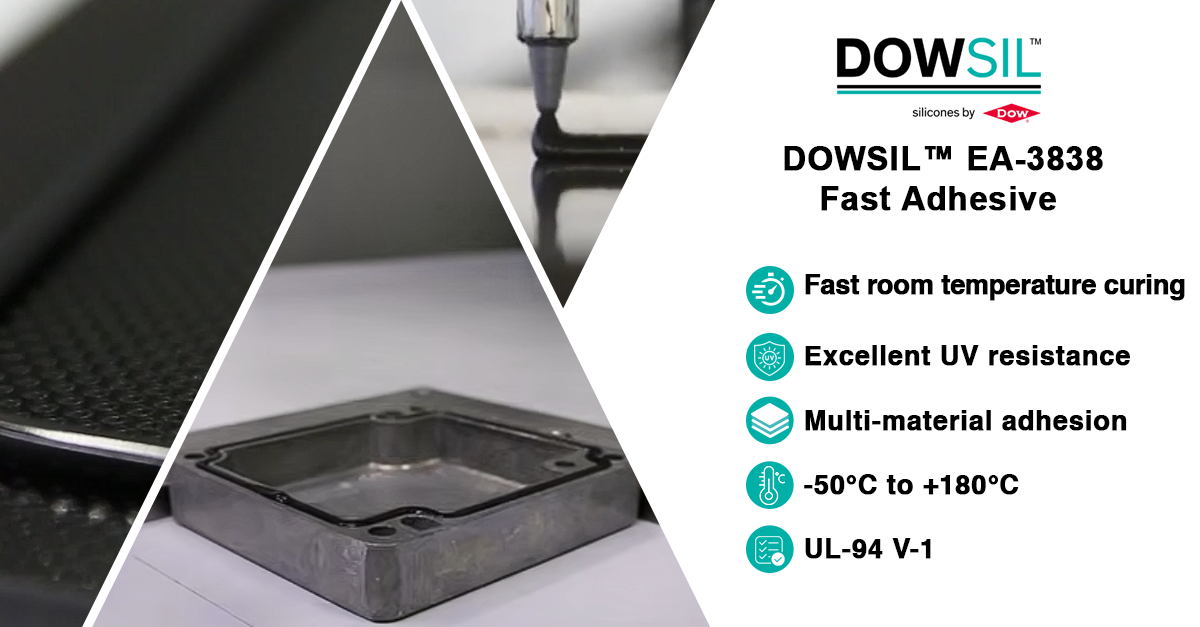
| 1 | Fast room-temperature curing | Parts can be handled in 15 min: no oven, no waiting |
| 2 | Adjustable mix ratio (2:1 to 4:1) | One product for multiple workstations, adjustable kinetics on demand |
| 3 | Primerless on the majority of substrates | Eliminates a process step, less handling of chemicals |
| 4 | Homogeneous through-cure | No surface/core gradient, consistent joint quality regardless of thickness |
| 5 | Thermal resistance from -50°C to +180°C | Compatible with extreme environments: automotive, aerospace, wind energy |
| 6 | UV and weathering resistance | Long-term outdoor durability without joint degradation |
| 7 | UL 94 V-1 certification | Fire safety compliance for electronics and charging applications |
What Fundamentally Sets a Fast-Curing Two-Component Apart
Before detailing the applications, it is important to understand why the two-component nature concretely changes things on a production line.
A standard one-component alkoxy silicone cures from the surface inward, at a speed directly dependent on ambient humidity. On a 2 mm thickness — that of a housing seal or a glass/metal bond — mechanically usable strength can take several hours to develop, with variability linked to workshop climate conditions.
The EA-3838 works differently: curing begins as soon as the base and catalyst are mixed, uniformly throughout the entire mass, with no surface/core gradient, no humidity dependency. The result in numbers, on glass/stainless steel at a 2:1 ratio:
| Time after mixing | Shear strength |
| 15 minutes | ≥ 0.5 MPa |
| 1 hour | 0.7 MPa |
| 24 hours | 1.0 MPa |
| 7 days (final value) | 1.4 MPa |
What this means in practice: an assembled part can be handled in under fifteen minutes. Holding fixtures are released faster. Cycle times shorten without sacrificing joint quality.
Markets and Applications Covered
Automotive and Embedded Electronics
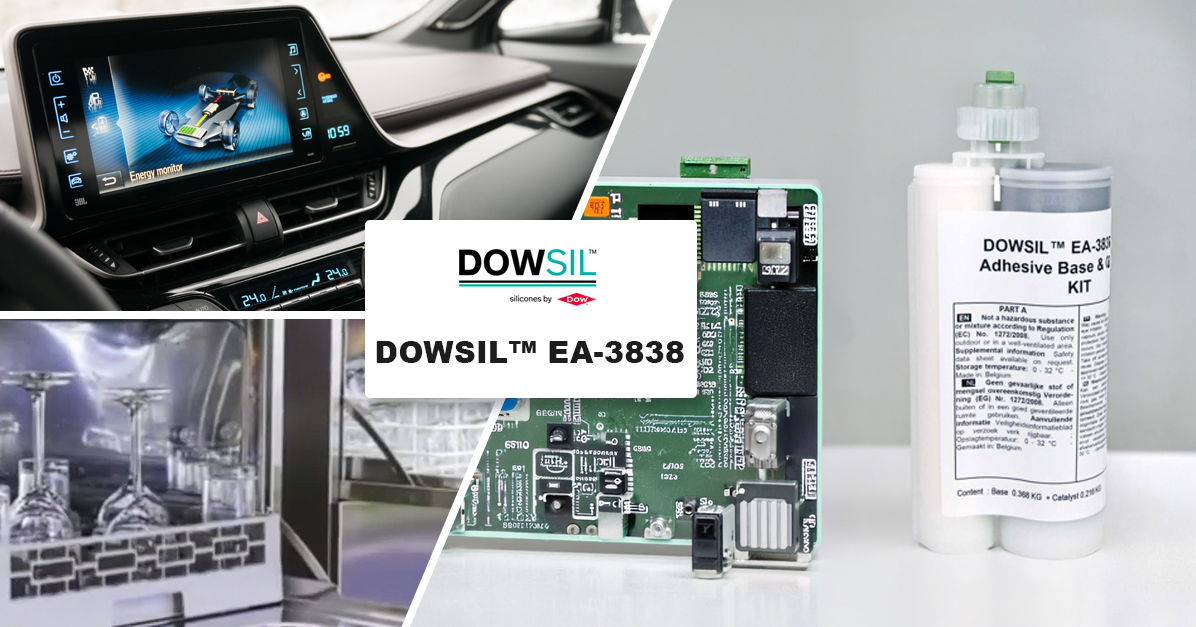
Modern vehicles pack an ever-growing density of embedded electronics into confined spaces subject to vibrations, thermal gradients, and constant moisture exposure. The EA-3838 addresses this on several fronts:
Display and infotainment system bonding:
Panel glass must be assembled onto metal or plastic structures while absorbing differential thermal expansion. With an elongation at break exceeding 250% and a Shore A hardness of 40, the joint remains flexible under cyclic thermal stress without debonding or cracking.
Sealing and assembly of embedded electronic housings:
The thixotropic, non-self-leveling consistency (vertical flow < 2 mm/60 s) allows precise bead deposition on vertical or inclined surfaces without sagging before the joint closes.
Maintenance and replacement seals:
Its room-temperature curing, without thermal equipment, makes it a natural candidate for MRO operations on vehicles or subassemblies outside of production lines.
Home Appliances
Home appliances are one of the EA-3838’s historical application areas. The Dow datasheet explicitly positions it for glass/metal, glass/painted metal, and glass/plastic bonding in ovens, refrigerators, and small household appliances.
This market illustrates the product’s dual requirement well: resistance to moist heat (proven hold after 7 days at 70°C immersion) and resistance to dry heat up to 180°C — conditions experienced daily by washing machine door seals or oven door assemblies.
Energy and Industry: Wind Turbines and General Applications
The Dow product page explicitly designates the EA-3838 for wind turbine nacelle seals, glazing, and general industrial sealing applications. These applications share a common characteristic: prolonged exposure to weathering, UV radiation, and amplified temperature cycles.
UV and weathering resistance — an intrinsic property of alkoxy silicone chemistry — ensures the joint does not degrade under solar exposure over the installation’s service life — 20 to 25 years for a wind turbine. The absence of primer simplifies maintenance operations at height, where preparing surfaces with chemicals is a real operational constraint.
EV Charging Infrastructure
In DC fast-charging stations, the EA-3838 is used at two levels documented in Dow’s MobilityScience™ guide:
Gun head:
Assembly and sealing of connector housings subject to repeated insertion cycles and outdoor environments, on technical plastic/metal combinations typical of these parts.
Station shell:
Cabinet door seals, bonding of aluminum/steel/reinforced plastic panels, cable entry sealing. UL 94 V-1 certification is a frequent OEM requirement for any assembly near switching power supplies and power modules.
Aerospace and Defense
Dow positions the EA-3838 on several demanding aerospace applications: cargo door seals, general maintenance seals, lighting seals, and edge seals. These applications share extreme thermal cycling, structural vibrations, and long-term durability requirements without mechanical property degradation.The service range of -50°C to +180°C (with resistance to short-duration peaks beyond this) covers conditions encountered on aerospace structures, between cruising altitudes and ground environments in hot climates.
Adhesion Performance on Common Industrial Substrates
All values below are measured by lap shear, 2 mm bond thickness, 7 days at 23°C, 2:1 ratio. In all cases, failure is 100% cohesive — it is the silicone joint that fails, not the interface, attesting to the intrinsic quality of adhesion on these substrates:
| Substrate assembly | Shear strength |
| Glass / Stainless steel, steel, galvanized steel | 1.4 MPa |
| Glass / Aluminum, anodized aluminum | 1.2 MPa |
| Glass / Polycarbonate (PC), Polyamide (PA) | 1.2 MPa |
| Glass / ABS, PBT | 1.0 MPa |
No primer required on these substrates. Plasma or flame activation, or application of a suitable primer, can improve adhesion on low-surface-energy or contaminated surfaces.
What This Product Is Not
An honest article must also clarify its limitations. The DOWSIL™ EA-3838 is a structural adhesive/sealant: it is not formulated for potting or encapsulation of electronic boards, nor for thermal management as a gap filler. For these specific uses, Samaro offers other suitable Dow references (SYLGARD™, DOWSIL™ EE-3200, Thermally Conductive range).
FAQ — DOWSIL™ EA-3838 Fast Adhesive
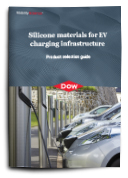
Sources : Technical Data Sheet DOWSIL™ EA-3838 Fast Adhesive (Form No. 11-4117-01-0420 S2D, Dow 2020) ; Dow MobilityScience™ — Silicone materials for EV charging infrastructure (Form No. 80-8636-01-0224, Dow 2023–2024) ; Page produit Dow — DOWSIL™ EA-3838 Fast Adhesive.