





















Railway Lubrication: Discover the New MOLYKOTE® Brochure Dedicated to Railway Applications
In the railway industry, the reliability of equipment depends on many factors: component quality, maintenance, operating environment… but also the choice of lubrication solutions.
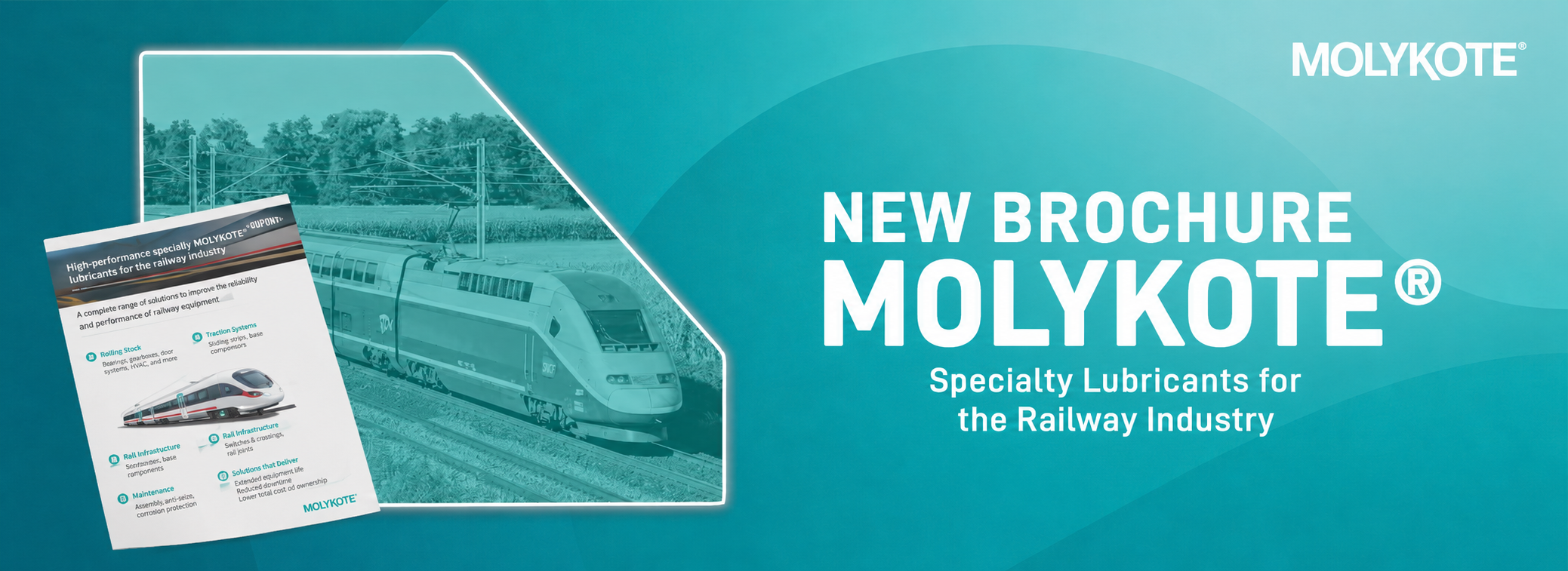
To support industrial players in the sector, MOLYKOTE® has published a new brochure dedicated to railway applications. This documentation presents the main areas of the train and infrastructure where special lubricants can help reduce friction, limit wear, prevent seizing, or protect certain components against external aggressions.
As a MOLYKOTE® partner, Samaro makes this brochure available to its customers and assists them in identifying solutions suited to their technical requirements. The goal is not simply to present products, but to help industrials understand the challenges of each application and guide their selection based on real operating conditions.
You will find in particular a map of the main areas of the train and infrastructure: bogie, track, coupling, pantograph, doors, seals, bellows, and some emerging applications.
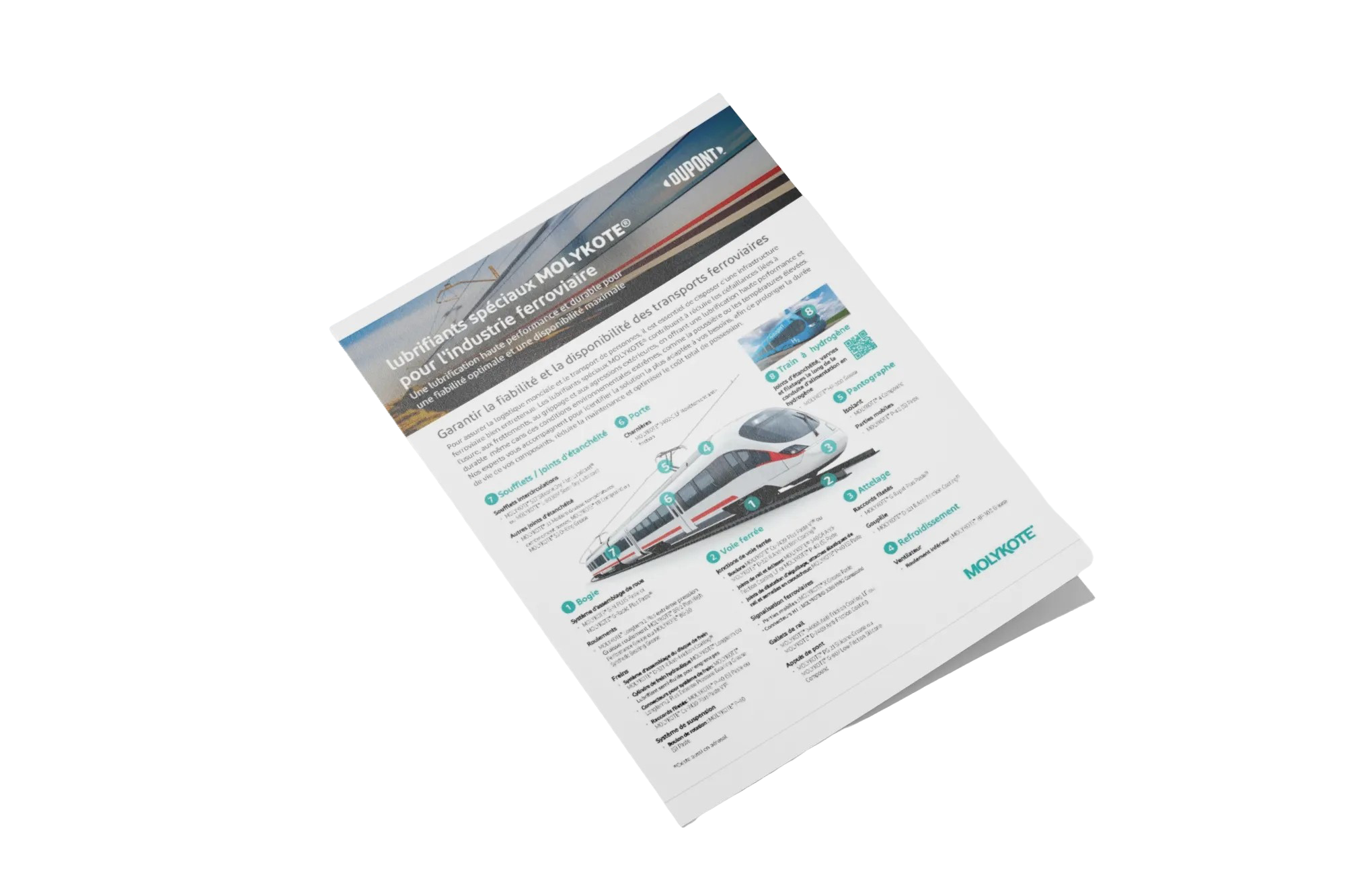
Receive the MOLYKOTE® brochure dedicated to railway applications free of charge
To go further, the MOLYKOTE® brochure dedicated to the railway industry helps you identify the main application areas and the solution families to evaluate according to your constraints. In this brochure, you can:
A New MOLYKOTE® Brochure to Support Railway Industry Players
The MOLYKOTE® Railway brochure takes a particularly interesting approach: it does not simply present products, but places them in their context of use.
Each area of the train or infrastructure is associated with specific issues. The constraints encountered on a bogie bearing are not the same as those of a threaded fitting, a seal, or a door hinge.
This application-based approach allows maintenance teams, methods engineers, design offices, manufacturers, or operators to better understand the challenges related to lubrication and identify the families of solutions likely to meet their needs.
Key Takeaway
The MOLYKOTE® railway brochure offers an application-based reading: bogie, track, coupling, pantograph, doors, seals, bellows, and other railway equipment. It is a useful starting point before any technical validation
Why Is Lubrication a Strategic Issue in the Railway Sector?
The railway sector is a particularly demanding environment.
Equipment is subjected to heavy loads, constant vibrations, sometimes extreme climatic variations, and high availability requirements. Components must operate reliably for long periods while minimizing maintenance operations.
In this context, appropriate lubrication can contribute to:
- Reducing friction.
- Limiting component wear.
- Preventing certain seizing phenomena.
- Facilitating assembly and disassembly operations.
- Improving protection against corrosion.
- Contributing to equipment service life.
- Participating in maintenance and availability objectives.
It is precisely to address these issues that MOLYKOTE® has been developing special lubrication solutions for many years, used in numerous industrial sectors, including the railway industry.
A Map of the Main Railway Applications
One of the strengths of the brochure is its visual representation of the different areas concerned by lubrication.
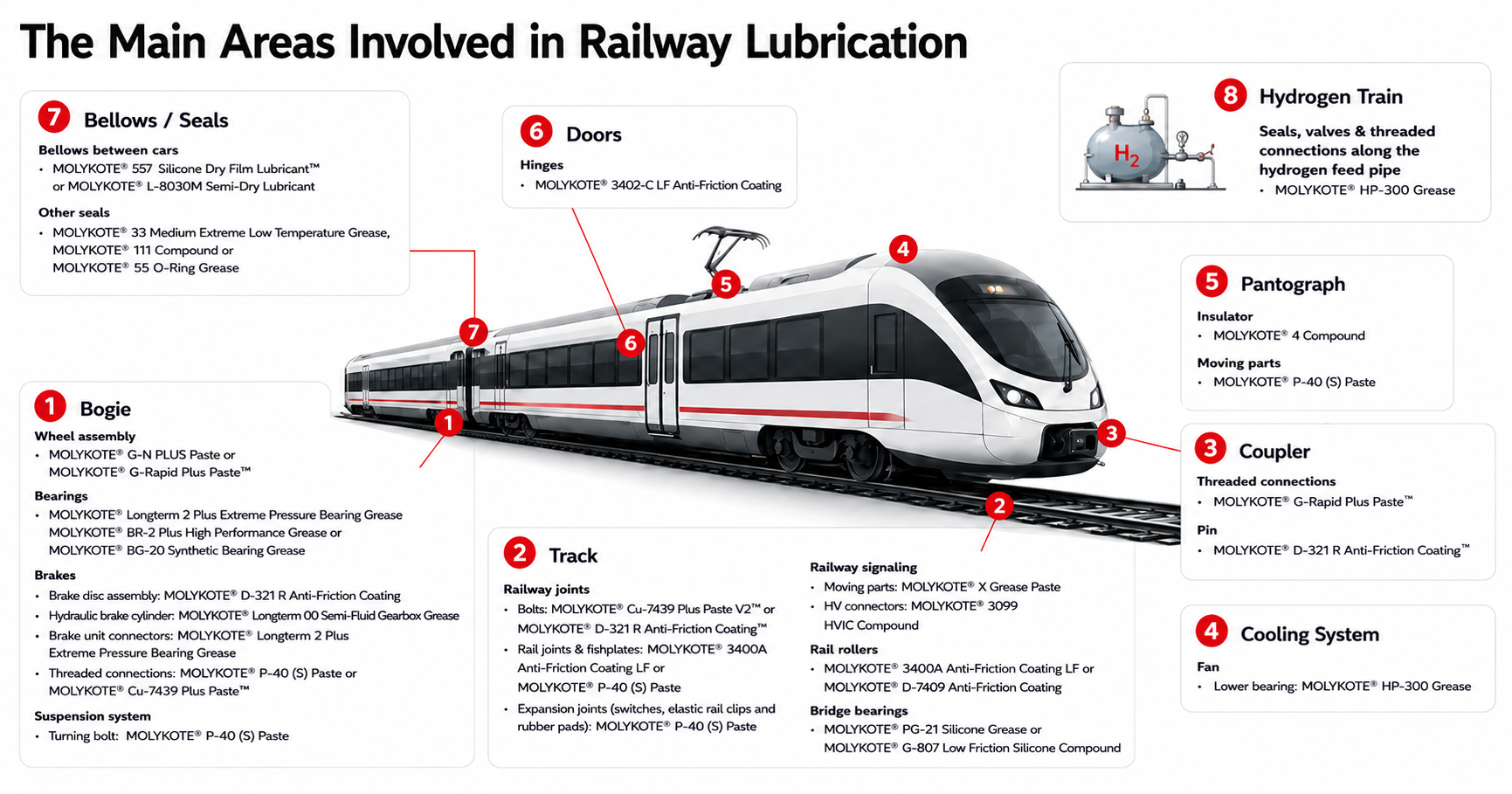
This map allows you to quickly understand that railway lubrication is not limited to bearings or the most visible mechanical components. It also covers numerous interfaces subjected to movement, vibration, weather conditions, or repeated maintenance operations.
Bogies: a highly critical application area
Bogies are among the most critical areas of rolling stock.
They include applications involving wheel assemblies, bearings, braking systems, threaded connections and suspension components.
These components are exposed to high loads and continuous mechanical stress. Lubrication solutions must therefore meet demanding requirements regarding friction and wear control, seizure prevention and component service life.
Examples of MOLYKOTE® solutions for these applications include:
MOLYKOTE® BR-2 Plus High Performance Grease may help reduce friction and wear in bearings while contributing to longer component service life.
MOLYKOTE® P-40 (S) Paste and MOLYKOTE® Cu-7439 Plus Paste V1 may be used on threaded connections to help ensure appropriate tightening and release torque, maintain a consistent coefficient of friction, prevent seizing and facilitate repeated assembly and disassembly cycles.
Tracks and railway infrastructure: often underestimated operating constraints
The brochure is not limited to rolling stock. It also covers several railway infrastructure applications.
Railway joints, bolts, fishplates, switch expansion joints, rail rollers and bridge bearings may be affected by corrosion, seizing or wear caused by mechanical movement and outdoor operating conditions.
Lubrication and protection solutions used on this equipment may need to withstand moisture, weather exposure and extended maintenance intervals.
One example is MOLYKOTE® D-321 R Anti-Friction Coating, which is recommended in the brochure for bolts used in railway joints. It may help provide a consistent coefficient of friction, support appropriate tightening and release torque, prevent seizing and provide additional corrosion protection
Couplers, pantographs and doors: equipment exposed to repeated operating cycles
Some railway applications are particularly exposed to repeated movement and outdoor conditions.
This is notably the case for coupling systems, pantographs and door mechanisms.
These components may be affected by friction, fretting corrosion, seizing or accelerated wear caused by repeated opening, closing or operating cycles.
Depending on the application requirements, several technologies may be considered, including assembly pastes, specialty greases, compounds and anti-friction coatings.
MOLYKOTE® 3402-C LF Anti-Friction Coating is an air-curing dry-film lubricant suitable for door hinges. It can help reduce friction and wear, contribute to longer component service life and is not affected by dust.
Seals, bellows and sealing applications
Seals and bellows play an essential role in protecting railway equipment.
They must maintain their properties despite movement, changing weather conditions, dust and exposure to moisture.
Depending on the materials used and the operating conditions, certain solutions may help reduce friction, limit wear and extend the service life of sealing components.
For seals, valves and threaded connections along hydrogen feed pipes, the MOLYKOTE® brochure presents MOLYKOTE® HP-300 Grease as a solution that may help reduce hydrogen contamination, improve sealing performance, reduce friction and wear, and prevent seizing in threaded connections.
A diverse range of technologies for different requirements
One of the brochure’s key messages is that there is no single solution for every railway lubrication requirement.
Depending on the application, different types of technology may be considered:
- Specialty greases.
- Assembly pastes.
- Compounds.
- Dry or semi-dry lubricants.
- Anti-friction coatings.
Each technology addresses specific operating constraints and must be selected according to the actual application, the materials involved and the operating environment.
Samaro, your MOLYKOTE® partner for railway applications
The brochure provides an excellent introduction to the railway applications covered by MOLYKOTE® solutions.
However, selecting a solution cannot be based solely on matching an application with a product. Actual operating conditions must always be considered, including the materials involved, temperature, environment, loads, maintenance frequency and assembly or disassembly requirements.
As a MOLYKOTE® partner, Samaro supports industrial companies throughout this qualification and selection process.
Our objective is to help technical teams identify the most relevant solutions for their requirements and make full use of the technical resources provided by MOLYKOTE®.
Move from application analysis to solution selection
Have you identified your railway lubrication constraints? The MOLYKOTE® brochure can be used as a first resource to go further and prepare the evaluation of suitable technologies. It allows you to: