





















PERMABOND® 712: the water-resistant cyanoacrylate adhesive for industrial assemblies exposed to moisture
Quick to apply, precise and capable of bonding a wide range of materials, cyanoacrylate adhesives are widely used in industry. They are often selected when components need to be bonded quickly, without mixing or heat curing.
However, not all cyanoacrylates are designed to meet the same requirements. When a bonded assembly is exposed to water, moisture, heat or demanding environmental conditions, a standard instant adhesive may reach its limits. This is precisely where PERMABOND® 712 stands out.
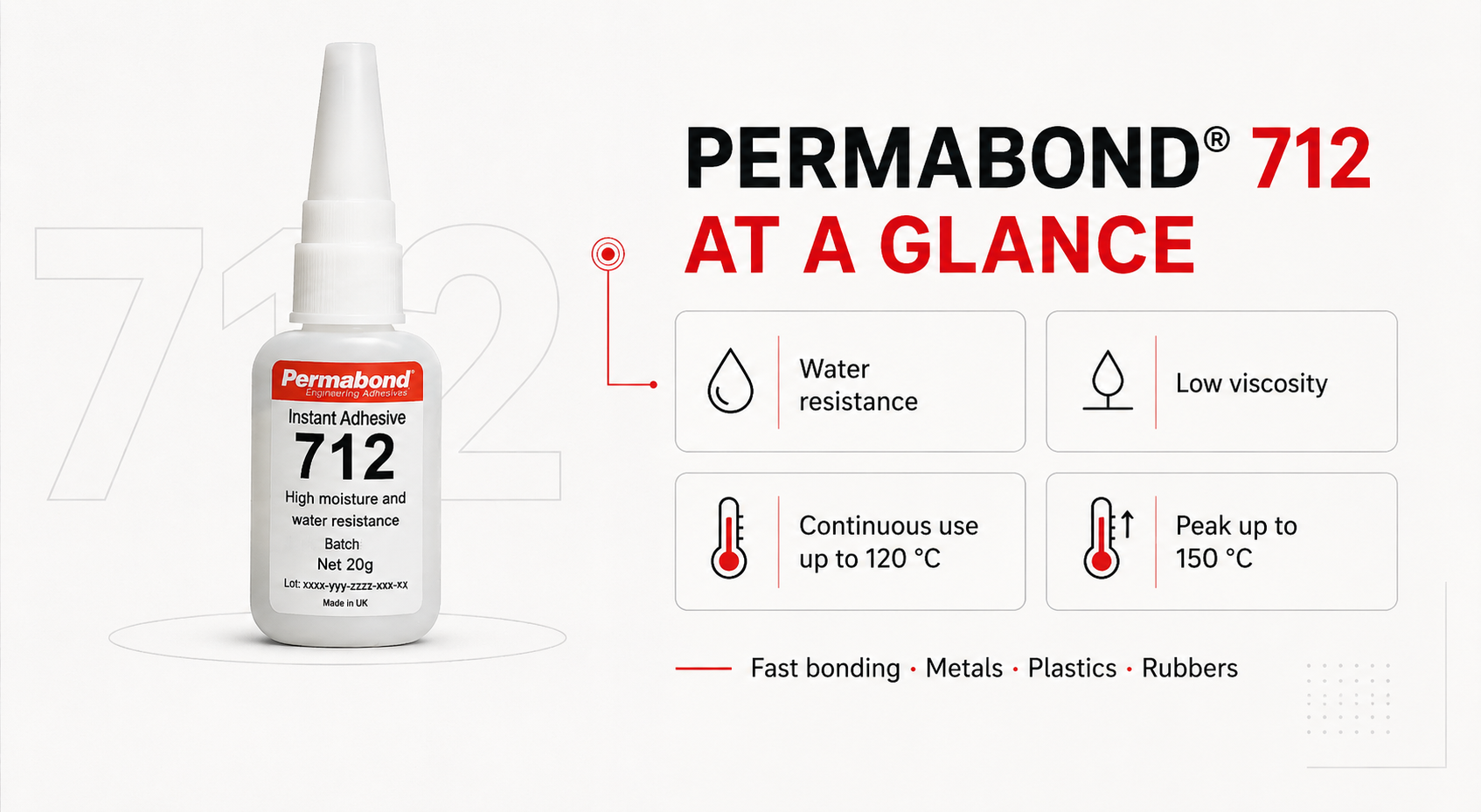
Its thermal resistance is another important benefit: the Technical Datasheet indicates that it is suitable for continuous use at temperatures up to 120°C, with short-term exposure up to 150°C.
This low-viscosity, solvent-free ethyl cyanoacrylate adhesive has been designed to provide excellent water resistance and performance in hot and wet environments. It bonds a wide variety of materials, including metals, plastics and rubbers, while retaining the ease of use expected from an instant adhesive.
At Samaro, a technical partner to industrial companies for their bonding applications, we consider this grade particularly relevant when the performance of a conventional cyanoacrylate adhesive may be limited by moisture or exposure to water.
Discover our full range of PERMABOND® cyanoacrylate adhesives
PERMABOND® offers several instant adhesive grades designed to meet different application requirements, including difficult-to-bond materials, variable bond gaps, water resistance, temperature resistance, flexibility and fixture speed.
Key takeaway
PERMABOND® 712 is a one-part, solvent-free, low-viscosity cyanoacrylate adhesive. Designed for assemblies exposed to water, moisture or hot and wet environments, it retains the main benefits of an instant adhesive: easy application, rapid fixture, no mixing and no heat curing. It is suitable for continuous use at temperatures up to 120°C, with short-term exposure up to 150°C.
Why PERMABOND® 712 stands out from conventional cyanoacrylate adhesives
Instant adhesives are commonly associated with fast, precise bonding and thin bond lines. They are well suited to close-fitting assemblies when the surfaces have been properly prepared and fixture is required within a few seconds.
Prolonged exposure to water or moisture can, however, be a limitation for some cyanoacrylate adhesives. In hot or wet environments, or in applications involving regular washing, the selection of a standard cyanoacrylate therefore requires particular attention.
PERMABOND® 712 was developed to address these conditions. Its value lies in the combination of three benefits that are not commonly found together in the same instant adhesive:
- Rapid fixture within a few seconds, depending on the materials.
- Excellent water resistance.
- Good performance in hot and wet environments.
It is therefore more than simply another grade in the product range. It is an adhesive designed for applications requiring both the speed of an instant adhesive and improved resistance to environmental exposure.
The main characteristics of PERMABOND® 712
PERMABOND® 712 is a transparent, low-viscosity ethyl cyanoacrylate adhesive. Its viscosity of 100 mPa·s at 25°C allows it to flow easily and makes it suitable for precise assemblies with small bond gaps.
As a 100% reactive, solvent-free adhesive, it requires no mixing or heat curing. This ease of use makes it a relevant option for industrial environments where cycle time, process repeatability and ease of application are key considerations.
| Characteristic | Technical data |
|---|---|
| Product type | Cyanoacrylate adhesive |
| Chemistry | Ethyl cyanoacrylate |
| Appearance | Transparent |
| Viscosity at 25°C | 100 mPa·s (cP) |
| Specific gravity | 1.1 |
| Maximum gap fill | 0.15 mm |
| Full strength | 24 hours |
| Continuous service temperature | Up to 120°C |
| Short-term peak temperature | Up to 150°C |
| Minimum exposure temperature | -55°C, depending on the materials being bonded |
| Storage temperature | 2 to 7°C |
These data summarise the product’s positioning: a technical instant adhesive designed for precise, close-fitting assemblies in environments where water, heat or moisture may become critical factors.
A cyanoacrylate adhesive designed to resist water, heat and moisture
Water resistance is the main distinguishing feature of this grade. According to the Technical Datasheet, bonded specimens on abraded mild steel retained 95% of their shear strength after 100 hours of immersion in water at 60°C and 75% after 1,000 hours at 60°C.
Its heat and moisture resistance further supports this positioning. After ageing for 170 hours at 85°C and 85% relative humidity, the bonded specimens retained 90% of their shear strength on abraded mild steel.
These results mean that PERMABOND® 712 may be considered for applications in which a standard instant adhesive might not be sufficient, particularly when the bonded assembly is exposed to moisture, washing, condensation or a hot environment.
Water resistance and sealing performance are two different concepts
One important point should be clarified: water resistance and sealing performance are not the same thing.
In this context, water resistance refers to the ability of the bonded joint to retain its mechanical performance after exposure to water or a humid environment under the test conditions defined in the Technical Datasheet.
It does not mean that the adhesive alone provides a completely watertight assembly or systematically prevents a liquid or gas from passing through the joint.
Sealing performance depends on several factors, including the joint design, the gap between the components, the continuity of the adhesive film, the materials, the pressure, the fluid and the temperature.
PERMABOND® 712 is first and foremost a cyanoacrylate adhesive intended for bonding. Its water resistance means that it may be considered for assemblies exposed to moisture or water, but this does not automatically mean that the assembly is watertight.
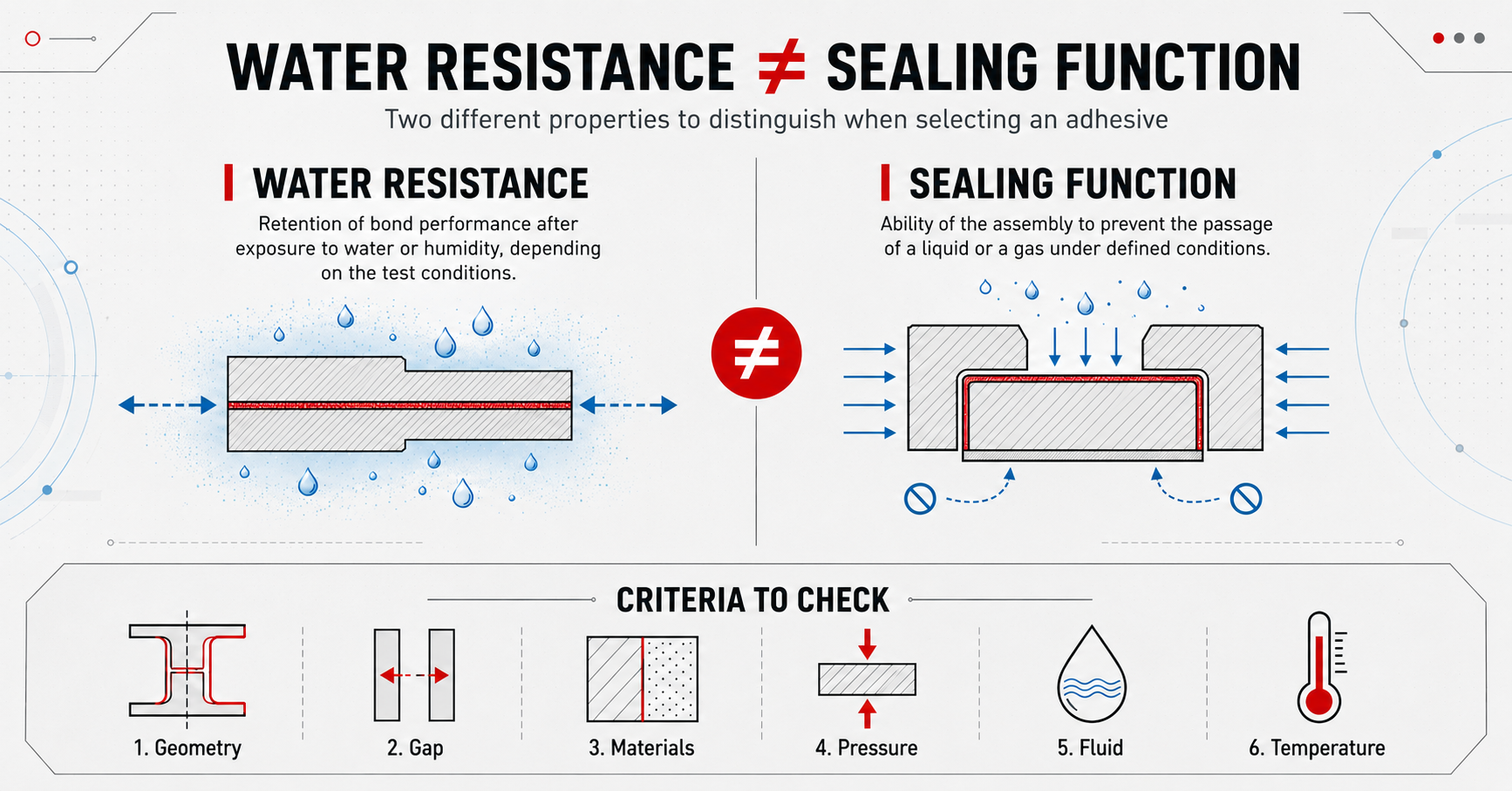
When the main purpose of the application is to prevent leakage or provide a seal against a liquid or gas, it is important to determine whether a dedicated sealing solution would be more appropriate.
In all cases, the selection must be confirmed against the actual operating conditions, materials, geometry, assembly requirements and application specifications.
Are you looking for a dedicated sealing solution?
Discover PERMABOND® solutions for industrial bonding and sealing, or contact Samaro’s experts to identify the technology best suited to your application.
Rapid fixture for industrial assemblies
PERMABOND® 712 retains one of the main advantages of cyanoacrylate adhesives: rapid curing. The fixture times stated in the Technical Datasheet vary according to the substrates and application conditions.
The following fixture times are provided as examples:
| Substrate | Fixture time |
|---|---|
| Buna N Rubber | 3 seconds |
| ABS | 10 seconds |
| EPDM | 10 seconds |
| PVC | 15 seconds |
| Aluminium | 15 seconds |
| Nylon 6 | 15 seconds |
| Nylon 6,6 | 20 seconds |
| Mild steel | 25 seconds |
These times may be affected by temperature, humidity, surface condition, the gap between the components and the chemical nature of the substrates. As with any instant adhesive, surface preparation remains critical.
In production, this rapid fixture may help reduce waiting times, simplify certain assembly operations and facilitate the bonding of small components or repetitive assemblies.
What materials can be bonded with PERMABOND® 712?
This adhesive provides high adhesion performance on a wide variety of substrates, including metals, plastics and rubbers.
The shear strength data in the Technical Datasheet notably cover gritblasted mild steel, gritblasted aluminium, polyamides such as Nylon 6 and Nylon 6,6, ABS, PVC and polycarbonate. Results vary depending on the level of surface preparation and the gap between the components, confirming the importance of preliminary testing before validation for production.
Rubbers are also a relevant target, particularly for seals and hoses exposed to moisture. PERMABOND® 712 may therefore be considered for applications involving sports equipment, household appliances and certain pump and valve components, subject to validation against the materials and operating conditions.
Typical applications: where can PERMABOND® 712 be used?
This industrial instant adhesive is particularly relevant when an assembly needs to combine rapid fixture, low viscosity and resistance to water or moisture.
Several applications are particularly worth considering:
- Seals, hoses and rubber components exposed to moisture.
- Pumps, valves and compressors incorporating small assemblies exposed to water or moisture.
- Plastic or metal components used in hot and wet environments.
- Sports equipment and accessories regularly exposed to water, including certain components intended for kayaks.
- Household appliances exposed to moisture, such as refrigerators, washing machines and tumble dryers.
- Small assemblies requiring rapid fixture and clean application.
Its value becomes particularly apparent when the application requirements involve more than rapid bonding alone, including exposure to water, moisture, temperature, different materials, thin joint geometries and long-term performance requirements.
Limitations to consider before selecting PERMABOND® 712
As with any technical adhesive, this product must be selected according to the actual application conditions and should not be presented as a universal solution.
Several points must be considered:
- The maximum gap fill is limited to 0.15 mm.
- Surfaces must be clean, dry and grease-free.
- The product is not recommended for use in contact with strong oxidizing materials or polar solvents.
- A cloudy appearance may develop within the joint when bonding certain transparent plastics.
- According to the Technical Datasheet, PERMABOND® 712 cannot be used with activators or primers such as PERMABOND CSA or PERMABOND Polyolefin Primer.
- The product must be stored between 2 and 7°C.
- The Technical Datasheet provides guideline information and does not constitute a specification.
These limitations do not reduce the value of the product. On the contrary, they help define its correct positioning: a solution to be evaluated for rapid, thin bond lines exposed to water or moisture, and to be validated using the customer’s actual materials and operating constraints.
Why choose PERMABOND® with Samaro?
PERMABOND® is an established manufacturer of technical adhesives for industrial applications. Its range includes several adhesive technologies, including cyanoacrylates, anaerobics, epoxies, acrylics, UV-curing adhesives and other technical bonding solutions.
With PERMABOND® 712, the manufacturer addresses a specific requirement: retaining the speed and ease of use of an instant adhesive while improving resistance in wet, hot or water-exposed environments.
Samaro supports industrial companies in identifying, qualifying and selecting bonding solutions suited to their application requirements. The objective is not simply to supply a product reference, but to help verify the essential parameters before selection:
- Materials to be bonded.
- Joint geometry.
- Gap between the components.
- Exposure to water or moisture.
- Service temperature.
- Mechanical stresses.
- Surface preparation.
- Production, storage and application requirements.
This approach combines PERMABOND® product expertise with Samaro’s technical support.
Application guidance
Reliable bonding starts with appropriate surface preparation. Surfaces must be clean, dry and free from oil, grease and other contaminants. Degreasing is therefore a priority step and must be adapted to the material and the type of contamination.
On certain metals, such as aluminium, copper and its alloys, light abrasion may improve surface preparation by removing the oxide layer.
Prepare surfaces using a suitable solution
Bonding quality is directly affected by the condition of the surfaces before the adhesive is applied. Traces of oil, grease, dust, release agents, oxidation and other contaminants may reduce adhesion and affect process repeatability.
Depending on the materials to be bonded and the nature of the contamination, a specific degreasing operation may therefore be required before applying the adhesive.
Samaro notably offers SOCOMORE DIESTONE DLS wipes for certain degreasing operations before bonding. Their suitability must be assessed according to the substrate, contamination and process conditions.
The surface preparation product must be validated according to:
- The material to be cleaned.
- The type of contamination.
- Compatibility with the substrate.
- The bonding process.
- Safety and environmental requirements.
- Production conditions.
A cleaning solution should not be selected solely because it visibly removes the contamination. It must also be compatible with the substrate and leave no residue that could interfere with adhesion.
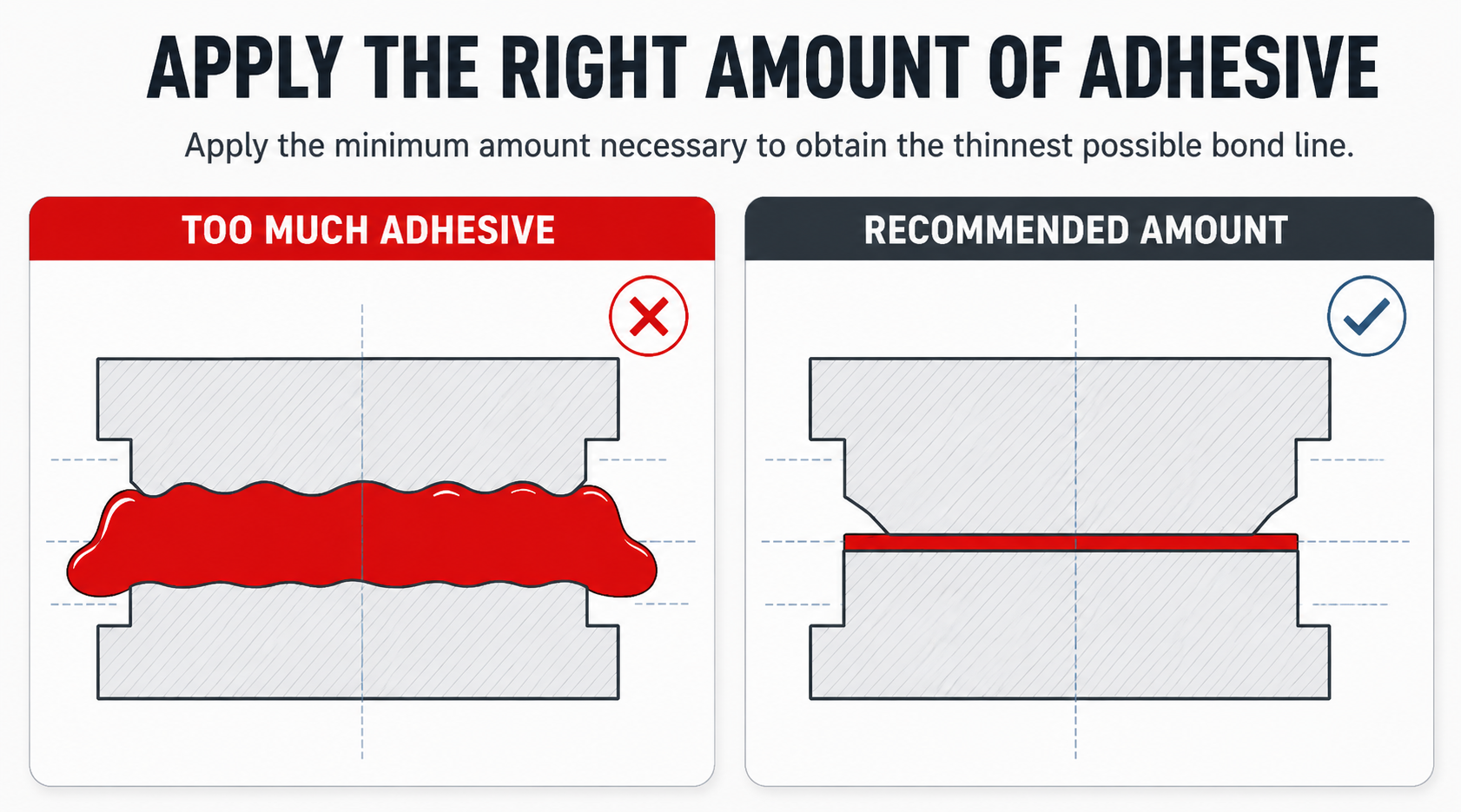
The application procedure is straightforward:
- Apply the minimum amount of adhesive required to one surface in order to obtain the thinnest possible film.
- Bring the components together quickly, ensuring that they are correctly aligned.
- Apply sufficient pressure to spread the adhesive into a thin film.
- Do not disturb or realign the components until sufficient strength has been achieved.
- Remove any excess adhesive using a suitable solvent, in accordance with the recommendations in the Technical Datasheet.
Testing under actual application conditions is recommended before the product is introduced into production.