



























MOLYKOTE® Anti-Friction Coatings in railway applications: when does dry lubrication make sense?
Railway equipment combines slow movements, oscillating contacts, high loads, vibration, dust and components that can be difficult to access once assembled. In some of these interfaces, a conventional grease or paste is not always the most practical lubrication approach. A dry, adherent lubricating film can provide a different way to control friction and wear.
MOLYKOTE® Anti-Friction Coatings (AFCs) are designed for this type of challenge. Once cured, they form a bonded dry film containing solid lubricants on the component surface. This makes them particularly relevant where lubricant migration, dust pick-up, stick-slip, heavy loading or pre-lubrication before assembly must be considered.
Three references illustrate how this technology can address different railway requirements: MOLYKOTE® D-321 R, MOLYKOTE® D-7409 and MOLYKOTE® 3400A Lead Free. The right choice depends not only on temperature, but also on movement, substrate preparation, environmental exposure and the curing process available.
Key takeaways
- MOLYKOTE® D-321 R is particularly useful when room-temperature curing is required, including maintenance or components that are difficult to bake.
- MOLYKOTE® D-7409 is designed for heavily loaded metal-to-metal contacts where wear and fretting resistance are key requirements.
- MOLYKOTE® 3400A Lead Free combines dry lubrication, strong adhesion to metal and corrosion protection.
- AFC selection is process-dependent: surface preparation, application method, coating thickness and curing conditions directly influence final performance.
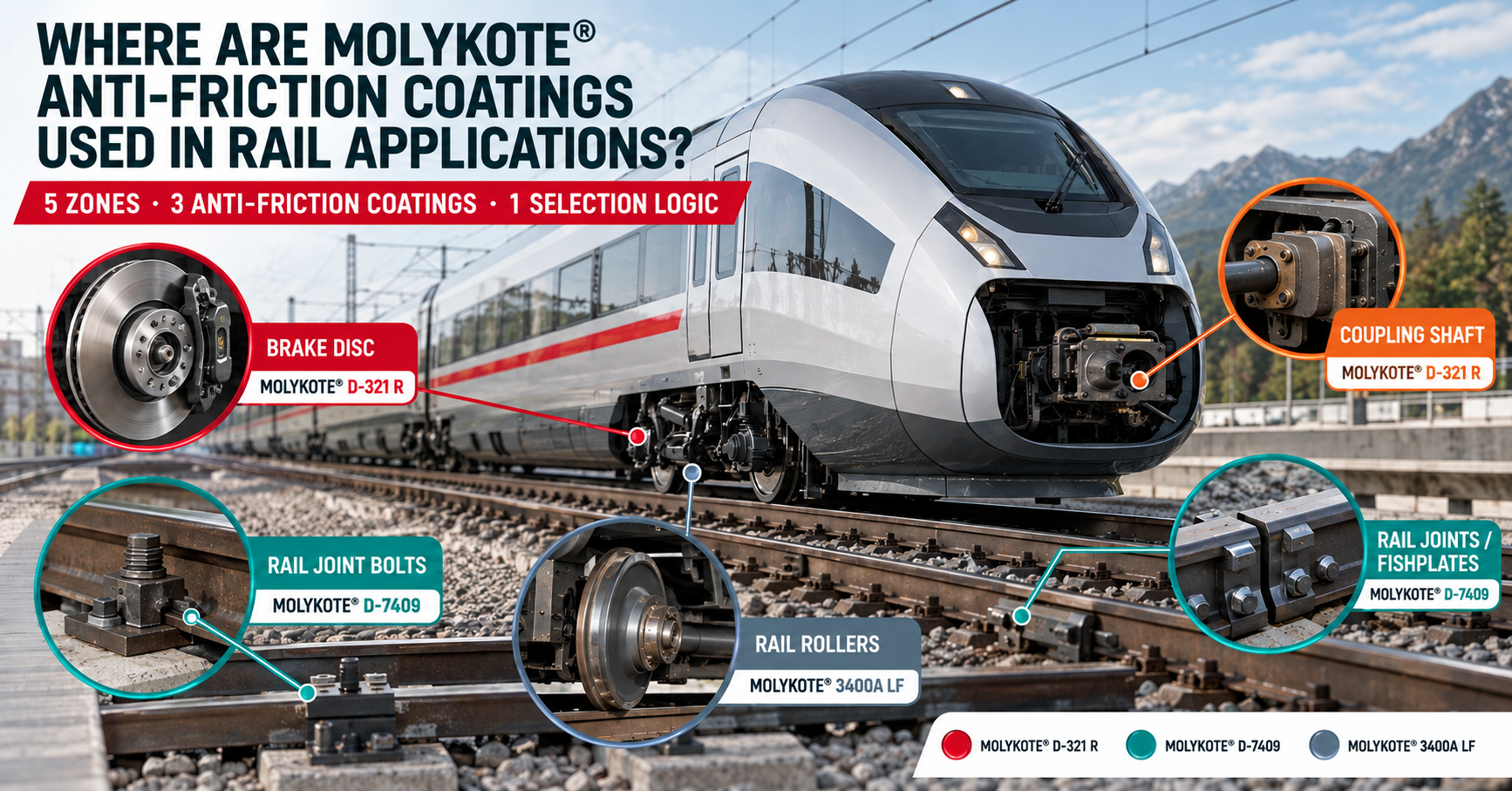
- Railway applications include brake-related assemblies, coupling parts, rail joints, rollers, slides and other highly loaded interfaces.
D-321 R, D-7409 or 3400A Lead Free: which MOLYKOTE® AFC should be considered?
| Reference | When to consider it first | Key differentiator | Railway examples |
| MOLYKOTE® D-321 R | Components difficult to bake; slow or oscillating motion; stick-slip issues. | Room-temperature curing; -180 to +450 °C; also available as an aerosol. | Brake disc assembly, rail joint bolts, coupling pins; heavily loaded hinges and slides. |
| MOLYKOTE® D-7409 | Heavily loaded metal-to-metal contacts that can be heat cured. | High load-carrying capacity; wear and fretting resistance; resistance to oils, greases and solvents; -70 to +300 °C. | Rail rollers and heavily loaded moving interfaces. |
| MOLYKOTE® 3400A Lead Free | Dry lubrication combined with strong metal adhesion and corrosion protection. | High load capacity, low friction and corrosion protection; -200 to +430 °C. | Rail joints, fishplates, rail rollers and selected control or braking fasteners. |
When can an AFC be more suitable than grease or paste?
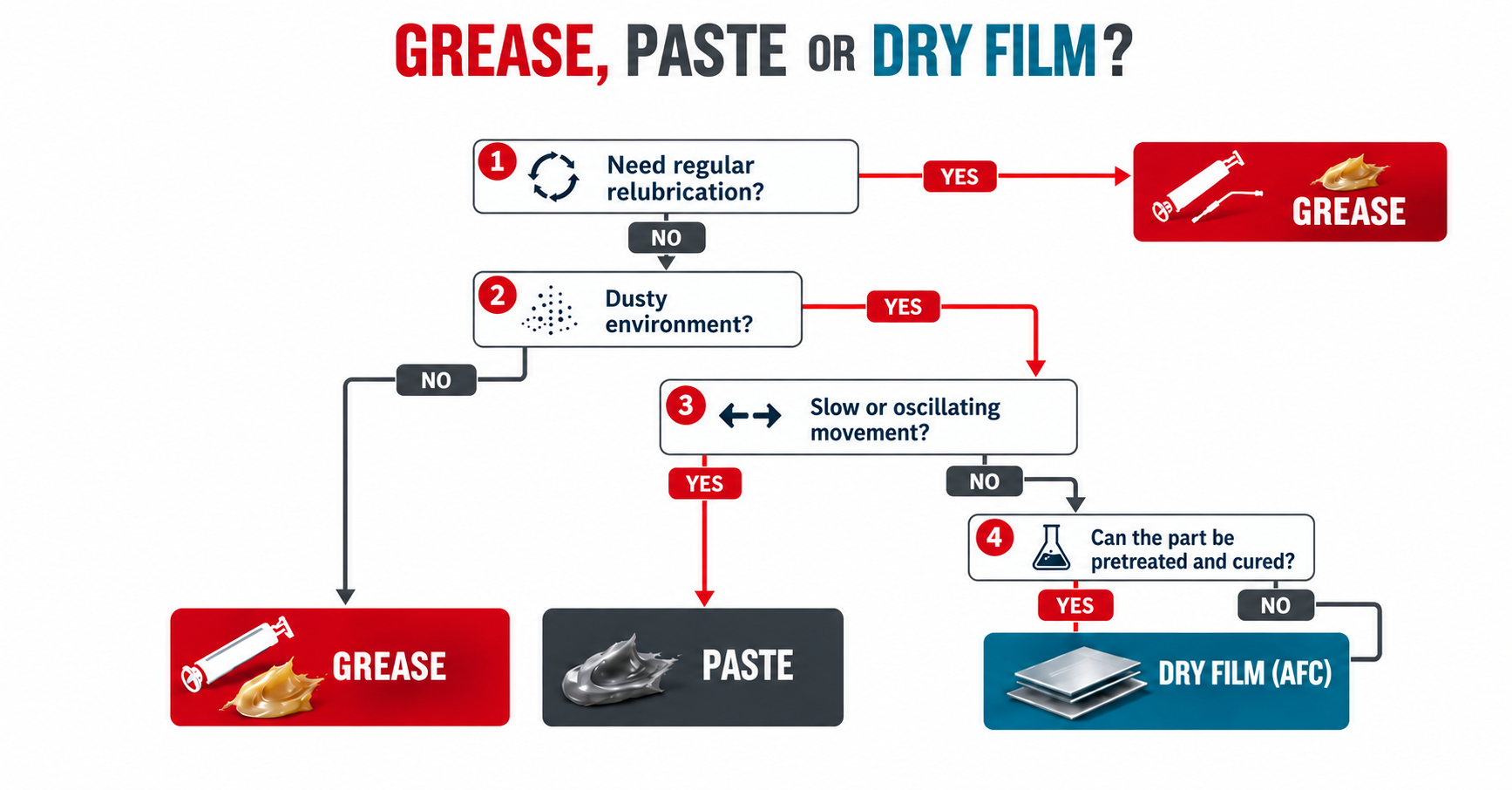
An AFC is not a universal replacement for grease or paste. Its value appears when the application benefits from a lubricant that remains as a dry film and does not flow or migrate away from the contact zone.
This can be important in dusty environments, where a tacky lubricant can retain contaminants. A dry film also helps when components must be lubricated before assembly and then remain difficult to access in service. For railway manufacturers, this can shift part of the lubrication work from field maintenance to a controlled production process.
Slow, short-stroke and oscillating movements are another relevant case. Under these conditions, a conventional fluid lubricant may not always maintain a stable separating film. Solid lubricants contained in the AFC remain bonded to the substrate and can help reduce direct surface interaction.
The difference between the three AFCs is also a process decision
MOLYKOTE® D-321 R: room-temperature curing for simpler implementation
MOLYKOTE® D-321 R cures at room temperature. This is its main process advantage in this selection. It can be considered when an oven is not available, when the assembled component is not suitable for heat curing or when maintenance work requires a simpler application route.
Its positioning is particularly relevant for slow and oscillating movements and for stick-slip control. This makes D-321 R a practical option when the lubrication requirement is closely linked to movement quality as well as wear reduction.
MOLYKOTE® D-7409: high-load contacts, wear and fretting
MOLYKOTE® D-7409 is heat cured, typically for 30 minutes at 220 °C. It is therefore better suited to components that can be coated and cured within a controlled industrial process.
In return, it offers a profile designed for heavily loaded metal-to-metal contacts, with resistance to wear and fretting as well as exposure to oils, greases, solvents and many chemicals. This combination can be valuable on components subjected to repeated micro-movements or highly loaded sliding contact.
MOLYKOTE® 3400A Lead Free: dry lubrication plus corrosion protection
MOLYKOTE® 3400A Lead Free is also heat cured, with a typical curing cycle of 30 minutes at 200 °C. It is particularly relevant where dry lubrication must be combined with strong adhesion to metal and corrosion protection.
This makes it worth considering on railway interfaces where the coating must contribute to both friction control and surface protection, including rail joints, fishplates or rollers exposed to demanding service conditions.
Surface preparation is part of AFC performance
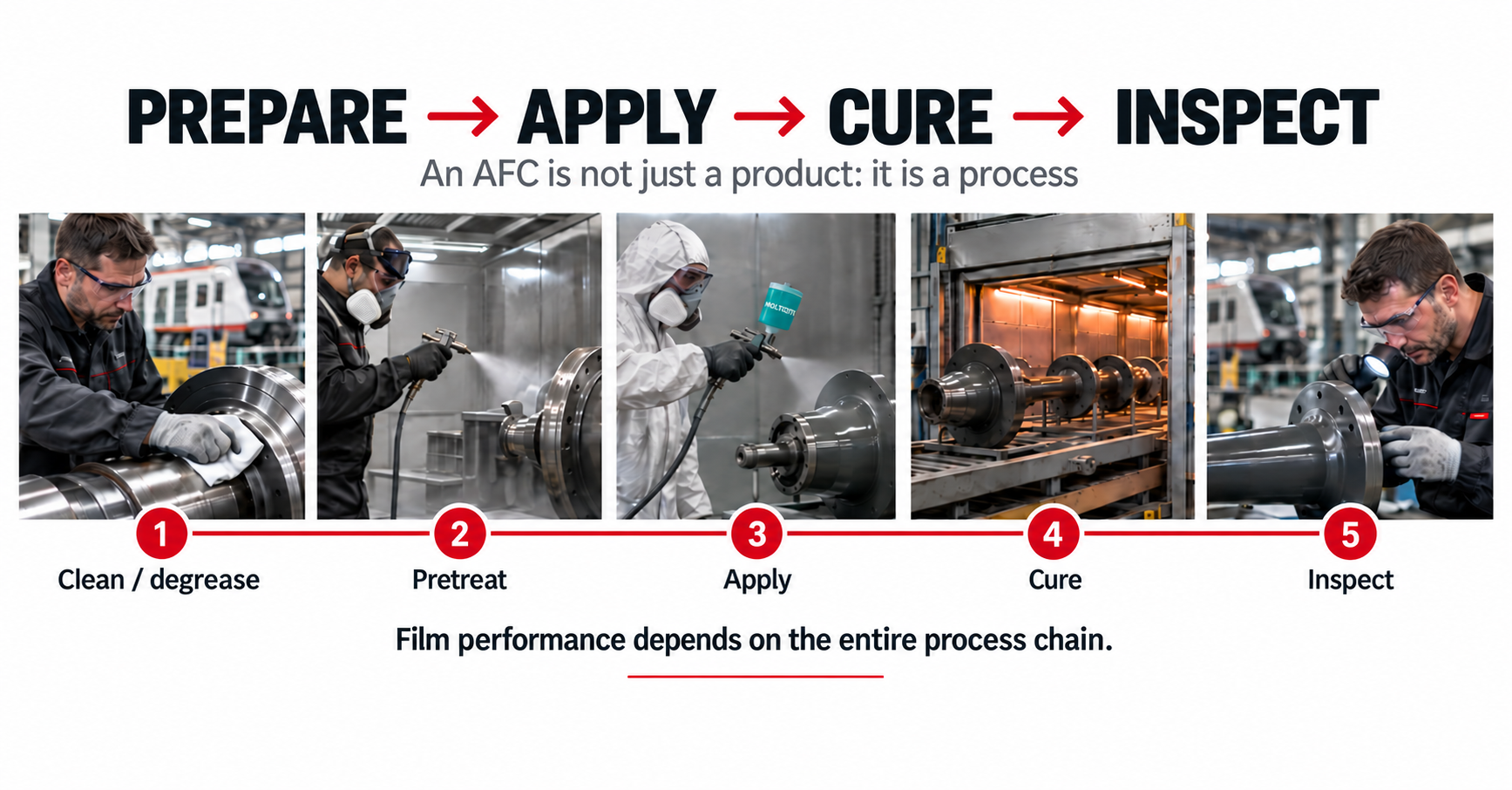
An Anti-Friction Coating works as a coating–substrate system. Degreasing, abrasive blasting, phosphating or another appropriate pretreatment can therefore influence adhesion and service life as much as the coating reference itself.
Qualification should cover the full chain: component material, surface condition, preparation method, application technique, dry-film thickness, curing cycle and actual operating conditions. A coating selected on temperature range alone may still be unsuitable if the substrate or production process cannot support the required preparation and curing.
Railway applications: start from the function, not only from the product
MOLYKOTE® railway documentation connects Anti-Friction Coatings with concrete component functions, including braking assemblies, rail joints, coupling parts and rail rollers. These examples are useful for a first shortlist, but the actual interface remains the deciding factor.
The same product can behave very differently depending on load, speed, oscillation amplitude, surface finish, contamination and curing quality. For this reason, railway AFC selection should begin with the function of the component and the production or maintenance process available.
When is an AFC not the right choice?
A dry coating is not automatically the best solution for every friction point. If a bearing requires continuous grease replenishment, if the part cannot be cleaned and prepared correctly, or if regular relubrication is an integral part of the design, another lubrication technology may be more appropriate.
This is why the most useful comparison is not simply AFC versus grease. It is a comparison between the lubrication function required by the component, the available process and the operating environment. MOLYKOTE® offers greases, pastes, oils and Anti-Friction Coatings precisely because different interfaces require different lubrication strategies.
MOLYKOTE® Anti-Friction Coatings for railway applications
Conclusion: choose the coating together with the component and the process
In railway applications, Anti-Friction Coatings provide a specific answer where a dry, durable and non-migrating lubricant is required. MOLYKOTE® D-321 R stands out for room-temperature curing, D-7409 for highly loaded contacts exposed to wear and fretting, and 3400A Lead Free for the combination of dry lubrication and corrosion protection.
The final choice should integrate substrate preparation, movement, load, environment and curing conditions. Treating the coating and the application process as one system is the most reliable way to build a relevant shortlist and prepare qualification testing.