


























Electronics protection in aerospace: which encapsulant, conformal coating or silicone solution should you choose?
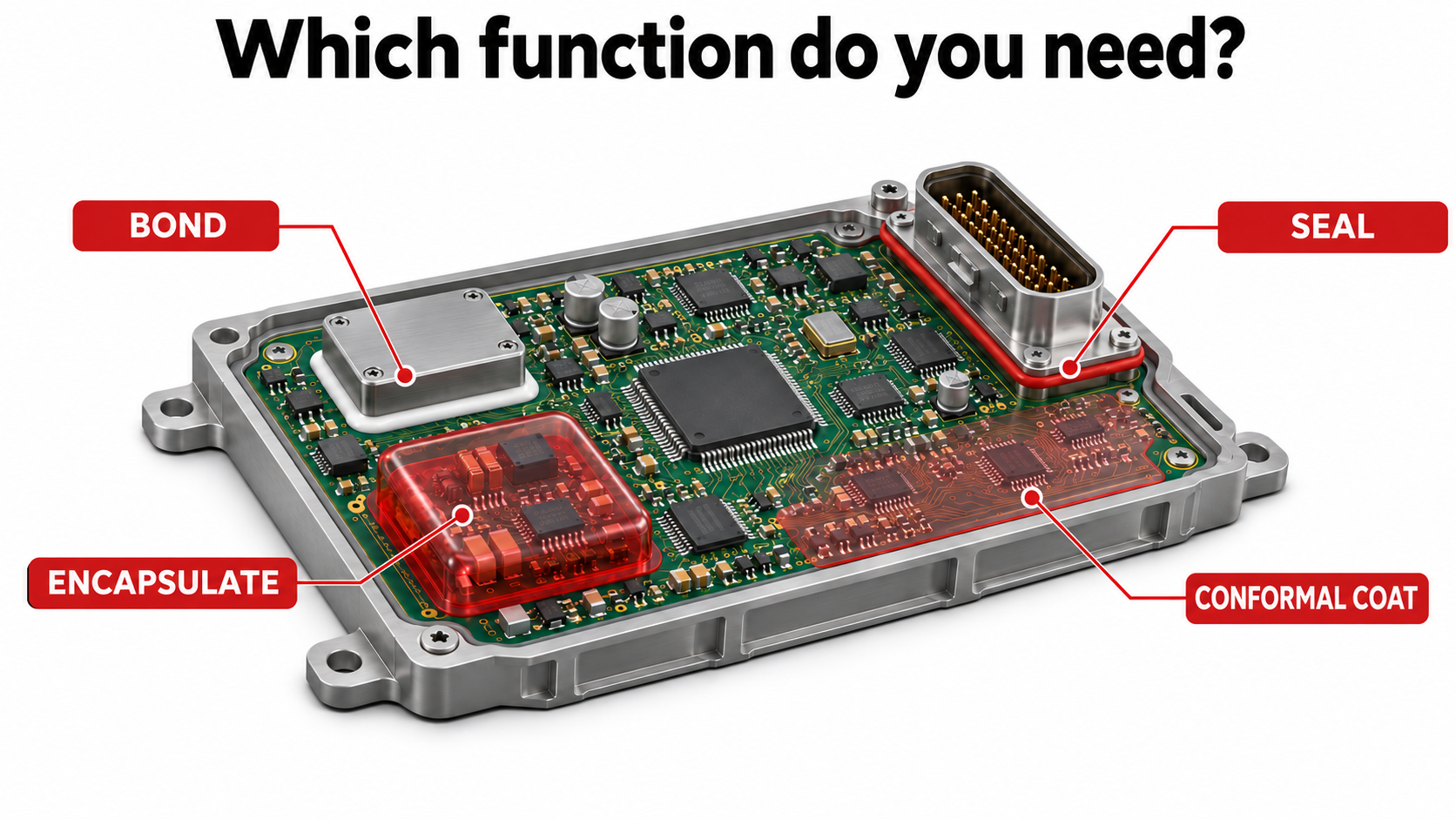
Protecting electronics in aerospace and avionics equipment is not a matter of choosing a single product. Depending on the area to be protected, it may be necessary to encapsulate a component, apply a conformal coating to a circuit board, seal an enclosure or secure a component with a suitable silicone.
The starting point is therefore the required function. Moisture, contaminants, vibration, temperatures, chemical exposure, dispensing processes and specifications then help determine which technology and product should be evaluated.
At Aeromart Toulouse 2026, Samaro is showcasing a range of DOWSIL™, SYLGARD™ and Electrolube solutions and launching its new Aerospace & Defence Selection Guide. Our team will be at MEETT in Toulouse from 1 to 3 December to discuss your applications, the products you currently use and your technical requirements.
Read also: Aeromart Toulouse 2026: how to choose specialty lubricants for aerospace applications.
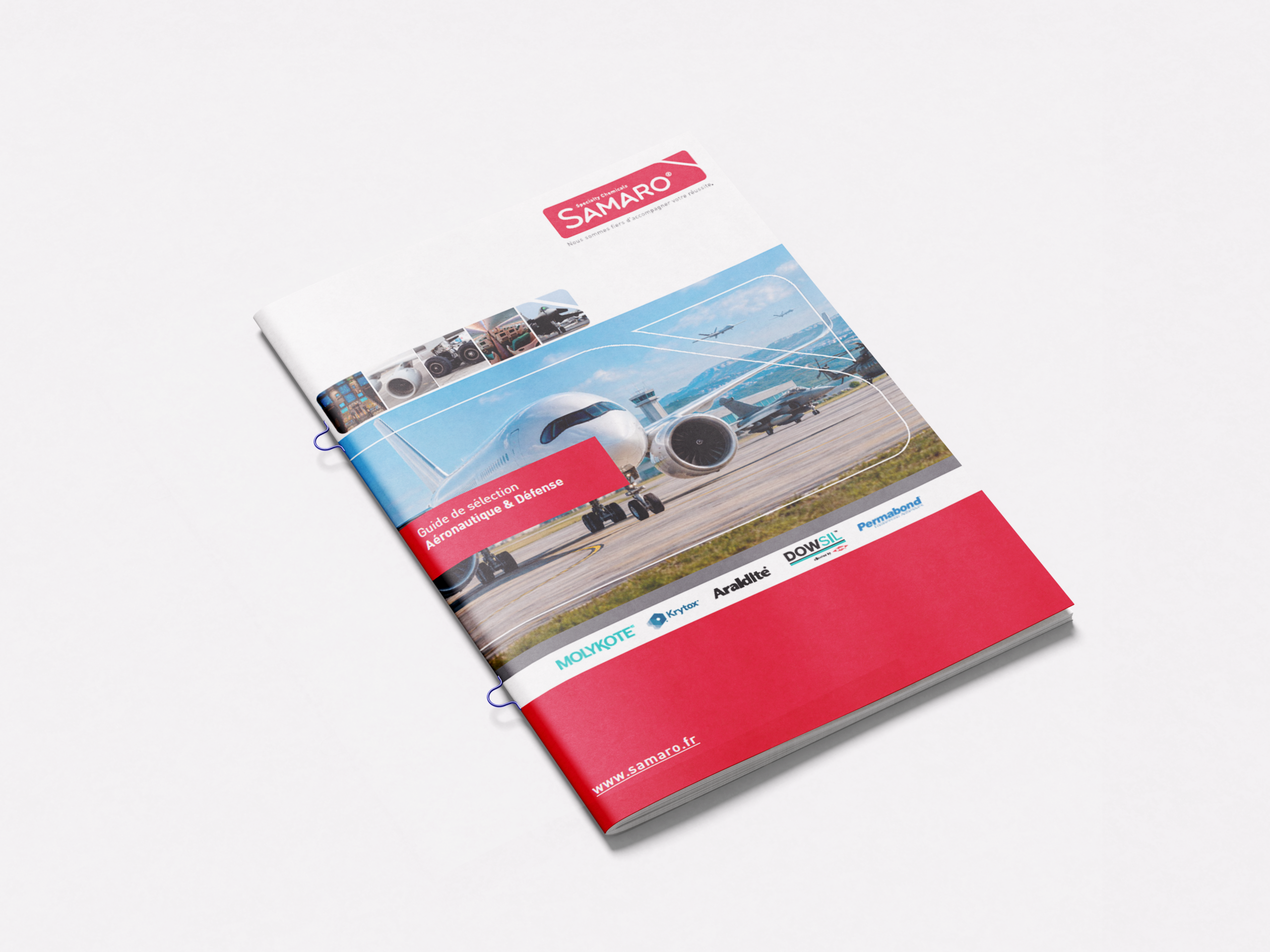
Explore the full range of solutions in our Aerospace & Defence Guide
The products featured in this article represent only part of the new Samaro Aerospace & Defence Selection Guide. It also covers specialty lubrication, bonding and sealing, composites, MRO (maintenance, repair and overhaul) and other electrical and electronics protection solutions. The guide is designed to facilitate initial product selection and prepare for a technical discussion based on the function, operating environment and application requirements.
Encapsulation or conformal coating: start with the required level of protection
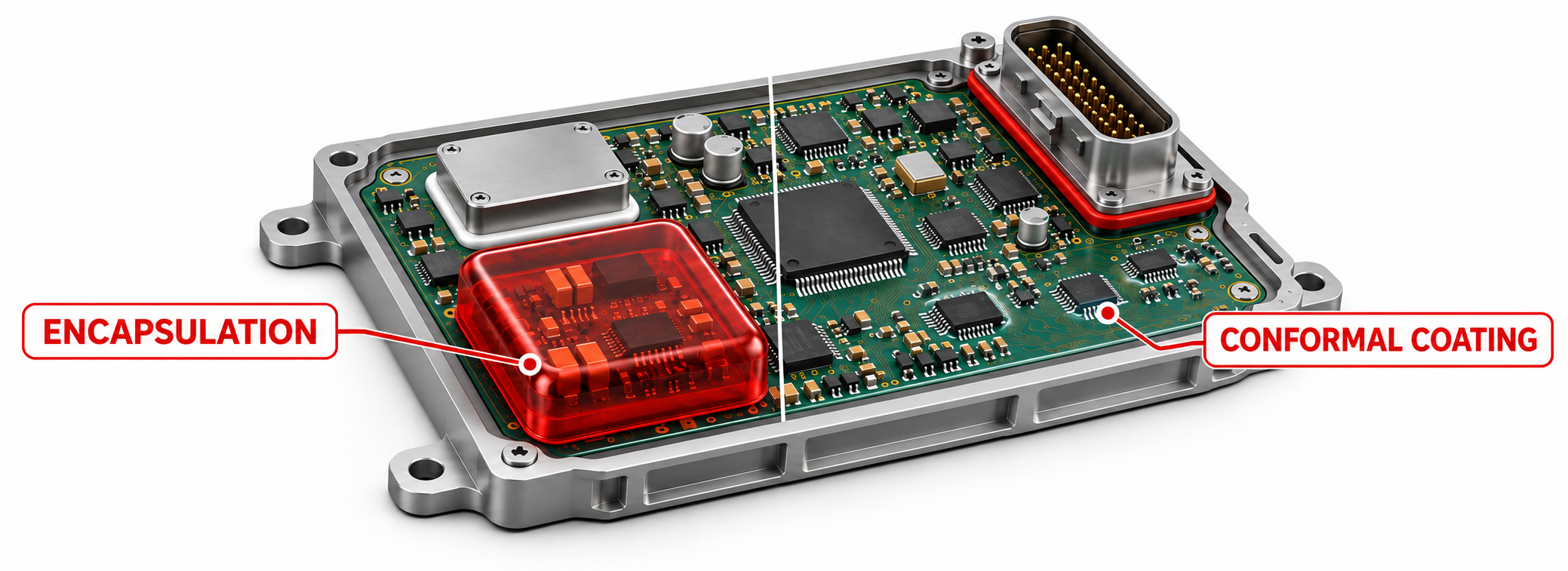
Both encapsulation and conformal coating are used to protect electronics, but they work in different ways. Encapsulation surrounds the component or subassembly with a greater volume of material. A conformal coating forms a much thinner protective layer over the circuit board and its components.
These technologies can help limit exposure to moisture and contaminants while taking into account the vibration and thermal stresses associated with the application. The required level of protection, board geometry, repairability requirements and processing conditions then guide the initial selection.
An encapsulant is not necessarily more suitable simply because it surrounds more of the electronics. Likewise, a conformal coating should not be selected solely because it forms a thinner layer. The function, operating environment and manufacturing process must be considered together.
When is encapsulation appropriate for aerospace applications?
When the surface protection provided by a conformal coating is insufficient, encapsulation allows sensitive components to be more fully surrounded by protective material. SYLGARD™ 170 FC is one option to consider for power supplies, sensors, connectors, transformers, amplifiers and relays. Depending on the application conditions, encapsulation can help enhance protection against moisture, contaminants and certain mechanical or thermal stresses.
SYLGARD™ 170 FC: a fast-curing encapsulant
SYLGARD™ 170 FC is a two-part, fast-curing silicone encapsulant. Its suitability depends as much on the manufacturing process as on the required level of protection: production throughput, time before handling, geometry of the volume to be filled and curing conditions are all factors to consider.
This product is associated with the MIL-PRF-23586 specification. For aerospace or defence applications, the exact commercial product designation and scope of the specification must be consistent with the programme requirements.
DOWSIL™ 93-500 Space Grade: when low outgassing is a selection criterion
In space environments, the selection criteria change. DOWSIL™ 93-500 Space Grade is an encapsulant intended for aerospace applications with low-outgassing requirements under thermal vacuum conditions.
However, this distinction must be made clear: ASTM E595 is a test method, not a blanket qualification. To learn more about total mass loss (TML), collected volatile condensable materials (CVCM) and the associated material selection criteria for space applications, read our dedicated article on low-outgassing silicones.
Further reading: Low-outgassing silicones: why material selection is critical in space applications.
Conformal coatings: how to choose the right protection for aerospace circuit boards
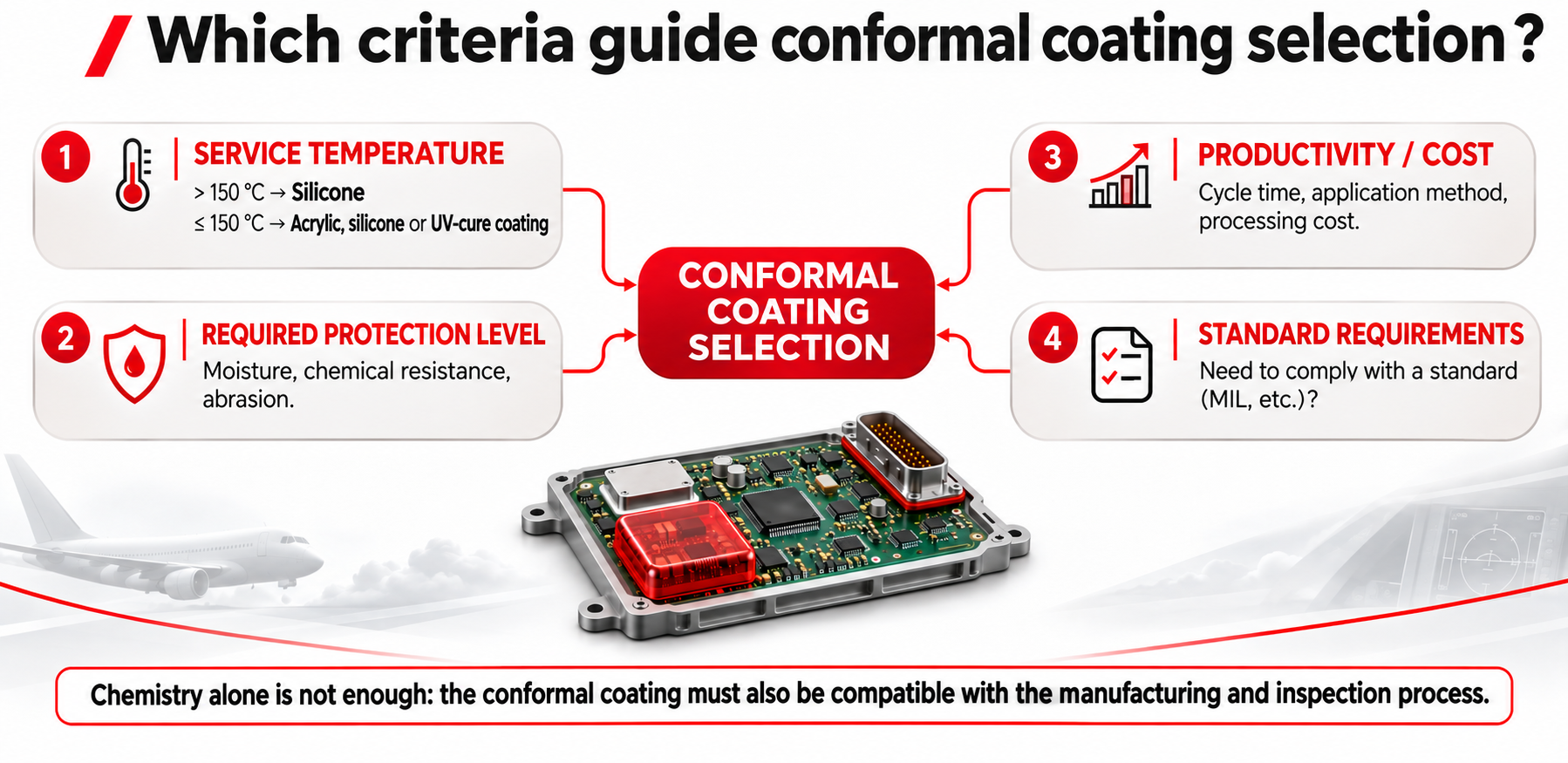
Where a thin protective layer is sufficient, conformal coating protects the circuit board without embedding it in a bulk resin. The first selection criterion is the operating temperature. Above approximately 150 °C, silicone conformal coatings are an initial option to evaluate. At lower temperatures, acrylic, silicone or UV-curable coatings may be considered, depending on the grade and application.
The next criterion is the required protection: resistance to moisture, chemical exposure or abrasion. Productivity and cost requirements come next, followed by a review of any mandatory standards and specifications, including military (MIL) specifications. This initial selection must then be confirmed against the exact product characteristics and qualifications.
DOWSIL™ 3-1944: when limited flow is required
DOWSIL™ 3-1944 is a high-viscosity silicone conformal coating suitable for applications where material flow needs to be limited. This behaviour helps control coating coverage on certain geometries. Its 100% solids, solvent-free formulation is another factor to consider in the manufacturing process.
DOWSIL™ 1-2577 and 1-2577 Low VOC: factoring in processing and VOC emissions
DOWSIL™ 1-2577 can be used on flexible or rigid circuit boards. Its UV fluorescent tracer facilitates coverage inspection after application. DOWSIL™ 1-2577 Low VOC follows the same approach, with a formulation designed to reduce volatile organic compound (VOC) content.
The choice also depends on shop-floor requirements: target viscosity, application method (spray coating, dip coating or selective coating), target film thickness and UV inspection. Health, safety and environmental (HSE) requirements related to solvent emissions, as well as drying or curing conditions, must also be taken into account.
Electrolube HPA and DCA: two distinct protection profiles
Electrolube HPA is a flexible, high-performance acrylic conformal coating with a UV fluorescent tracer. It is an option to consider where this chemistry meets the required level of protection and processing requirements.
Electrolube DCA offers a different protection profile, with high dielectric performance, fast drying and good chemical resistance.
OWSIL™ silicones for bonding and sealing: complementing electronics protection
Equipment protection does not always stop at the circuit board. An enclosure, interface, cable feedthrough or component may also require bonding or sealing. Several DOWSIL™ silicones offer different application characteristics for these requirements:
- DOWSIL™ 734: a flowable, acetoxy-cure silicone sealant for sealing applications.
- DOWSIL™ 3140: a self-levelling, neutral-cure silicone for sealing applications requiring good flow during application.
- DOWSIL™ 3145: a non-flow, neutral-cure silicone sealant for bonding and sealing applications requiring higher mechanical strength.
- DOWSIL™ 730 FS: a fluorosilicone to consider when resistance to hydrocarbons, solvents and chemical exposure is a key criterion.
For structural bonding and aerospace composite processing applications, also explore Huntsman ARALDITE® and EPOCAST® solutions.
Silicone primers: why surface preparation remains critical
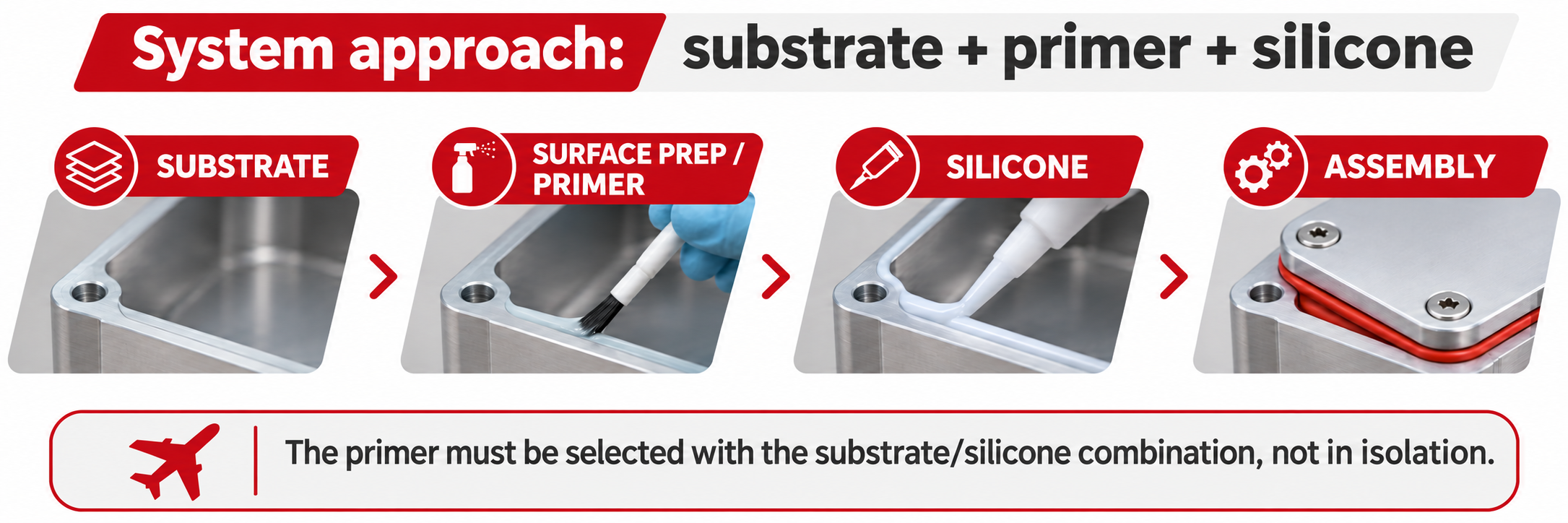
Even when the right silicone has been selected, final adhesion also depends on the substrate and how it is prepared. A primer can improve adhesion to certain materials or help reduce cure inhibition, depending on the cure chemistry.
DOWSIL™ 1200-OS is designed to improve the adhesion of RTV (room-temperature vulcanising) and heat-cure silicones to various substrates. DOWSIL™ 92-023 serves a different purpose: improving resistance to cure inhibition in two-part, addition-cure silicones.
A primer should therefore not be used by default. Its suitability must be validated in conjunction with the silicone, substrate, surface condition, cleaning process and curing mechanism.
Before choosing a product: what information helps identify a suitable solution?
An initial product selection is much more effective when the requirements are clearly defined. Before comparing products, the following information is particularly useful:
- The required function: encapsulation, conformal coating, bonding or sealing.
- The circuit board, component or assembly concerned, along with the main materials involved.
- Temperatures, humidity, contaminants and potential exposure to fuels, oils or solvents.
- Vibration, mechanical stresses and flexibility requirements.
- Dispensing method, production throughput, curing conditions and process-related HSE requirements.
- The applicable standard, OEM specification or product currently in use, if known.
This is also the most useful information to bring to a meeting at Aeromart Toulouse 2026. Details of an existing product, a technical data sheet, a drawing, a specification or an accurate description of the operating environment can help identify suitable options more quickly.