
























PFAS-free industrial lubricant: how to choose an alternative suited to your application?
The search for PFAS-free industrial lubricants is progressing across many industrial sites. HSE, maintenance, methods and purchasing teams need to anticipate changing regulatory requirements, respond to more specific customer requests and reduce the use of fluorinated substances where relevant alternatives exist. In this context, Samaro relies on its partnership with MOLYKOTE® to support manufacturers in identifying lubrication solutions suited to their real applications.
However, replacing a grease, an assembly paste or a lubricant containing PTFE should not simply mean looking for a “PFAS-free” statement. The choice must remain application-driven: load, speed, temperature, environment, materials, type of contact, maintenance frequency and cleanliness or hygiene requirements.
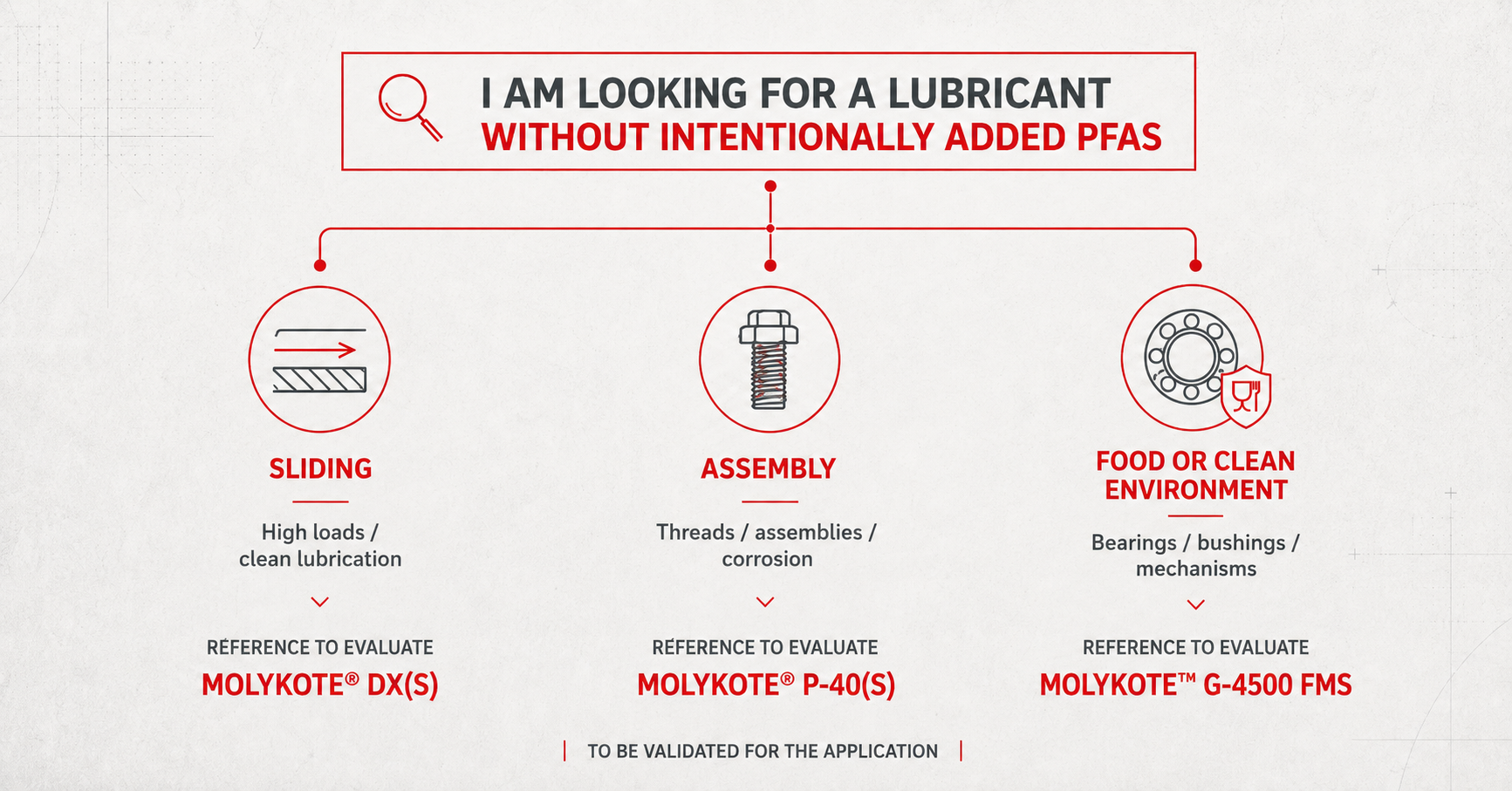
Within the MOLYKOTE® range, three references can be considered to support this transition: MOLYKOTE® DX(S), MOLYKOTE® P-40(S) and MOLYKOTE™ G-4500 FMS. Each addresses different constraints. The challenge is therefore less about choosing “a PFAS-free lubricant” than identifying, with Samaro’s technical support, the solution compatible with your real use case.
Key takeaways
- In product documentation, “PFAS-free” should be understood as “no intentional use of PTFE or PFAS-type substances”, not as an absolute guarantee of absence of traces or compliance with all future requirements.
- The choice of a PFAS-free lubricant must start with the application: load, speed, temperature, materials, environment, type of contact and application method.
- For lubricating pastes, MOLYKOTE® DX(S) and MOLYKOTE® P-40(S) address different needs. MOLYKOTE® DX(S) should be considered for sliding contacts subjected to high loads, where clean lubrication is required. MOLYKOTE® P-40(S) should be considered for assemblies, threaded connections, corrosive environments or assembly / disassembly operations.
- For grease applications, MOLYKOTE™ G-4500 FMS should be considered for bearings, plain bearings and mechanisms in food-processing or clean environments, subject to validation of the applicable requirements.
- These three references are not interchangeable: they must be preselected according to the expected function, then validated against the technical data sheets, SDS, real application conditions and the necessary tests
Why look for a PFAS-free industrial lubricant today?
PFAS are a broad family of per- and polyfluoroalkyl substances. They are monitored because of their environmental persistence and are subject to regulatory work in Europe, notably under REACH. For manufacturers, this context can lead to substitution requests, customer questionnaires, HSE reviews, supplier audits or stricter purchasing requirements.
In industrial lubricants, the question arises in particular when the historical formulation uses PTFE or other fluorinated substances to meet friction, stability or durability requirements. Alternatives with no intentionally added PFAS can open up a substitution route, but they must be validated on a case-by-case basis.
The right approach is therefore to combine two dimensions: on the one hand, the HSE or regulatory objective; on the other, the technical function that the lubricant must continue to perform. An unqualified substitution can create a mismatch between the selected solution and the expected behaviour in the field.
What does “PFAS-free” mean for a grease or lubricating paste?
For the MOLYKOTE® references presented here, the wording to retain is cautious: the technical data sheets indicate no intentional use of PTFE and PFAS-type substances. This clarification is important because it avoids turning a formulation statement into an absolute regulatory promise.
In an industrial selection process, this statement must be supplemented by a review of the technical data sheet, the SDS, any supplier declarations and the site’s internal requirements. Depending on the sector, the notion of “PFAS-free” may also be interpreted differently in specifications, audits or customer standards.
Before choosing a reference: which lubrication constraint do you need to address?
A PFAS-free lubricant should not be selected solely on the basis of its formulation. It must fulfil a specific function: reduce friction, facilitate assembly, prevent seizure, protect against corrosion, support slow movement, withstand high load, remain clean or meet hygiene requirements.
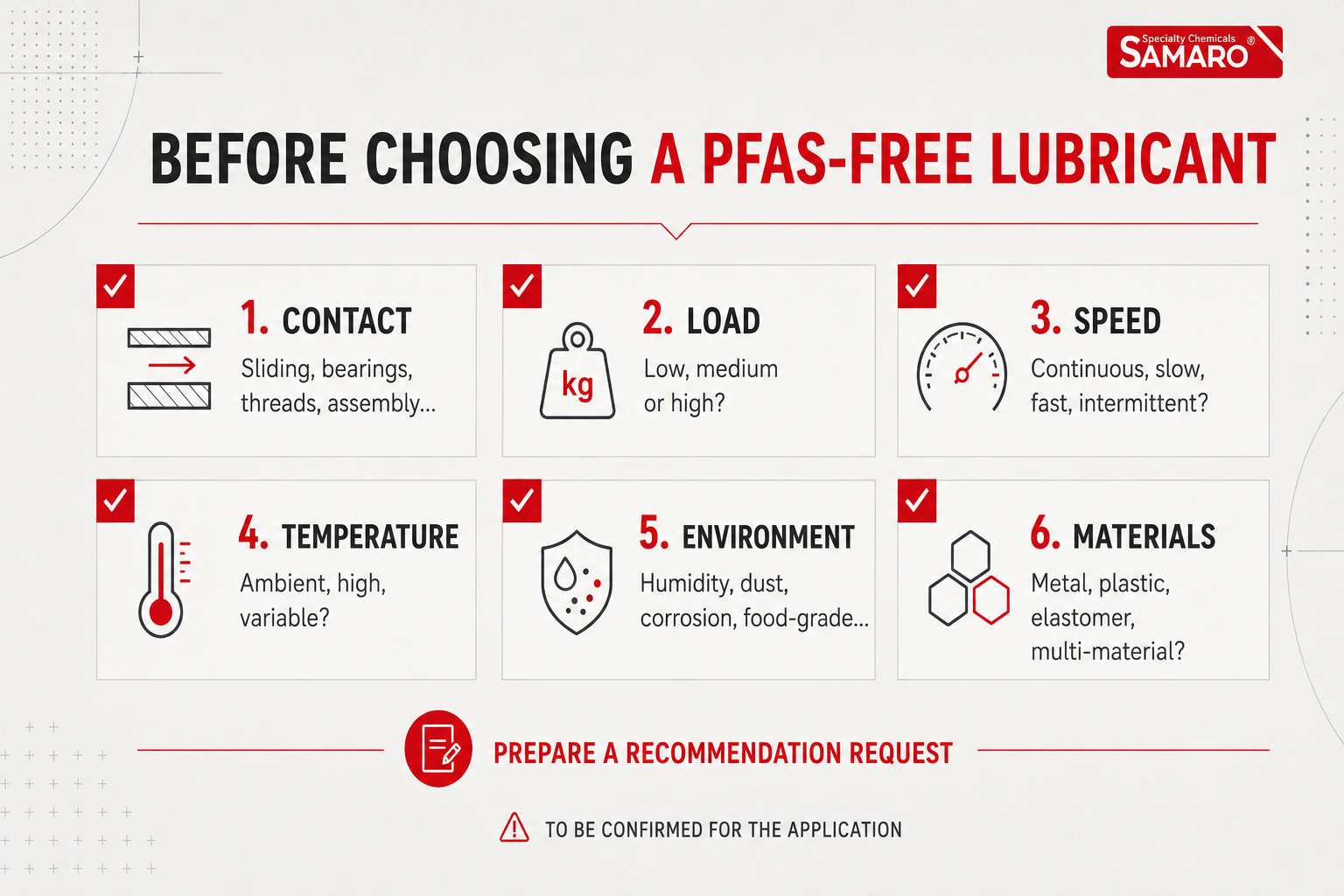
Before comparing references, it is useful to qualify the application with a few simple questions:
- Is the contact a sliding contact, rolling contact, thread, hinge, cam, slideway or gear?
- Does the part operate in continuous motion, slow motion or mainly during assembly / disassembly?
- What are the levels of load, contact pressure, vibration or shock?
- What temperature range must be covered?
- Is the environment humid, washed, corrosive, dusty, food-processing related or sensitive to contamination?
- Does the lubricant need to remain visible, clean, non-staining or compatible with certain plastics and elastomers?
- Is the replacement being carried out on an already validated application, with a maintenance history and requalification constraints?
MOLYKOTE® DX(S), P-40(S), G-4500 FMS: what are the differences in use?
The three references do not address the same need. They should be presented as options to be considered according to the application, not as interchangeable products.
MOLYKOTE® DX(S): sliding, high loads and clean lubrication
MOLYKOTE® DX(S) is a light-coloured grease paste with solid lubricants, designed for the assembly and long-term lubrication of metal components. It is particularly relevant for sliding surfaces and friction contacts subjected to high loads, especially at low or medium speed.
It can be considered for slideways, guides, cams, hinges, threaded spindles or mechanisms requiring clean lubrication, with good water resistance and protection against stick-slip, seizure, galling and corrosion. Its documented service temperature range is -25 °C to +125 °C.
MOLYKOTE® P-40(S): assembly, threaded assemblies and difficult environments
MOLYKOTE® P-40(S) is a metal-free adhesive lubricating paste intended for assembly operations and continuous lubrication. It can be considered for threaded connections, spline shafts, bearing mounting, cams, bearings, open gears or marine applications.
It provides good adhesion, corrosion protection, good water resistance and anti-fretting properties. Its technical data sheet mentions a service range of -40 °C to +121 °C as a paste, and up to +1093 °C for the solid lubricants after evaporation of the carrier. The technical data sheet also specifies that it must not be mixed with greases or oils.
MOLYKOTE™ G-4500 FMS: synthetic grease for food-processing or clean environments
MOLYKOTE™ G-4500 FMS is a white synthetic grease, thickened with an aluminum complex and based on PAO oil. It is designed for multipurpose use and meets FDA 21 CFR 178.3570 and NSF H1 classifications for incidental food contact.
It can be considered for rolling-element bearings, plain bearings, pivot pins, cams, guides, drive screws, gears, splines and other machine elements. Its documented service temperature range is -40 °C to +150 °C. Its compatibility with many plastics and elastomers can be useful in environments where the lubricant choice must not degrade the materials in contact.
Selection support table
| Main need | Reference to consider | Why | To validate |
| Metal sliding, high load, low or medium speed | MOLYKOTE® DX(S) | Light-coloured grease paste with solid lubricants, suitable for friction contacts subjected to high loads. | Pressure, speed, temperature, application method, expected cleanliness. |
| Screwed assembly, thread, spline shaft, bearing mounting | MOLYKOTE® P-40(S) | Metal-free adhesive assembly paste, designed for assembly, corrosion, humidity and difficult environments. | Tightening torque, material, environment, prior cleaning, absence of mixing with other greases or oils. |
| Rolling-element bearings, plain bearings, mechanisms in food-processing or clean environments | MOLYKOTE™ G-4500 FMS | White PAO synthetic grease, NSF H1 / FDA 21 CFR 178.3570 for incidental food contact. | Site requirements, compatibility with plastics / elastomers, temperature, maintenance frequency. |
| General search for an alternative to a fluorinated product | To be defined with Samaro | Substitution depends on the function of the historical lubricant, not only on the presence or absence of PFAS. | Current technical data sheet, SDS, conditions of use, comparative tests. |
How to compare a PFAS-free solution before testing?
A serious comparison must go beyond the single criterion “with or without PFAS”. To prepare a reliable selection, it is better to compare references based on application criteria.
| Criterion | Question to ask | Why it matters |
| Temperature | What minimum and maximum temperature does the contact area reach? | A suitable range avoids selecting a solution outside its service conditions. |
| Load and pressure | Does the contact withstand high load or shock? | Friction and wear behaviour strongly depend on load. |
| Speed / movement | Is the movement slow, intermittent or continuous? | A product that works for assembly may not be suitable for fast continuous lubrication. |
| Environment | Humidity, washing, corrosion, dust, food-processing environment, cleanliness? | The environment may become the dominant selection criterion. |
| Materials | Metal, plastic, elastomer, mixed assembly? | Material compatibility must be checked, especially with plastics and rubbers. |
| Maintenance | What relubrication interval is expected? | A substitution must take into account the actual maintenance rhythm. |
| Documentation | SDS, TDS, supplier declaration, customer constraints? | The choice must be validated using up-to-date documents and internal requirements. |
Points to watch before replacement or validation
The transition to a solution with no intentionally added PFAS must remain controlled. A reference may be relevant on paper, but still require testing to verify its behaviour on the parts, with the real process and in the final environment.
- Do not consider the three references as interchangeable: they fulfil different functions.
- Do not claim equivalence with a fluorinated lubricant without a test report or application validation.
- Do not present “PFAS-free” as an absolute regulatory guarantee.
- Check the SDS and precautions for use before any implementation.
- Check compatibility with materials, especially plastics, elastomers and coatings.
- When replacing an existing product, check substrate cleanliness, residues, tightening torques and the impact on maintenance.
- For food-processing applications, distinguish between incidental food contact, internal site requirements and the customer’s documentation obligations.
What information should you prepare before contacting Samaro?
To obtain a useful recommendation, it is preferable to share a few details from the first exchange. This helps the Samaro team and Manon Marty, Specialty Lubricants expert, identify the relevant MOLYKOTE® families, check the documentation points to watch and prepare a test approach consistent with your specification.
- Current reference used, if any, with available TDS and SDS.
- Reason for the search: customer requirement, HSE audit, PFAS substitution, maintenance improvement, product availability.
- Type of contact: sliding, rolling, thread, gear, cam, shaft, hinge, chain, guide.
- Materials in contact and possible presence of plastics, elastomers or coatings.
- Minimum / maximum temperatures and exposure time.
- Load, speed, vibration, shock, humidity, corrosion, washing or food-processing environment.
- Application method: brush, cloth, gun, grease gun, automated system or aerosol.
- Success criteria: noise reduction, easier disassembly, relubrication interval, cleanliness, documentation compliance, internal tests.
Conclusion
The transition to an industrial lubricant with no intentionally added PFAS should not be treated as a simple label change. It requires going back to the lubricant’s function, the constraints of the contact and the validation requirements.
MOLYKOTE® DX(S), MOLYKOTE® P-40(S) and MOLYKOTE™ G-4500 FMS offer three different routes to consider depending on the applications. Samaro supports you in comparing these solutions, checking the technical documents and preparing the necessary tests before validation.