































MOLYKOTE® P-3300: a versatile PTFE-free anti-seize paste with an SDS containing no hazard pictogram
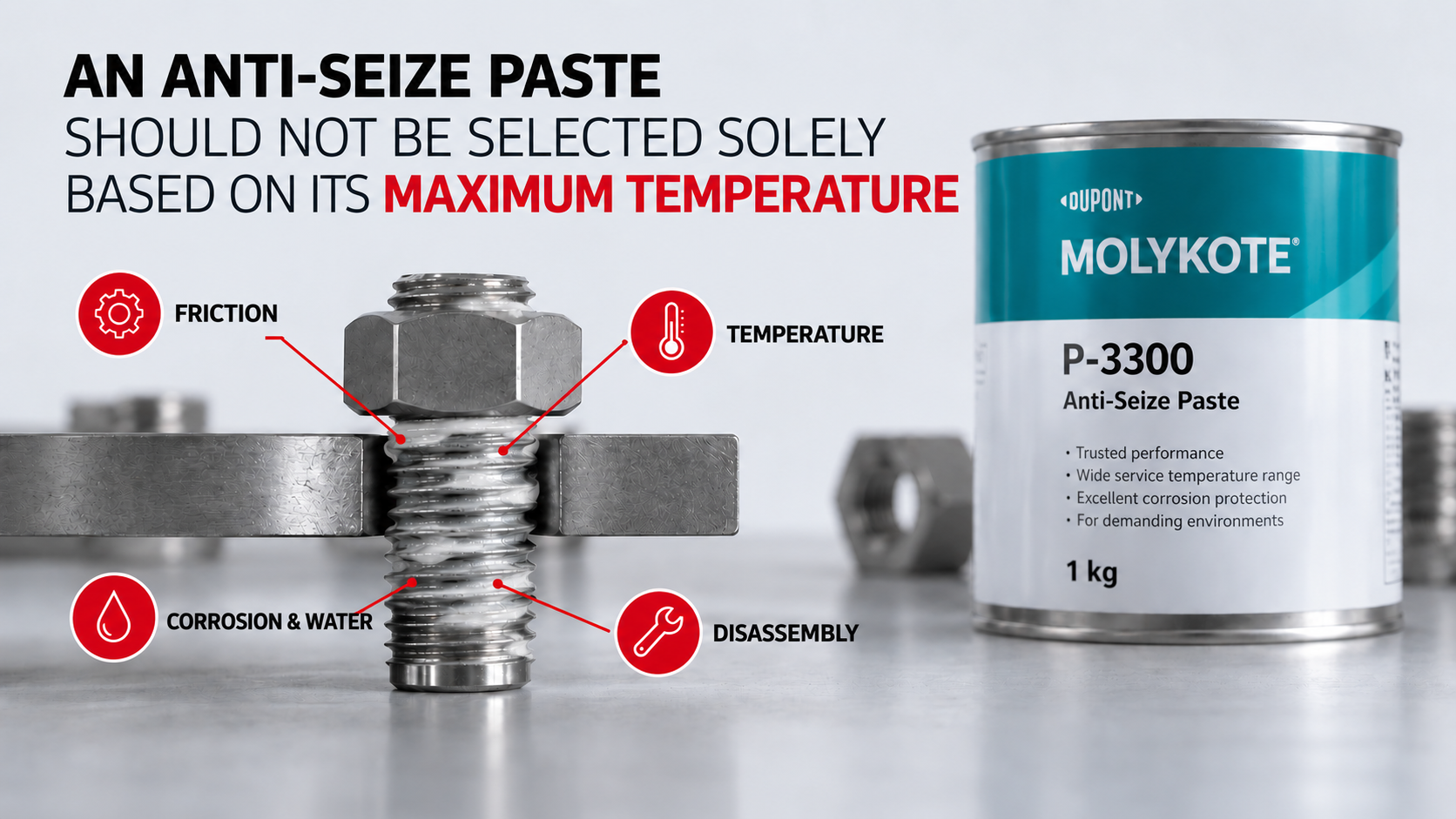
For a threaded assembly exposed to heat, performance is not limited to preventing seizure. Friction during tightening must also be controlled, disassembly must remain possible, the threads must be protected against water and corrosion, and the HSE requirements associated with the lubricant formulation must be taken into account.
As a MOLYKOTE® brand partner in France, Samaro supports maintenance, engineering and design teams in selecting lubricants for threaded assemblies. MOLYKOTE® P-3300 stands out for its versatility: a service temperature range of -30 °C to +540 °C, defined and consistent friction, good resistance to water and corrosion, documented performance on different types of fasteners, and manual or automated application.
For end users, its HSE profile is a major advantage: the current French SDS carries no hazard pictogram, no hazard statement (H statement) and no precautionary statement (P statement). P-3300 is also formulated with no intentionally added calcium, PTFE or per- and polyfluoroalkyl substances (PFAS). This development is part of a broader evolution within the MOLYKOTE® range, including P-3700 and P-1042 for other temperature, load and environmental requirements.
Key takeaways
- Current SDS with no hazard pictogram, no hazard statement (H statement) and no precautionary statement (P statement): a tangible benefit for users and HSE initiatives.
- No intentionally added calcium, PTFE or per- and polyfluoroalkyl substances (PFAS).
- Versatile paste for threaded assemblies: defined and consistent friction, a service temperature range of -30 °C to +540 °C, and documented performance on different types of fasteners.
- Good resistance to water and corrosion, while maintaining the anti-seize function to facilitate disassembly after heat exposure.
- Application by brush, spatula or grease gun, with the option of integration into an automated dispensing process.
- Within the same range, MOLYKOTE® P-3700 extends this approach to very high temperatures, while MOLYKOTE® P-1042 is more specifically aimed at highly loaded metal-to-metal contacts exposed to water or machining emulsions.
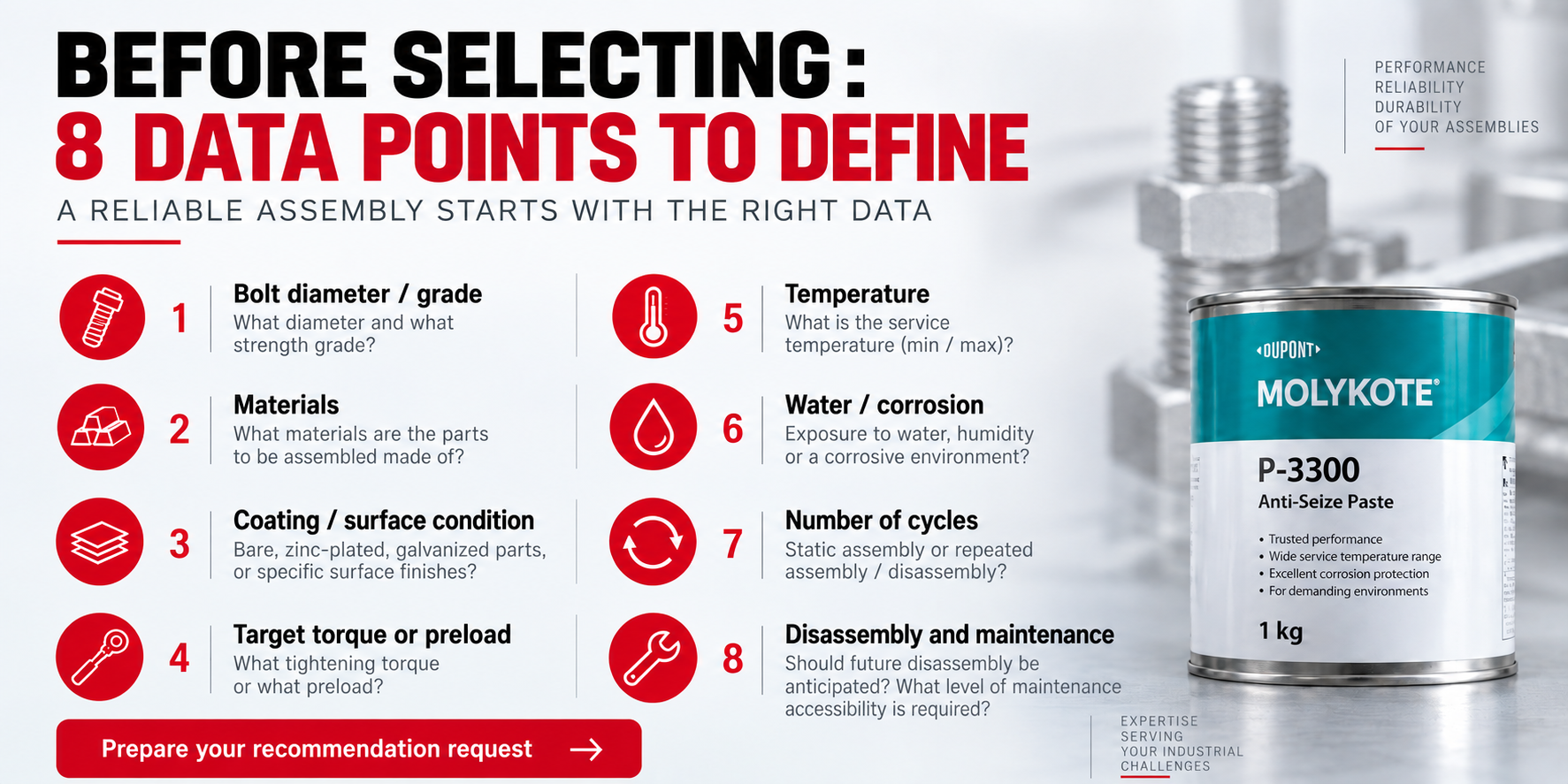
- Final selection must take into account the fasteners, surface condition, tightening method, actual temperature, environment and maintenance strategy.
KEY POINT – For users, the difference is immediately visible on the MOLYKOTE® P-3300 SDS: no hazard pictogram, no hazard statement (H statement) and no precautionary statement (P statement). This low-hazard profile is combined with a formulation containing no intentionally added calcium, PTFE or PFAS, without giving up the functions expected from a high-temperature anti-seize paste.
MOLYKOTE® P-3300: key user benefits
| Key feature | User benefit |
| SDS with no hazard pictogram or H/P statements | The current SDS carries no hazard pictogram, no hazard statement (H statement) and no precautionary statement (P statement). This low-hazard profile supports safer handling and makes the product easier to assess from an HSE perspective. |
| No intentionally added calcium, PTFE or PFAS | Supports initiatives to reduce intentionally added substances and helps limit issues associated with calcium at high temperature on certain chromium-containing alloys. |
| Versatility for threaded assemblies | Combines a wide service temperature range (-30 °C to +540 °C), defined friction and documented performance on different types of fasteners. |
| Good resistance to water and corrosion | Protects threaded assemblies exposed to moisture, washdowns and harsh industrial environments. |
| Manual or automated dispensing | Can be integrated into both maintenance operations and industrial automated dispensing processes. |
| White color | Facilitates visual inspection of the product and treated areas during maintenance operations. |
An SDS with no hazard pictogram or H/P statements: a tangible user benefit
The current French SDS for MOLYKOTE® P-3300 presents a particularly favorable profile for end users: the product is not classified as hazardous under the CLP Regulation, and the SDS carries no hazard pictogram, no hazard statement (H statement) and no precautionary statement (P statement). This low-hazard positioning supports safer handling at the workstation while maintaining standard industrial hygiene practices.
This SDS profile is combined with a formulation containing no intentionally added calcium, PTFE or per- and polyfluoroalkyl substances (PFAS). The intentional absence of calcium is particularly relevant at high temperature on certain chromium-containing alloys, while the intentional absence of PTFE and PFAS supports industrial initiatives to reduce or substitute fluorinated substances.
For maintenance, production and HSE teams, the benefit is therefore twofold: retaining the expected functions of an anti-seize paste – controlled tightening, resistance to water and corrosion, and disassembly after heat exposure – with a formulation designed to reduce the hazard level associated with the product.
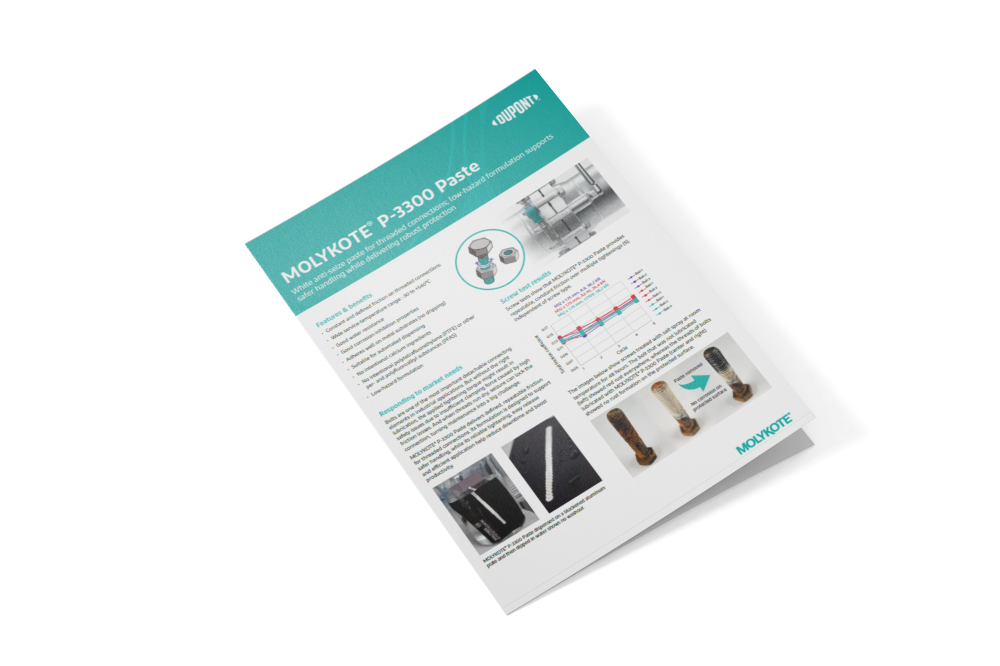
Receive the MOLYKOTE® P-3300 technical documentation
Are you evaluating an anti-seize paste for threaded assemblies exposed to heat, water or corrosion? Download the MOLYKOTE® P-3300 documentation to review, in particular:
Why is friction a key criterion in a bolted joint?
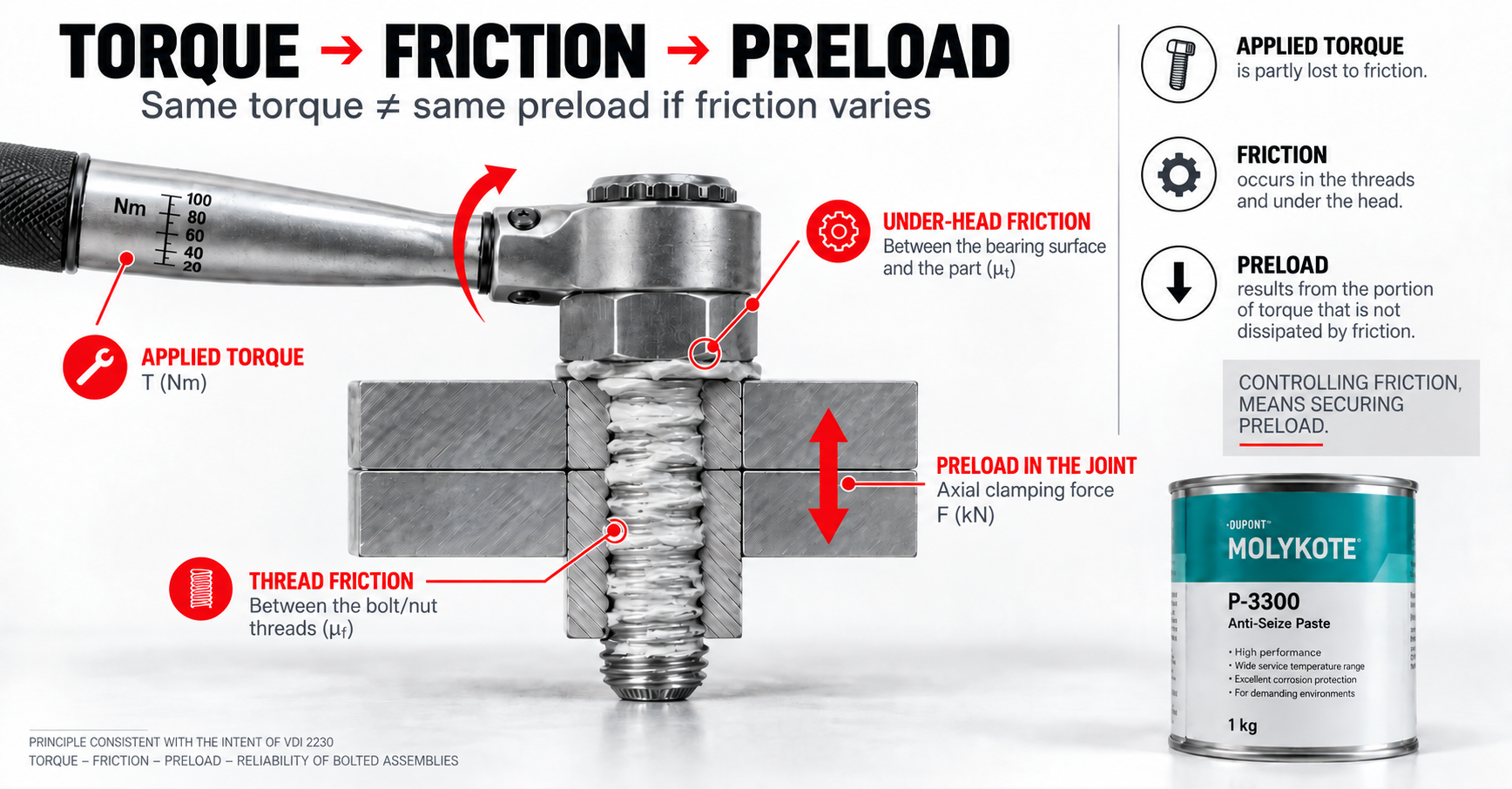
During torque-controlled tightening, the relationship between applied torque and the resulting preload depends strongly on friction conditions in the threads and under the bolt head or nut. A significant variation in the coefficient of friction can therefore change the tightening result, even when the operator applies the same nominal torque.
This is why selecting a thread paste must go beyond the anti-seize function alone. For sensitive assemblies, defined and reproducible friction helps achieve more consistent tightening. P-3300 notably targets friction class B as defined in VDI 2230, but this reference remains secondary to qualification on the actual fasteners and tightening process.
Up to 540 °C: maintaining disassembly capability after heat exposure
MOLYKOTE® P-3300 covers a service temperature range of -30 °C to +540 °C. For the user, the challenge is not only temperature resistance: the paste must also continue to protect the threads so that the assembly can be disassembled after a long period in service.
Its ability to facilitate loosening after prolonged exposure to high temperature is one of the key benefits highlighted for P-3300. This is particularly relevant for bolted joints, flanges and threaded connections where maintenance requires non-destructive disassembly.
Water and corrosion: protecting threads in exposed environments
A threaded connection exposed to moisture, washdowns or weather must remain protected throughout its service life. An anti-seize paste that washes out too easily can leave the threads more vulnerable to corrosion and make disassembly more difficult.
MOLYKOTE® P-3300 combines good water resistance with corrosion protection. As a reference point, its water washout test result remains below 5% by mass after 1 hour at 80 °C.
This combination is particularly useful when the threaded connection must remain reliable and dismountable despite moisture, washdowns or thermal cycling. The required level of protection must still be adapted to the equipment’s actual operating environment.
In which applications should MOLYKOTE® P-3300 be considered?
P-3300 is intended for threaded connections and assemblies. It becomes particularly relevant when several constraints are combined: high temperature, a need for controlled friction during assembly, exposure to water or corrosion, the need to disassemble the assembly after service, and the search for a more favorable HSE profile for maintenance operators.
- Bolted joints and threaded fittings exposed to high thermal cycles.
- Flanges and process assemblies requiring reproducible tightening.
- Threaded connections exposed to moisture or washdowns.
- Assemblies where seizure would significantly complicate maintenance operations.
- Industrial equipment where the tightening strategy relies on a defined coefficient of friction.
In energy, industrial processing, infrastructure, transportation or heavy industry, P-3300 can be considered whenever these constraints match the specification. The actual application takes precedence over the market sector: two bolted joints in the same industry may require different pastes if the temperature, alloy or tightening method differs.
How should MOLYKOTE® P-3300 be applied?
Application quality directly contributes to tightening reproducibility. Contact points must be cleaned before application. If visible oil separation is present in the container, the paste must be homogenized before use.
P-3300 can be applied like a grease: with a brush, spatula or grease gun. It can also be integrated into an automated dispensing process, making it easier to use in repetitive industrial processes. In all cases, the objective is to achieve a uniform application on the contact surfaces that contribute to friction within the assembly.
3300, P-3700 or P-1042: how should preselection be guided?
This article focuses on MOLYKOTE® P-3300, but it is part of a range of pastes evolving in the same direction. P-3700 follows a low-hazard approach, with no intentionally added calcium, PTFE or PFAS, for very high temperatures. P-1042 is also formulated with no intentionally added PTFE or PFAS and is more specifically targeted at highly loaded metal-to-metal contacts, particularly in the presence of water or machining emulsions.
| Reference | When to consider it first | Temperature reference | Key differentiator |
| MOLYKOTE® P-3300 | Threaded assembly requiring defined and consistent friction, water/corrosion resistance, high-temperature capability and HSE considerations | -30 to +540 °C | SDS with no hazard pictogram or H/P statements; no intentionally added calcium, PTFE or PFAS; versatility up to +540 °C |
| MOLYKOTE® P-3700 | Very-high-temperature bolted assemblies, particularly on high-chromium alloys | -30 to +900 °C | Very-high-temperature capability up to +900 °C; high-purity formulation with no intentionally added calcium, PTFE or PFAS, with no hazard labeling or precautionary statements |
| MOLYKOTE® P-1042 | Highly loaded metal-to-metal surfaces exposed to water or machining emulsions; chucks, slideways and clamping mechanisms | -25 to +120 °C as a paste; solid lubricants up to +500 °C | Very high adhesion, high load-carrying capacity and resistance to washout; no intentionally added PTFE or PFAS |
This comparison is intended to guide the initial selection. If the requirement combines a threaded assembly, a wide temperature range, friction control, water/corrosion resistance and an SDS profile with no hazard pictogram or H/P statements, P-3300 is the reference to examine first. P-3700 is more suited to very high temperatures, particularly on chromium-rich alloys. P-1042 is aimed more at highly loaded metal-to-metal surfaces exposed to water or machining emulsions.
Samaro: turning a lubricant reference into a practical tightening solution
Selecting an anti-seize paste should not be separated from assembly calculations or HSE requirements. Samaro can support technical teams in qualifying the need: fastener type, coating, environment, temperature, tightening torque, disassembly requirements and constraints related to the lubricant formulation.
This approach helps avoid two common mistakes: selecting a paste solely because it withstands the stated maximum temperature, or assuming that the same coefficient of friction will apply to every fastener configuration. For sensitive assemblies, testing or validation on the actual configuration remains the best way to secure the preselection.
MOLYKOTE® P-3300 and threaded assemblies
Conclusion: for reliable bolted joints, look beyond anti-seize performance
In a critical threaded assembly, performance is not just about preventing seizure. Lubricant selection must also take into account friction during tightening, disassembly after heat exposure, water, corrosion and the composition of the product being used.
MOLYKOTE® P-3300 addresses these requirements with a service temperature range of -30 °C to +540 °C, defined friction, good resistance to water and corrosion, and manual or automated application. Its main differentiator for users remains its HSE profile: an SDS with no hazard pictogram, no H statement and no P statement, combined with a formulation containing no intentionally added calcium, PTFE or per- and polyfluoroalkyl substances (PFAS).
The final step remains application-specific: the fasteners, surface condition, tightening method and environment must be qualified together. Samaro can help turn these data into a practical technical preselection and, where necessary, prepare the required validation testing.