























Samaro becomes a distributor of Base Materials: high-performance machinable boards for composite tooling, sport and motorsport
Samaro is pleased to announce its partnership with Base Materials, a UK specialist in high-performance syntactic materials and, in particular, machinable boards for tooling and the manufacture of moulds, models and fixtures. The objective is clear: to make proven solutions more available, faster to deploy and more reliable for applications requiring dimensional stability and high-quality surface finish—especially in demanding markets such as competitive sports, motorsport, aerospace and defense.
In this article, we intentionally focus on three key references now available through Samaro:
- BASE MATERIALS EPOXY BE978 (epoxy machinable board, a “market benchmark”)
- BASE MATERIALS BP700 PU (the go-to medium-density PU machinable board)
- BASE MATERIALS BP1404 PU (high-density PU machinable board, abrasion-resistant)
Key benefits at a glance
- Dimensional stability at temperature thanks to low-CTE epoxy machinable boards, suited to composite tooling constraints.
- Surface finish quality designed for CNC machining and controlled finishing operations.
- Material and density selection based on the application: epoxy-based boards for temperature resistance / geometric stability, or PU-based boards for workshop versatility and lower-temperature applications.
- Complete tooling workflow: ability to bond boards to create large volumes, carry out local repairs, prepare/protect surfaces and secure demoulding.
- Samaro support: technical needs assessment, material/density selection, and implementation support.
Why this partnership is strategic
In your workshops, the challenge is not simply to machine “fast.” The real goal is to achieve tooling that is dimensionally stable, with a controlled surface finish, suited to the application constraints, and with the repeatability required for industrialising parts (or short production runs) without multiplying iterations.
Machinable boards have become an industrial standard because they enable precise geometry control via CNC machining, while providing a more homogeneous material framework than traditional alternatives for certain applications.
Competitive sports and motorsport amplify these constraints: short development cycles, frequent design changes, demanding aesthetics, tight tolerances, and the need for tooling that can keep pace with composite processes and development rates.
Base Materials: a structured, workshop-driven approach
Base Materials is positioned as a leading player in:
- epoxy machinable boards: intended for high-temperature applications where dimensional stability is essential, such as producing models for composite tooling manufacture or designing tooling for composite parts directly from machinable boards.
- PU machinable boards (more economical, suited to lower-temperature applications), for example: part design, automotive concept cars and prototypes, tooling supports, positioning fixtures for tampography or machining rework, foundry patterns, core boxes, etc.
- and a full range of tooling-related solutions (block bonding, repair systems, surface protection, release agents, etc.).
But also:
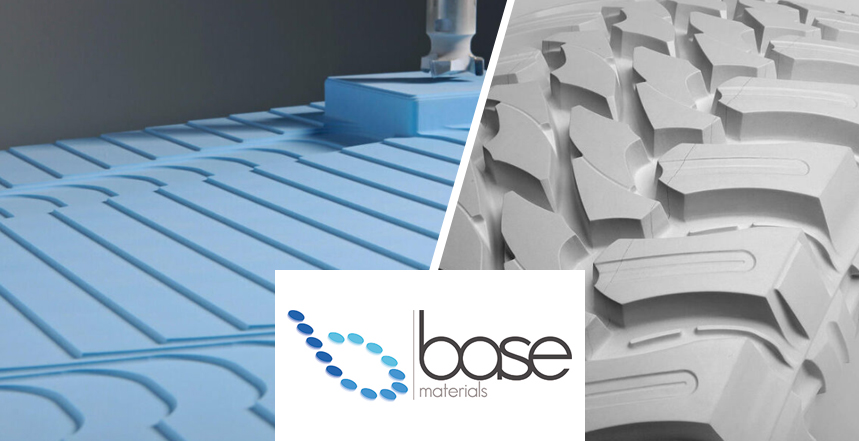
- the “bonded blocks + CNC machining” approach for producing large volumes and achieving high-precision moulds and models,
- the value of low-CTE epoxies for maintaining tolerances at temperature (with performance capable of withstanding up to +190 °C in their epoxy range),
- and the relevance of PU boards for workshop needs where finish quality, ease of shaping, mechanical performance (abrasion, compression, etc.) and cost competitiveness are critical.
Epoxy vs PU: the right choice based on your process constraints
Epoxy machinable boards
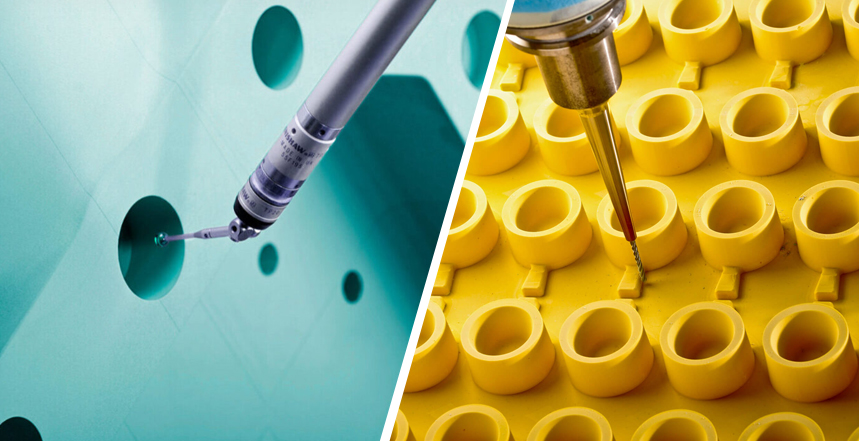
Epoxy becomes the preferred option when temperature resistance and dimensional stability become critical parameters. Low-CTE epoxy machinable boards are particularly relevant whenever thermal cycles and tolerance retention are determining factors for final tooling quality.
PU machinable boards
PU is widely used for its workshop versatility and its ability to cover a broad range of applications (modelling, masters, fixtures, thermoforming, foundry, design, prototypes). The choice of density and board type allows you to fine-tune the response: a machinability/performance balance for medium densities, and increased robustness for higher densities when mechanical load, abrasion or repeated contact are involved.

Product focus: BE978, BP700, BP1404
1) EPOXY BE978: stability + surface finish for demanding composite tooling
BE978 is an epoxy machinable board positioned for high-performance composite applications, with a clear purpose: maintain geometry and provide a consistent surface finish for tooling and masters where precision is critical.
Key points (technical data)
- Density: 680 kg/m³
- Hardness: 73 Shore D
- Tg: 145 °C
- CTE: 39 × 10⁻⁶ K⁻¹ (±5)
- Flexural modulus: 2400 MPa
- Flexural strength: 38 MPa
- Compressive modulus: 2200 MPa
- Compressive strength: 50 MPa
Typical applications
- composite tooling requiring good thermal resistance
- high-precision masters and patterns
- fixtures/models where dimensional stability at temperature must be maintained
- tools and models for thermoforming / vacuum forming where stability is a criterion
Markets
This grade is particularly well aligned with the needs of the composites sector (competitive and leisure sports, motorsport, aerospace, defense, etc.), where the combination of stability + finish is a prerequisite for many tooling applications.
The tooling ecosystem: bond, repair, prepare, release
Beyond the board grade itself, Base Materials follows a full process-chain approach:
- bonding boards together to build large volumes before machining
- repair solutions to address local defects or impact damage
- surface preparation / protection via sealers
- release agents to secure mould/part separation
This is an important point for methods and production teams: the logic is not just about the board material itself, but about a complete system that stabilises workshop workflow.
2) BP700 PU: the versatile “workshop core” (models, masters, fixtures, thermoforming)
BP700 PU is the benchmark medium-density PU machinable board. Designed for versatility and finish quality, it naturally fits modelling, master model and forming-tool applications at moderate temperatures.
Key points (technical data)
- Density: 700 kg/m³
- Hardness: 65 Shore D
- HDT: 67 °C
- CTE: 45 × 10⁻⁶ K⁻¹ (±5)
- Flexural strength: 30 MPa
- Compressive strength: 30 MPa
Typical applications
- mock-ups, models, masters
- fixtures, holding devices
- vacuum forming / thermoforming
- workshop applications requiring a good machinability/performance balance
BP1404 PU: high density, abrasion resistance and mechanical strength for “heavy-duty” uses
BP1404 is a high-density PU machinable board, designed for mechanically demanding applications, with highlighted abrasion resistance and high compressive strength.
Key points (technical data)
- Density: 1400 kg/m³
- Hardness: 85 Shore D
- Tg: 80 °C
- CTE: 80 × 10⁻⁶ K⁻¹ (±5)
- Flexural strength: 77 MPa
- Compressive strength: 80 MPa
- Abrasion resistance: < 30 mm³/100R (Taber, H18; 500 g)
Typical applications
- thermoforming / vacuum forming
- metal forming (hammering / forming)
- foundry patterns
- RIM (Reactive Injection Moulding)
Conclusion
With Base Materials, Samaro strengthens its “Model & Mould” offering with clearly positioned machinable boards tailored to workshop requirements: BE978 for composite tooling where temperature stability is critical, BP700 as the versatile workshop benchmark, and BP1404 for applications involving high mechanical stress and abrasion.
❓FAQ — Samaro x Base Materials
🔹 How do I choose between epoxy and PU?
Choose epoxy if temperature resistance and dimensional stability are the main drivers in your specifications. Choose PU for more versatile needs (models, masters, fixtures, thermoforming) at moderate temperature, with density selected according to the level of mechanical stress.
🔹Why is BE978 particularly relevant for motorsport?
Because it combines high-performance composite tooling positioning with a high Tg, low CTE and dimensional stability suited to demanding precision and surface finish requirements.
🔹BP700: what is a typical use case?
BP700 is suited to versatile workshop use: models, masters, fixtures, and thermoforming/vacuum forming tools where the required thermal resistance remains moderate.
🔹BP1404: why move up in density?
Higher density provides a better response when tooling is mechanically more stressed, with requirements for compressive strength and abrasion resistance—typically in forming, foundry, RIM, or certain forming tools.
🔹 Can large blocks be created for CNC machining?
Yes. Boards can be bonded together to create large volumes before machining.
🔹 What should I do in case of impact damage or a local defect after machining?
Repair solutions are available to locally correct defects and restore a usable surface.
🔹How can I secure surface quality before a mould is put into service?
Surface preparation/protection solutions (sealers) can be used depending on the process and target finish.
🔹 Are compatible release solutions available?
Yes, release agents are available to secure moulding cycles and mould/part separation depending on the system used.
🔹 Which markets are mainly targeted?
Sports and motorsport are particularly relevant markets for these references, but applications also extend to automotive, aerospace, foundry, manufacturing, marine, rail and other specialised industrial sectors.
🔹 How can I obtain a material/density recommendation?
Samaro supports you based on your process and tooling constraints (temperature, cycles, tolerances, finish, CNC strategy) to recommend the most suitable machinable board.
🔹What does “low-CTE epoxy” mean, and why is it critical for a tooling machinable board?
CTE (Coefficient of Thermal Expansion) describes the dimensional variation of a material as a function of temperature. A low-CTE epoxy expands (and contracts) less when exposed to thermal changes.
In composite tooling, this is a key parameter whenever the tool undergoes thermal cycles (heating/cooling) or must maintain tight tolerances: a lower CTE helps limit dimensional drift and maintain nominal geometry over time, especially at temperature.