

















Railway bogie lubrication: how to choose between grease, paste and anti-friction coating?
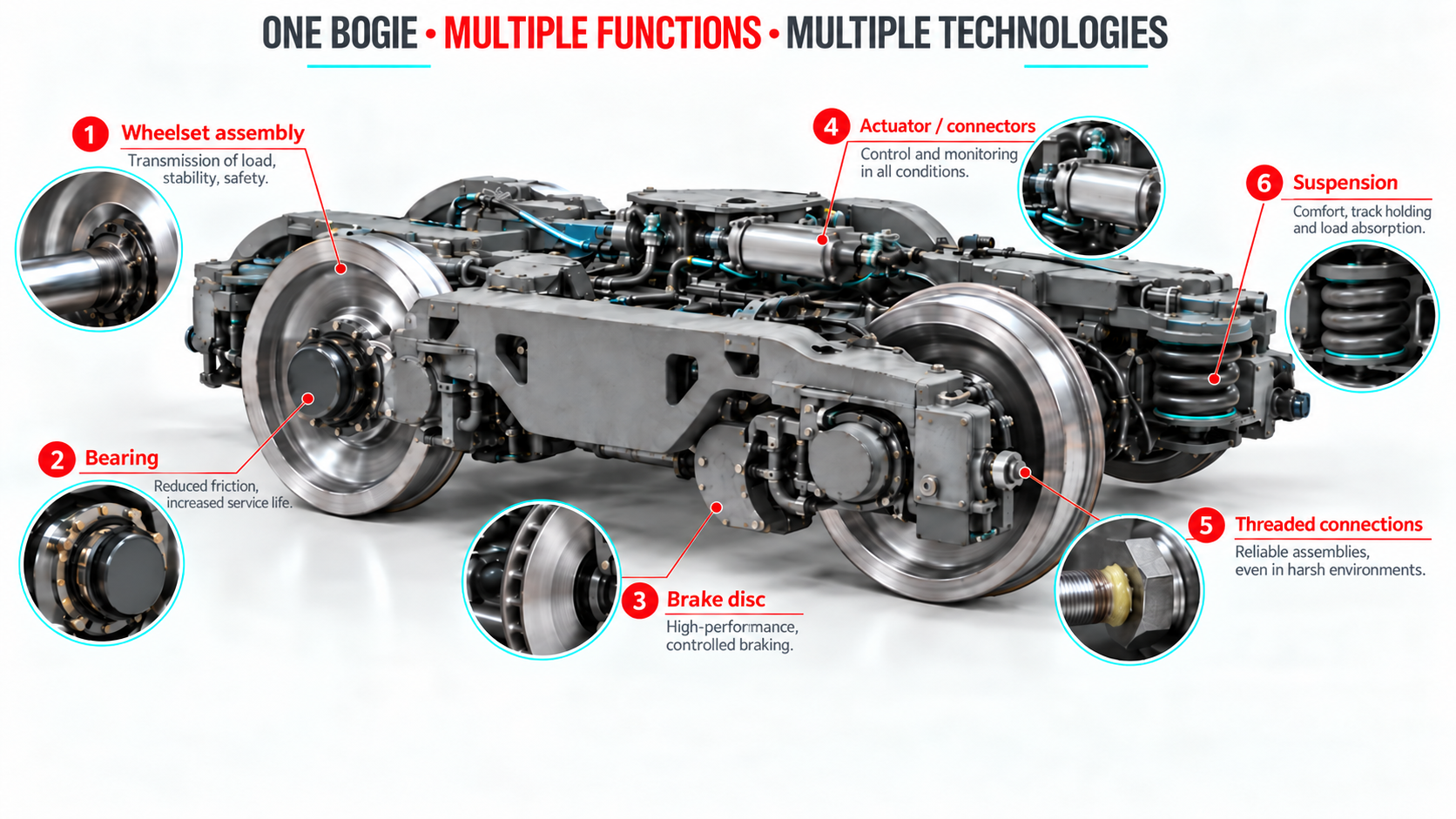
A railway bogie does not involve just one lubrication issue: it combines several. Rotating bearings, wheel assemblies, braking mechanisms, threaded connections and suspension components operate with different movements, loads, temperatures and contamination levels. Using the same grease or the same paste everywhere can therefore simplify stock management, but not necessarily maintenance or reliability.
Samaro supports railway manufacturers and maintenance teams with DuPont MOLYKOTE® solutions to select a lubricant according to the function of the component, the environment and maintenance constraints. On the bogie, the range covers several complementary technologies: bearing greases, assembly pastes, anti-friction coatings and semi-fluid greases.
Among these references, MOLYKOTE® P-40 (S) Paste has a specific role. As a reminder, MOLYKOTE® P-40 (S) is the “PFAS Free” version of MOLYKOTE® P-40: its formulation does not intentionally use PTFE or PFAS-type substances. This development was designed to maintain the level of performance expected from P-40 for the relevant assembly and lubrication functions, including adhesion, anti-fretting behavior, water resistance and corrosion protection. It also supports HSE approaches aimed at reducing the intentional use of fluorinated substances and improving control of the substances present in the working environment of maintenance operators. On the bogie, P-40 (S) can be applied to threaded connections and to the suspension pivot bolt.
Key takeaways
- A bogie requires several lubrication technologies: a bearing grease, an assembly paste and an anti-friction coating do not perform the same function.
- MOLYKOTE® P-40 (S) can be evaluated on threaded assemblies in the braking system and on the suspension pivot bolt.
- For bearings, the references to evaluate include MOLYKOTE® Longterm 2 Plus, BR-2 Plus and BG-20, depending on the operating profile.
- In the braking system, the choice changes depending on the component: D-321 R for brake disc assembly, Longterm 00 for the hydraulic cylinder, Longterm 2 Plus for connectors, and P-40 (S) or Cu-7439 Plus Paste V1 for threaded connections.
- MOLYKOTE® P-40 (S), the PFAS Free version of P-40, helps integrate a PFAS substitution objective without giving up the targeted mechanical functions; this development also fits into an HSE approach aimed at better control of the substances used during maintenance operations.
One bogie, several interfaces: which technology for which component?
| Zone / function | MOLYKOTE® solutions to evaluate | Main objective |
| Wheel assembly | G-N PLUS Paste / G-Rapid Plus Paste | Facilitate assembly, reduce friction and stick-slip, and help limit fretting. |
| Bearings | Longterm 2 Plus / BR-2 Plus / BG-20 | Reduce friction and wear and support service life depending on load, speed and temperature. |
| Brake disc assembly | D-321 R Anti-Friction Coating | Control friction and limit stick-slip with a dry film. |
| Brake hydraulic cylinder | Longterm 00 | Reduce friction and wear in the mechanism. |
| Brake system connectors | Longterm 2 Plus | Lubrication of mechanical interfaces subjected to loads. |
| Threaded connections | P-40 (S) Paste / Cu-7439 Plus Paste V1 | Control friction, limit seizure and facilitate repeated disassembly. |
| Suspension – pivot bolt | P-40 (S) Paste | Protection against seizure, fretting and exposure to moisture. |
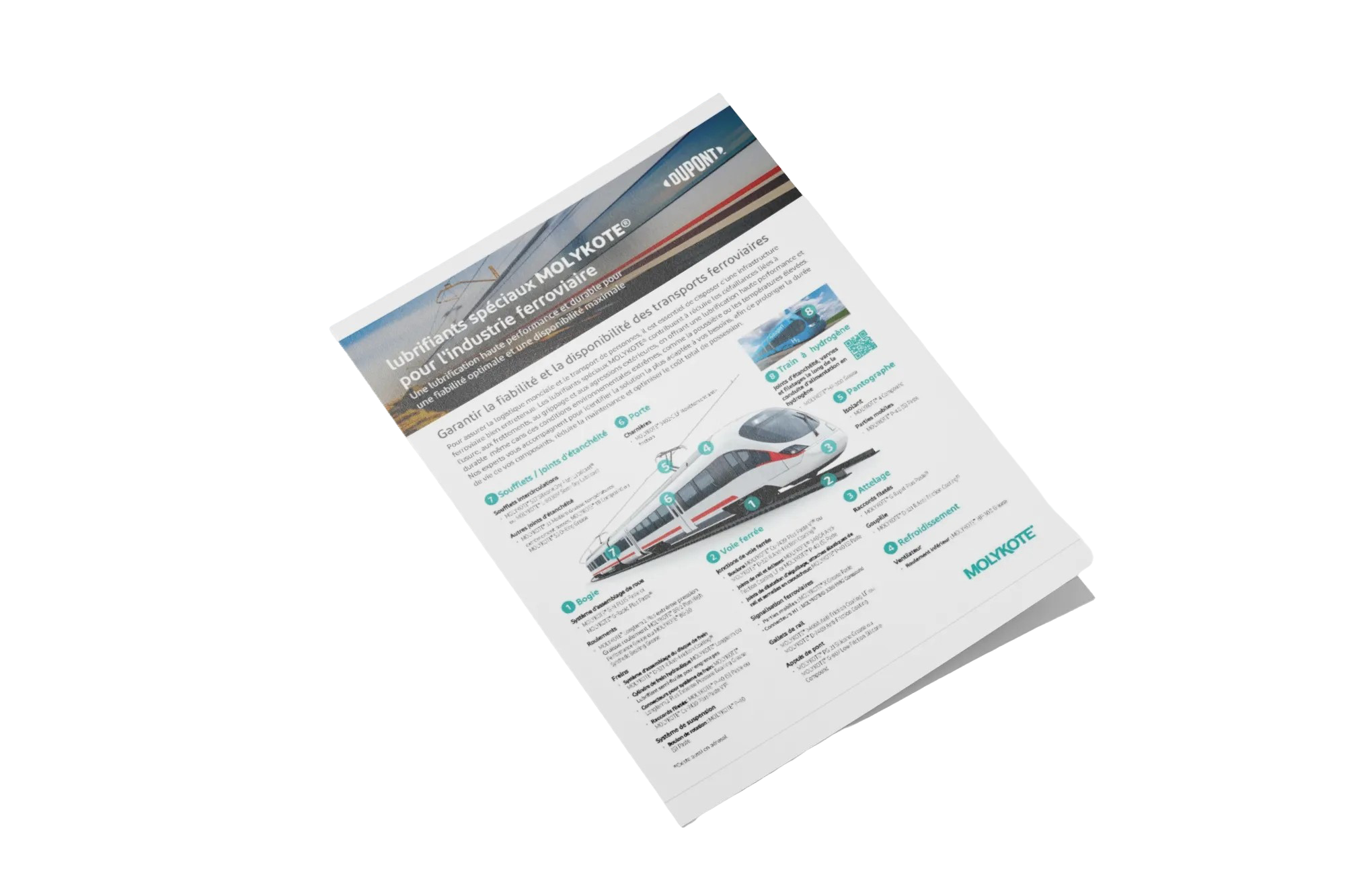
Download the MOLYKOTE® railway mapping
The MOLYKOTE® railway brochure maps the main lubrication areas of the train and infrastructure: bogie, track, coupling, cooling, pantograph, doors, bellows and hydrogen applications.
Why is MOLYKOTE® P-40 (S) particularly relevant on a bogie?
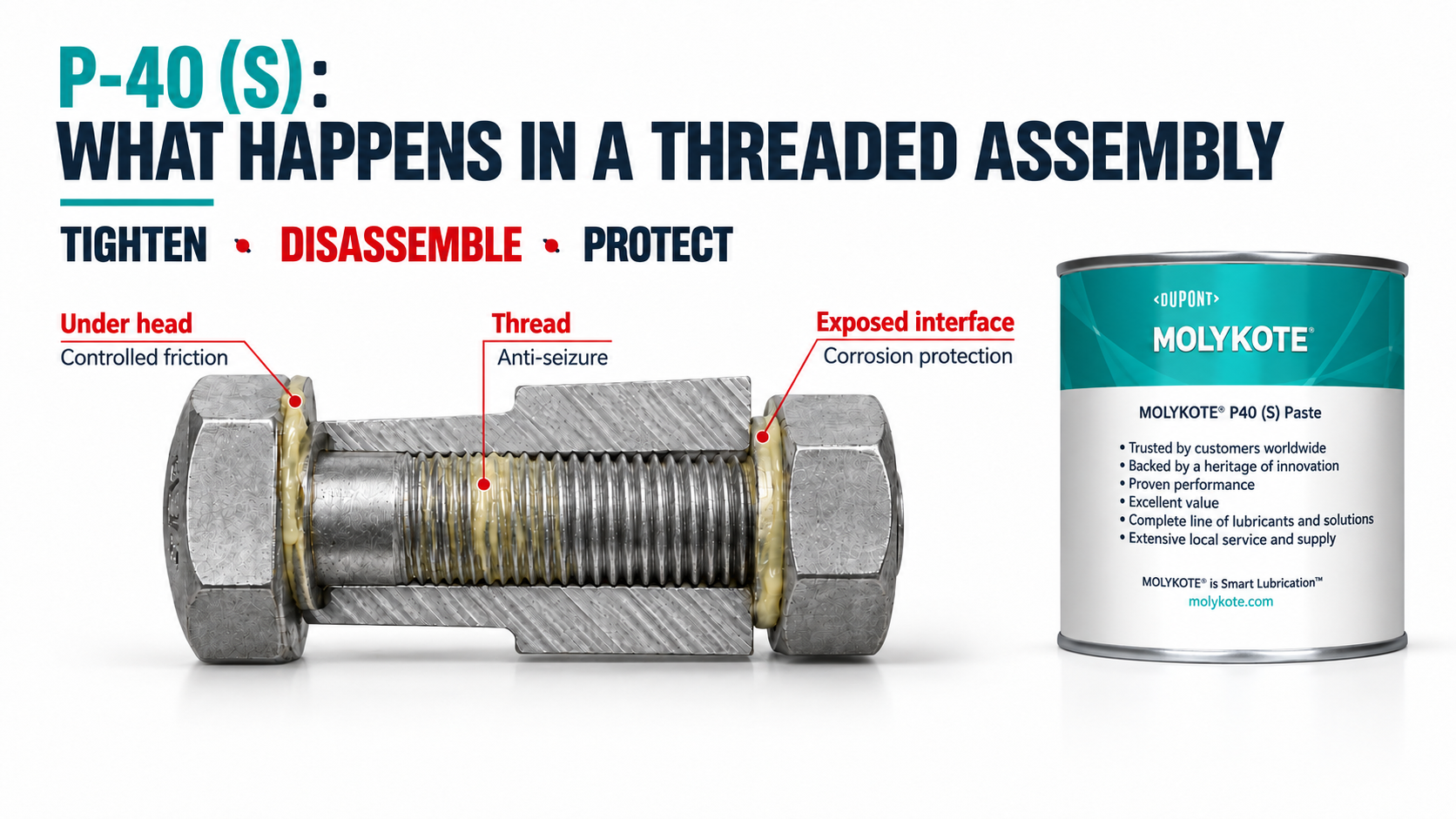
MOLYKOTE® P-40 (S) is a metal-free adhesive lubricating paste designed for assembly and continuous lubrication. On a bogie, it can notably be evaluated for threaded connections in the braking system and for the suspension pivot bolt. These interfaces are directly affected by seizure, fretting, moisture and repeated disassembly / reassembly operations.
On a threaded assembly, the function of the lubricant goes beyond simply “making tightening easier”. Friction in the threads and under the head influences the relationship between the applied torque and the clamping force obtained. In the documented M12 × 1.75 test configuration, P-40 (S) has a typical coefficient of friction of 0.13 in the thread and 0.11 under the head. The coefficient measured in the press-fit test is 0.16.
Its anti-fretting behavior, water resistance and corrosion protection are also relevant for railway maintenance. A bogie is exposed to vibration, water spray, moisture, dust and repeated maintenance cycles. A paste that remains well adhered to the assembly area helps secure the function between two maintenance operations.
The temperature range must nevertheless be read correctly. The paste is usable from -40 to +121 °C. The solid lubricants it contains remain functional up to +1,093 °C, but this value does not correspond to the normal service temperature of the complete paste. For a railway component, selection must therefore always be based on the actual temperature reached by the lubricated area and on the function required.
| P-40 (S) property | Typical value / characteristic |
| Nature | Metal-free adhesive paste, mineral oil + solid lubricants |
| Use | Assembly and continuous lubrication |
| Paste service temperature | -40 to +121 °C |
| Solid lubricant stability | up to +1,093 °C |
| Coefficient of friction – thread | 0.13 – M12 × 1.75 configuration |
| Coefficient of friction – under head | 0.11 – M12 × 1.75 configuration |
| Press-fit coefficient | 0.16 |
| SKF-Emcor corrosion protection | 0 |
| Formulation | no intentional addition of PTFE or PFAS-type substances |
Bearings: why are several greases proposed for the same bogie?
P-40 (S) is not the operating grease for bogie bearings. For this function, the preselection is more likely to focus on MOLYKOTE® Longterm 2 Plus, BR-2 Plus or BG-20. The choice then depends on parameters specific to bearings: rotational speed, load, base oil viscosity, temperature, sealing, contamination and relubrication interval.
MOLYKOTE® Longterm 2 Plus is intended for heavily loaded bearings and components and combines load-carrying capability, adhesion and corrosion protection. MOLYKOTE® BR-2 Plus is also positioned for the lubrication of bearings subjected to high loads. MOLYKOTE® BG-20 is another option when the speed and temperature profile points toward a synthetic grease.
P-40 (S), however, can be used during bearing assembly. It is important to distinguish assembly lubrication from bearing lubrication in operation. This distinction avoids extending a reference that is relevant during assembly to a dynamic function for which a specific grease is required.
Braking: one subassembly, several friction issues
The braking system clearly shows why it is risky to simply ask for “a grease for brakes”. The disc, the cylinder, the connectors and the threaded connections do not operate in the same way and therefore do not call for the same technology.
- MOLYKOTE® D-321 R Anti-Friction Coating: for brake disc assembly when the function requires a dry film to control friction and stick-slip.
- MOLYKOTE® Longterm 00: for the brake system hydraulic cylinder to reduce friction and wear.
- MOLYKOTE® Longterm 2 Plus: for brake unit connectors.
- MOLYKOTE® P-40 (S) or Cu-7439 Plus Paste V1: for threaded connections when tightening, repeated disassembly, seizure and corrosion must be controlled.
Good selection practice consists of starting from the component, then the contact, then the failure mode to be avoided. The term “brake lubrication” is too broad to lead directly to a reliable recommendation.
How to qualify a bogie lubrication request?
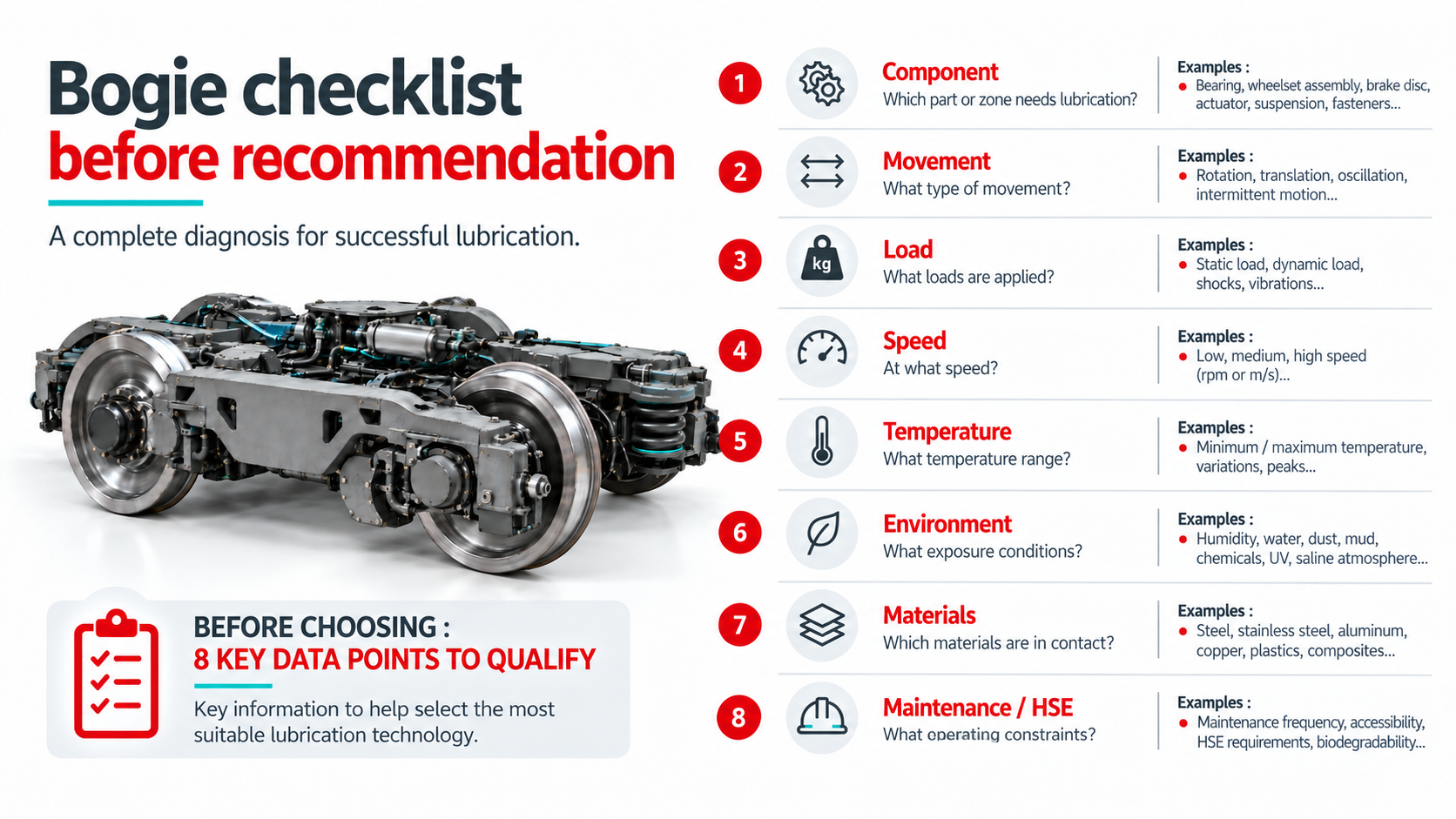
Before selecting a reference, Samaro recommends qualifying the application in a structured way. The VTEC logic – speed, temperature, environment and load – remains particularly relevant in railway applications, provided it is supplemented by the type of contact and the maintenance cycle.
- Component and contact: bearing, thread, pin, sliding surface, brake mechanism or press-fit assembly?
- Movement: rotation, oscillation, sliding, tightening / loosening or static assembly?
- Load: continuous load, shock, vibration, high contact pressure or fretting?
- Speed: a determining factor, particularly when choosing a bearing grease.
- Temperature: actual component temperature, not only ambient temperature.
- Environment: water, moisture, dust, washing, contaminants, outdoor exposure.
- Materials and surface conditions: steels, surface treatments, coatings, elastomers or other materials in contact.
- Maintenance: relubrication interval, disassembly frequency, accessibility and target service life.
- HSE / formulation constraints: notably the absence of intentional addition of PTFE/PFAS when it is part of the specification.
This qualification makes it possible to obtain a preselection to test and validate, not an automatic answer. The final reference must remain consistent with the design of the component, the OEM or operator requirements and the actual maintenance process.
Wheel assembly: mounting friction is not bearing friction
Wheel assembly is another good example of this functional distinction. For press-fit operations, MOLYKOTE® G-N PLUS Paste or G-Rapid Plus Paste can be evaluated to facilitate assembly, reduce friction and stick-slip, and help limit fretting.
The objective here is to control the mounting interface, not to lubricate the bearing in rotation. During maintenance on an axle, several technologies may therefore be required in the same area: mounting paste, bearing grease and assembly paste on fasteners or suspension elements.
When is MOLYKOTE® P-40 (S) not the right solution?
A credible recommendation must also specify the limits of the reference. P-40 (S) is highly relevant on certain threaded assemblies and surfaces subjected to fretting, but it should not become, by default, “the bogie paste” used on every component.
For a bearing in operation, lubrication must maintain the appropriate film under rotation, load and temperature: a dedicated bearing grease therefore remains necessary. P-40 (S) can support assembly, but the two functions are not interchangeable.
For brake disc assembly, a dry anti-friction coating such as D-321 R may be preferable when a dry, stable film is required. The hydraulic cylinder, for its part, requires a semi-fluid grease.
Finally, P-40 (S) must not be mixed with greases or oils. When changing technology, cleaning the area and defining the application method are therefore an integral part of qualification, particularly during overhaul operations where residues of previous products may be present.
Railway bogie lubrication and MOLYKOTE® P-40 (S)
Conclusion: on a bogie, start from the function before choosing the reference
The bogie is a clear example of why railway lubrication cannot be reduced to a single grease. Wheel assembly, bearings, braking, threaded connections and suspension are located within the same mechanical area but require different tribological responses.
MOLYKOTE® P-40 (S) deserves particular attention for bogie maintenance operations and assemblies. As the PFAS Free version of MOLYKOTE® P-40, it maintains the targeted in-use performance in terms of adhesion, anti-fretting behavior, water resistance, corrosion protection and friction control, without intentional addition of PTFE or PFAS-type substances. This positioning makes it possible to reconcile mechanical requirements, a PFAS substitution approach and better HSE control of the substances used by maintenance operators.
The final selection nevertheless remains linked to the component and its actual operating conditions. Samaro can support you in mapping lubrication points, comparing MOLYKOTE® technologies and preparing the necessary tests or validations before maintenance deployment.