
























Heat pump: which heat transfer fluid should you choose, Antifrogen™ N or L?
In a heat pump, performance does not depend solely on the compressor or the refrigerant. The hydronic circuit and the fluid flowing through it also play an essential role in heat transfer, freeze protection and corrosion control. Clariant has been developing the Antifrogen™ range of heat transfer fluids for more than 75 years. Samaro supports HVAC professionals in selecting the formulation and concentration suited to their installations.
For HVAC applications and heat pumps, two references cover most requirements: Antifrogen™ N, based on monoethylene glycol (MEG), and Antifrogen™ L, based on monopropylene glycol (MPG). Their value goes beyond simply ‘adding glycol to water’: their formulation combines freeze protection with a corrosion inhibitor system designed to provide long-term protection for the metals in the circuit.
Key takeaways
- Antifrogen™ N is an MEG-based heat transfer fluid suited in particular to closed-loop heating and cooling systems and heat pumps.
- Antifrogen™ L is MPG-based and is the option to evaluate when the toxicological profile or a risk of contact with process water or hot water requires a different approach. Its SDS contains no hazard pictogram, no hazard statement (H statement) and no precautionary statement (P statement), which facilitates integration into HSE approaches for installations.
- Corrosion inhibitors are a major differentiating factor: an uninhibited glycol can, on the contrary, promote corrosion in the circuit.
- Freeze protection depends directly on concentration and must be sized according to the actual minimum temperature encountered.
- In an R290 heat pump, R290 remains the refrigerant in the refrigeration circuit; Antifrogen™ can be used in a separate hydronic circuit, depending on the equipment architecture.
- Samaro can support concentration sizing, MEG/MPG selection and in-service fluid monitoring.
Antifrogen™ N or Antifrogen™ L: the two solutions to know for a heat pump
| Reference | Base | Prioritize when… | Key differentiator |
| Antifrogen™ N | Monoethylene glycol (MEG) | Thermal performance, freeze protection and corrosion protection are the main criteria for a closed-loop HVAC/heat-pump circuit. | Minimum concentration: 20% v/v.
Formulation that meets and exceeds the ASTM D1384-05 corrosion test. |
| Antifrogen™ L | Monopropylene glycol (MPG) | The specification requires a different toxicological profile, particularly in food/pharmaceutical applications or where accidental contact with process water/hot water cannot be ruled out. | Dual function: freeze protection + corrosion protection.
Minimum concentration: 25% v/v. |
This MEG/MPG distinction should be made very early in the project. Antifrogen™ N is intended for hot-water heating systems, heat pumps, heat recovery and refrigeration circuits. Antifrogen™ L also addresses heat-pump applications, with an MPG base that is particularly relevant when the specification requires a different toxicological profile.
For a broader overview of the range, see our general article on Antifrogen™ N and L heat transfer fluids.
Why a simple water + glycol mixture is not enough
The word ‘glycol’ is often used as though it referred to a complete heat transfer fluid on its own. In practice, glycol mainly provides freeze protection. In a real system, the fluid must also coexist for years with heat exchangers, pumps, piping, fittings and different alloys.
This is where formulation makes the difference. Antifrogen™ combines water, glycol and inhibitors. The inhibitor package in Antifrogen™ N forms a protective film on metal surfaces and helps stabilize pH. The formulation is designed to protect, among other materials, carbon steel, copper, brass, cast iron and cast aluminium.
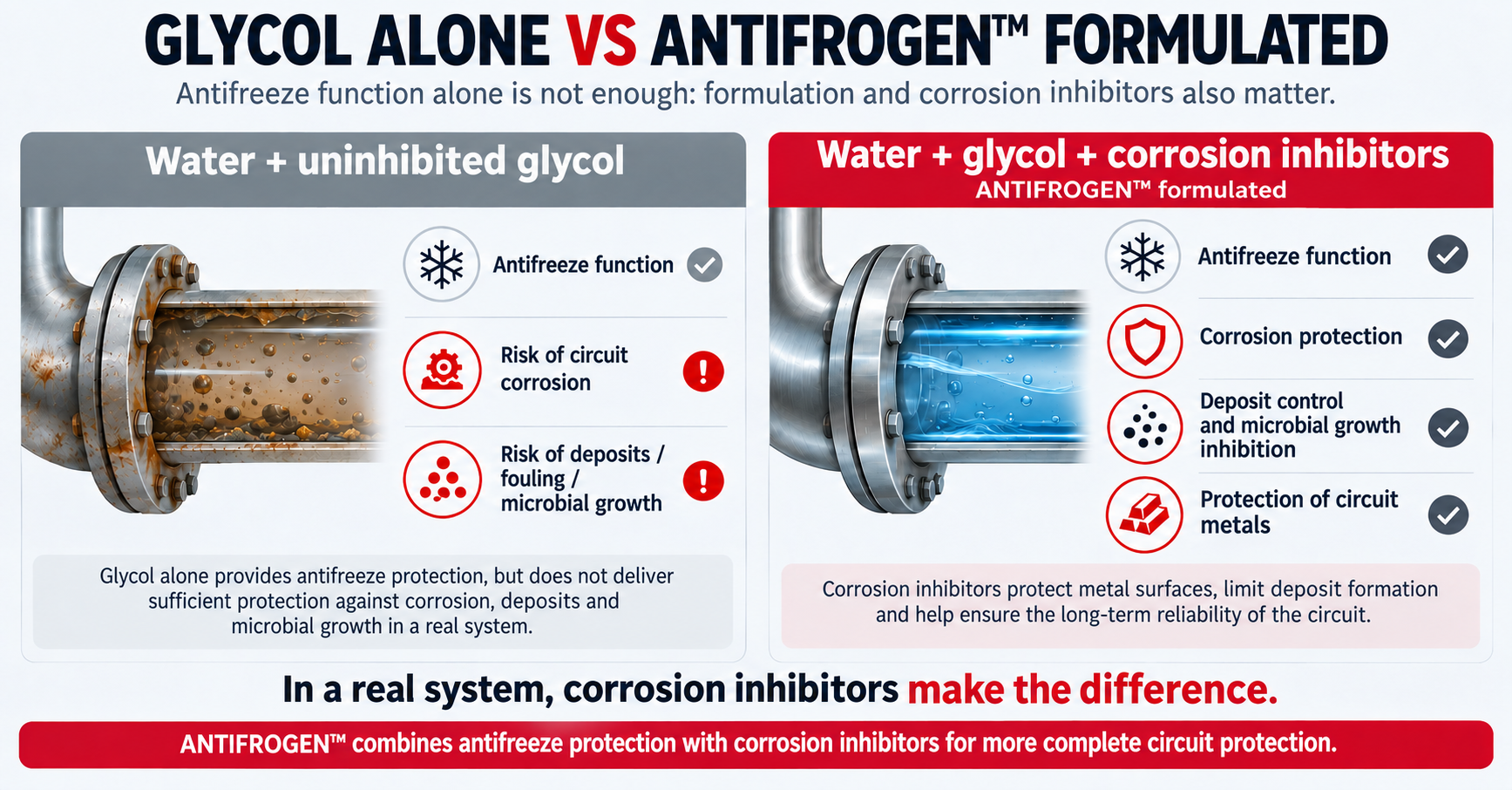
ASTM D1384: useful evidence when discussing corrosion protection
ASTM D1384 is a reference test for evaluating metal corrosion in the presence of a heat transfer fluid. Antifrogen™ N meets and exceeds the requirements of ASTM D1384-05. Compared with an uninhibited water + ethylene glycol mixture, mass losses after 336 hours are significantly reduced, particularly on steel and cast iron.
Durability testing of Antifrogen™ N is also extended to 3,000 hours. Antifrogen™ L follows the same principle of long-term metal protection.
Microbiological and antifungal protection: why Antifrogen™ does not add chemical biocides
In addition to freezing and corrosion, microbiological growth (fungi, bacteria and algae) and biofilm formation are major threats to heat exchangers. Unlike some market solutions that incorporate synthetic fungicides or bactericides, the Antifrogen™ range relies on a three-part formulation logic:
- Natural biostatic action through osmotic pressure
Antifrogen™ does not require added biocides. When the minimum use concentrations are respected — 20% v/v for Antifrogen™ N and 25% v/v for Antifrogen™ L — the glycol content produces a natural biostatic effect. Through osmotic pressure, the mixture inhibits the growth of fungi and bacteria and the formation of biofilms.
- A streamlined toxicological profile without CMR substances
The absence of chemical fungicides preserves the range’s stringent environmental and health profile, which is free from borates, phosphates, nitrites, amines, silicates and CMR substances. This formulation purity is essential to support the safe use of Antifrogen™ L in food/pharmaceutical applications and its VdS approval for sprinkler systems.
- The risk of underdosing: reversal of the microbiological effect
An overly diluted mixture (below 20% for Antifrogen™ N or 25% for Antifrogen™ L) loses its biostatic effect. The glycol can then become a nutrient source for microorganisms. Their proliferation generates organic degradation acids that consume the reserve alkalinity, attack metals and clog filters.
KEY POINT
For a heat pump or HVAC circuit, the right question is therefore not only ‘how much glycol is needed?’, but ‘which freeze-protection + corrosion-protection formulation is suited to the materials, temperature and risk level of the installation?
R290 heat pump: do not confuse refrigerant and heat transfer fluid
R290, i.e. propane, is used as a refrigerant in some heat pumps. It does not necessarily replace the heat transfer fluid in the hydronic circuit. In an architecture using a plate heat exchanger, the R290 refrigeration circuit can remain separate from a water + Antifrogen™ circuit: the fluids do not mix; only heat is transferred.
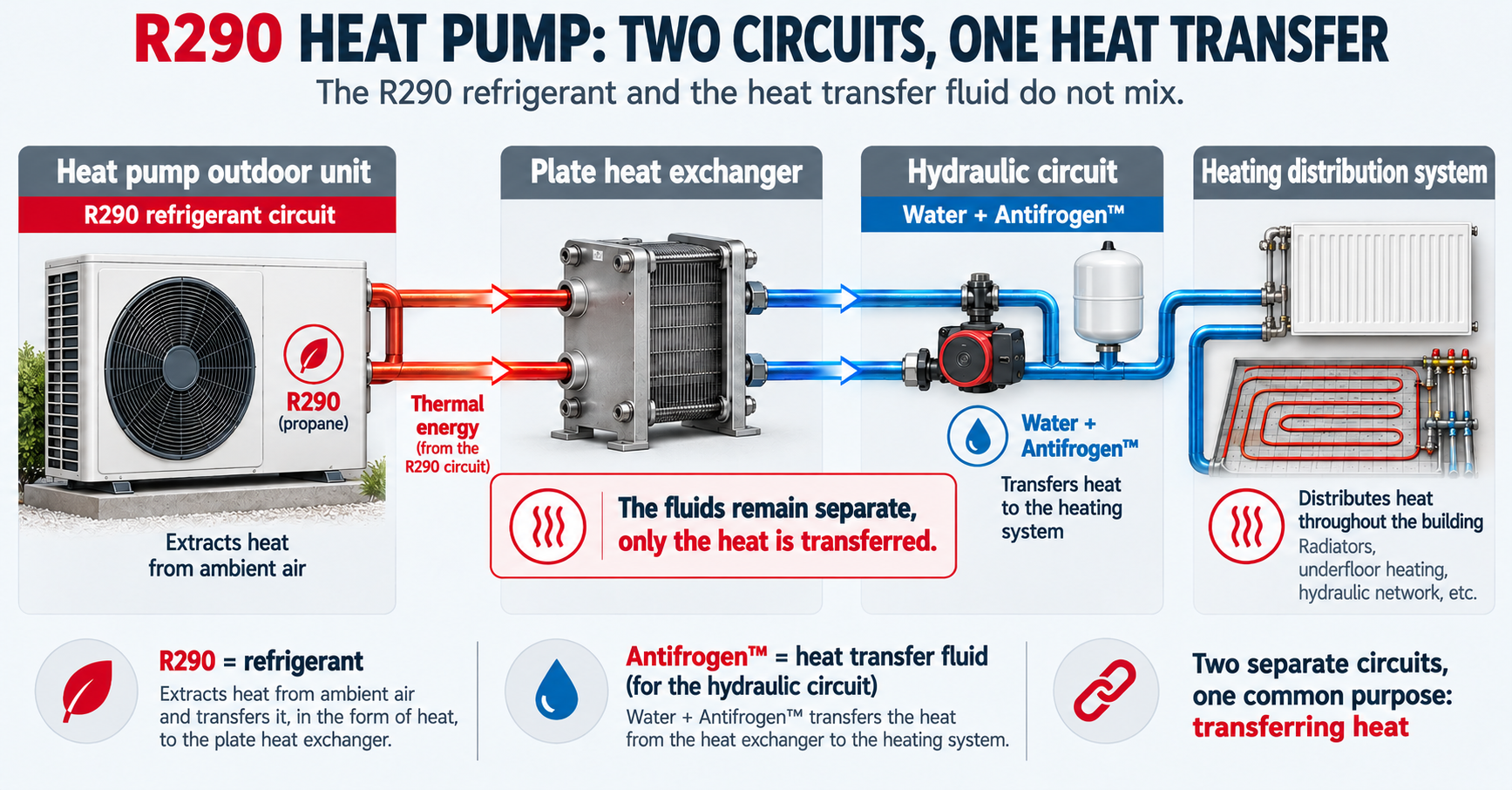
This distinction is essential in the field. When discussing the fluid in a heat pump, the term may refer either to the machine refrigerant or to the heat transfer fluid in the hydronic circuit. In the latter case, the fluid must transfer heat while protecting the installation against freezing and corrosion.
Freeze risk remains real on a heat pump with exposed hydronic components
When part of the hydronic circuit is outdoors, a power outage, prolonged shutdown or low outdoor temperature can create a freezing risk. The Antifrogen™ concentration must therefore be sized according to the required protection temperature. For example, 30% v/v Antifrogen™ N corresponds to a freezing point of approximately -16°C; for Antifrogen™ L, 30% v/v corresponds to approximately -13°C.
Do not overdose ‘for safety’. A higher concentration also changes the fluid’s physical properties, particularly viscosity, density and thermal conductivity. The Antifrogen™ calculator is designed to link concentration, temperature, freezing point and thermophysical properties.
MEG or MPG: how to choose between Antifrogen™ N and L?
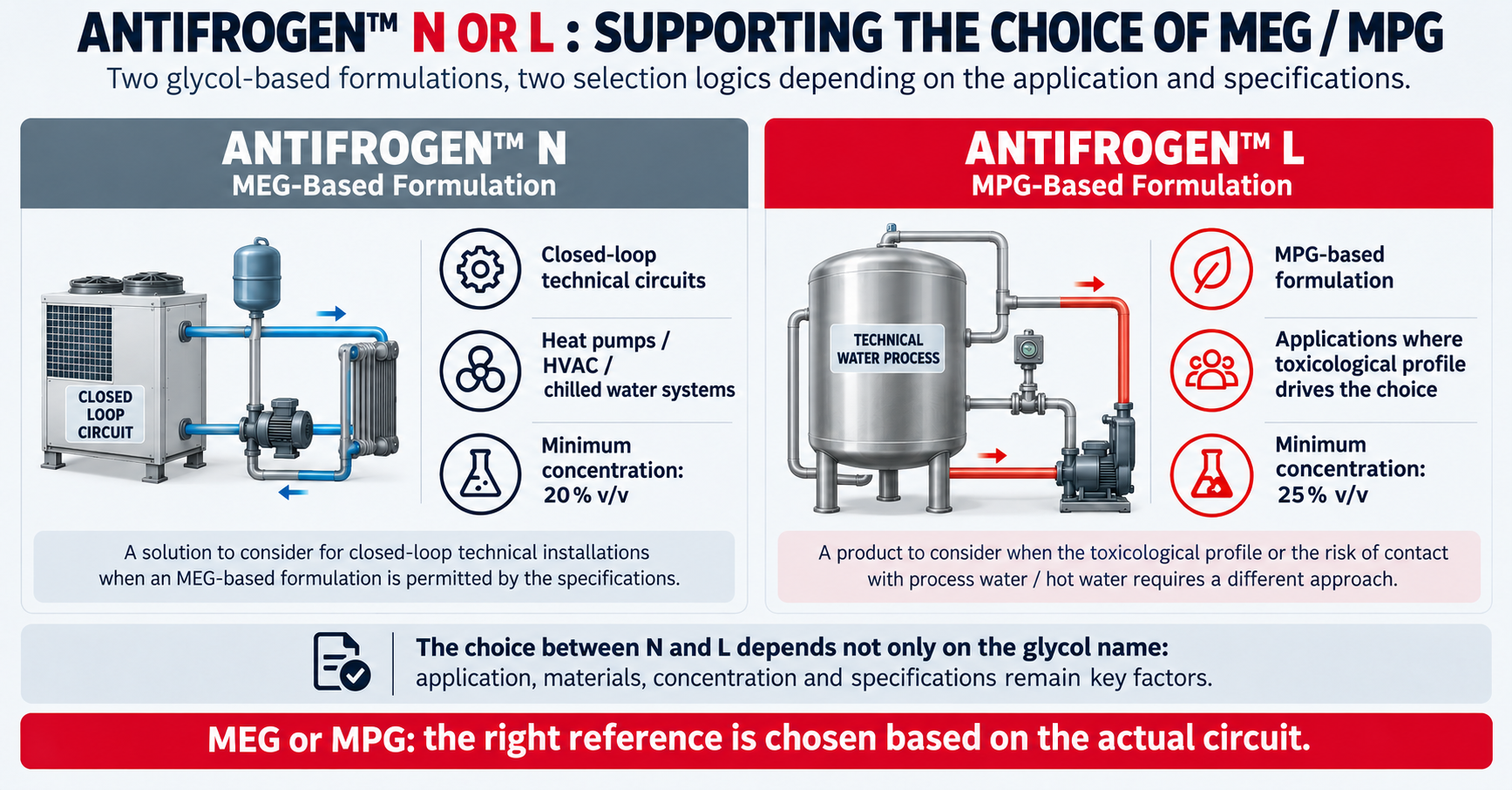
Antifrogen™ N: the versatile technical choice for closed HVAC circuits
Antifrogen™ N is based on monoethylene glycol. It is designed as a heat transfer and refrigeration fluid for closed heating and cooling circuits, including chillers, chilled-water air-conditioning systems, heat pumps and heat recovery systems.
Its minimum concentration is 20% v/v. At this concentration, the freezing point is approximately -9°C. The concentration can then be increased to achieve lower-temperature freeze protection within the product’s specified operating range. For purely technical installations where MEG is compatible with the specification, Antifrogen™ N is therefore a particularly logical solution.
Antifrogen™ L: an MPG base for environments where the toxicological profile matters more
Antifrogen™ L is formulated with monopropylene glycol. It is particularly suitable for heat pumps, heat recovery, food and pharmaceutical applications, as well as situations where accidental contact with process water or hot water cannot be completely ruled out.
This difference does not mean that a fluid can be selected solely on the basis of its chemical name. The heat-pump specification, manufacturer recommendations, circuit materials and service conditions remain decisive. However, it provides a clear selection criterion between Antifrogen™ N and L from the design phase onward.
Heat pumps, geothermal systems and solar thermal: the fluid becomes part of the energy system
HVAC applications are no longer limited to a standalone heat pump. Installations may combine a heat pump, a geothermal collector, a buffer tank and a solar thermal contribution. In this hybrid architecture, several circuits exchange energy without necessarily sharing the same fluid.
A hybrid architecture can combine a ground-source heat pump using Antifrogen™ N with solar thermal backup. The ground-loop fluid contributes to freeze and corrosion protection, while the solar contribution supplements the energy available for heating or hot water. This illustrates the role of the heat transfer fluid: it is not an accessory, but a functional component of the heat transfer system.
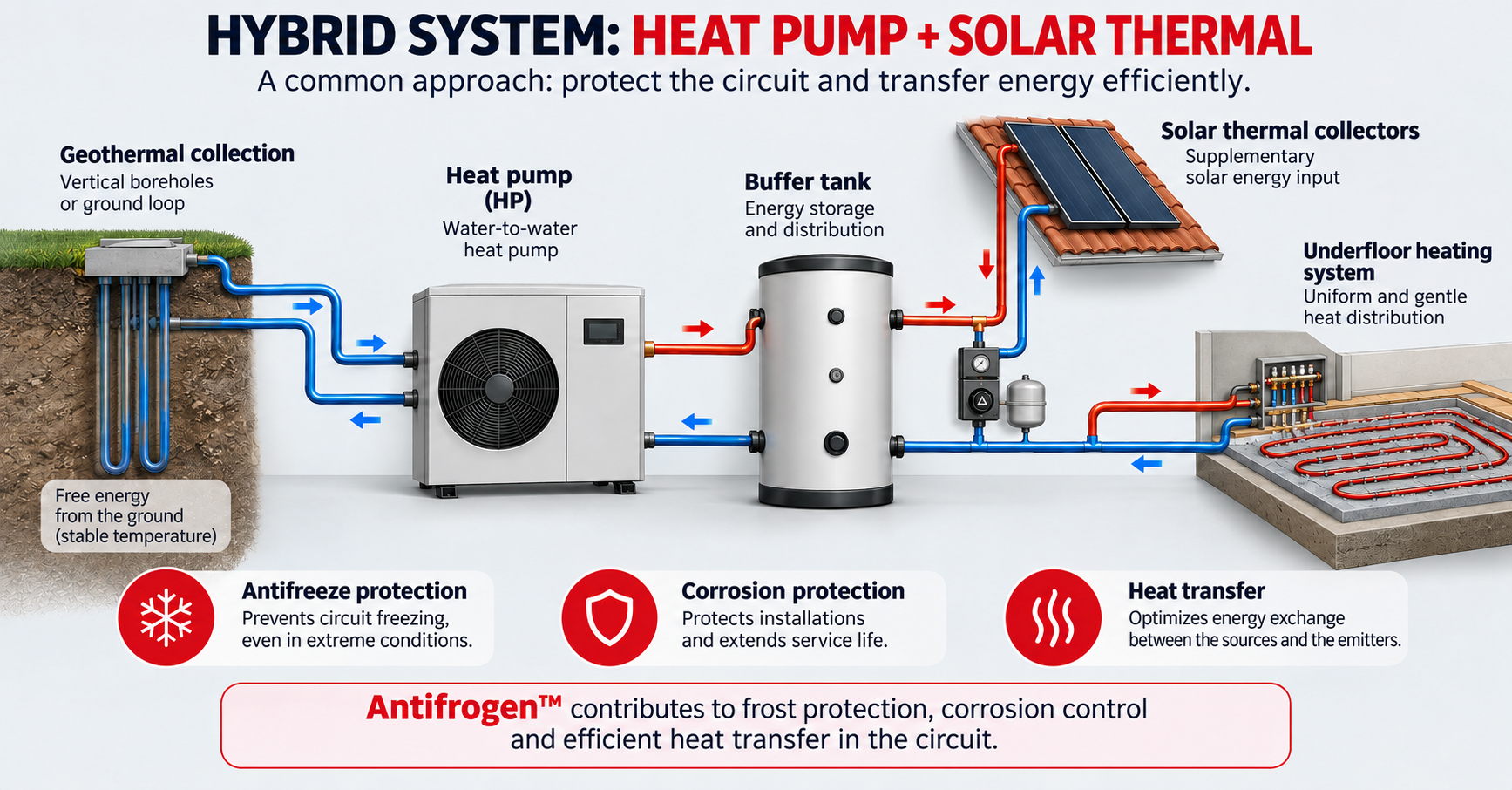
For solar circuits subject to high stagnation temperatures, the Antifrogen™ range also includes dedicated formulations such as Antifrogen™ SOLAR or SOL HT. Selection must therefore remain linked to the actual function of the circuit: heat pump/HVAC with N or L, geothermal applications with a solution suited to the collector loop, and high-temperature solar thermal with a formulation designed for that constraint.
What does a corrosion-protection fluid actually protect in an HVAC installation?
A heat pump and its hydronic network often bring together several materials: steel, copper, brass, cast iron, aluminium, brazed joints, seals and pump components. In the presence of water, dissolved oxygen, temperature variations and dissimilar metals, corrosion mechanisms can develop progressively. The result is not always an immediate leak: it can also take the form of deposits, particles, heat-exchanger fouling or degradation of internal surfaces.
The value of a fluid such as Antifrogen™ N or L lies precisely in combining freeze protection with a corrosion-inhibited formulation. The inhibitors help create more favourable chemical conditions in the circuit and protect metal surfaces. For the operator, the objective is practical: preserve heat exchangers, circulation pumps and pipework, while also keeping the circuit clean and easier to monitor over time.
This protection is particularly important in plate heat exchangers, where passages are narrow and fluid quality can have a direct impact on operation. It also matters in large HVAC networks, where corrective intervention, draining or heat-exchanger replacement can create significant downtime and maintenance costs.
The right fluid must also remain compatible with hydronic operation
Adding glycol changes the properties of the mixture compared with water alone. Viscosity increases, while heat capacity and thermal conductivity vary with concentration and temperature. This means that freeze-protection selection cannot be separated from hydronic sizing: flow rate, pressure drop, pump power and heat transfer must remain consistent with the selected concentration.
This is also why the optimum concentration is not necessarily the maximum concentration. The objective is to obtain the required level of protection while maintaining thermophysical properties suited to the installation. The Antifrogen™ calculator can be used to check these parameters based on the product, concentration and service temperature.
Concentration, water quality and maintenance: three parameters that determine the result
A good formulation can lose part of its value if it is incorrectly diluted or poorly monitored. Three parameters are decisive: glycol selection, the presence of suitable inhibitors and the quality of the dilution water.
1. What Antifrogen™ concentration should you choose?
The concentration of Antifrogen™ in water directly determines the level of freeze protection, but it also influences the thermal and hydronic properties of the fluid. The objective is therefore not to add ‘as much glycol as possible’, but to select the concentration suited to the actual minimum temperature encountered by the installation.
For Antifrogen™ N, the minimum concentration is 20% v/v. This corresponds to a freezing point of approximately -9°C. At 30%, protection reaches approximately -16°C, and around -20°C at approximately 35%. Higher concentrations can be used to target even lower temperatures.
For Antifrogen™ L, the minimum concentration is 25% v/v, corresponding to a freezing point of approximately -10°C. At 30%, this reaches approximately -13°C, and approximately -17°C at 35%.
| Concentration in water | Antifrogen™ N | Antifrogen™ L |
| 20% v/v | approx. -9°C | — |
| 25% v/v | approx. -12°C | approx. -10°C |
| 30% v/v | approx. -16°C | approx. -13°C |
| 35% v/v | approx. -20°C | approx. -17°C |
| 40% v/v | approx. -25°C | approx. -21°C |
| 50% v/v | approx. -37°C | approx. -33°C |
These values make it possible to size freeze protection according to the actual requirement of the installation. For a heat pump exposed to moderate winter temperatures, an intermediate concentration may therefore be sufficient; an installation exposed to lower temperatures will require stronger protection.
Samaro also offers certain ready-to-use dilutions. Antifrogen™ N is available, in particular, at a 34% concentration, positioned around -20°C protection, while Antifrogen™ L is available, among others, at 25%, 32% and 35% concentrations.
A higher concentration does not automatically mean better performance. As the glycol content increases, mixture viscosity also rises, while heat capacity and thermal conductivity change. These parameters influence flow rate, pressure drop and circulation-pump operation. The correct dosage must therefore strike a balance between freeze protection, corrosion protection and the thermal performance of the circuit. The Antifrogen™ N technical data sheet also specifies a minimum concentration of 20% v/v to maintain the intended protective formulation.
2. Pay attention to dilution-water quality
For dilution, use deionized, distilled or reverse-osmosis water wherever possible. Water quality is not a minor detail: it affects mixture stability and deposit control. Before filling, it should be included in the commissioning plan in the same way as concentration.
3. Monitor the fluid over time
Regularly check mixture concentration and performance, ideally every one to two years. An analysis service can evaluate, among other parameters, fluid quality, reserve alkalinity and inhibitor condition. For an HVAC operator, this monitoring makes it possible to move from systematic replacement to maintenance based on the actual condition of the fluid.
Heat transfer fluid, glycol and heat pumps
Conclusion: protect the circuit, not only against freezing
In an HVAC installation or heat pump, the heat transfer fluid performs several functions at the same time. It carries energy, protects against freezing and must help limit corrosion of the materials. This is precisely the value of Antifrogen™ N and L formulations: combining a glycol base suited to the application with an inhibitor system designed for thermal circuits.
The choice between MEG and MPG, followed by concentration setting, must be based on the actual circuit. For an R290 heat pump, HVAC network, geothermal installation or hybrid system with solar thermal input, Samaro can support this qualification and provide the necessary technical documentation.